


FiiO M25 R2R Portable High Resolution Music Player with In-House Developed 24+5-Bit R2R DAC Architecture
The FiiO M25 R2R swaps the usual delta-sigma chip for FiiO's own 24+5-bit R2R PRO resistor network, with the top five bits handled by 31 thermometer-coded resistors. Four independent signal paths, up to 2 × 1.700 mW from the 4.4 mm output and a 6.500 mAh battery make it a serious portable and desktop source. We look at how the architecture works, what the Warm and Natural voicings really offer, and where the player sits next to its AKM-based sibling.

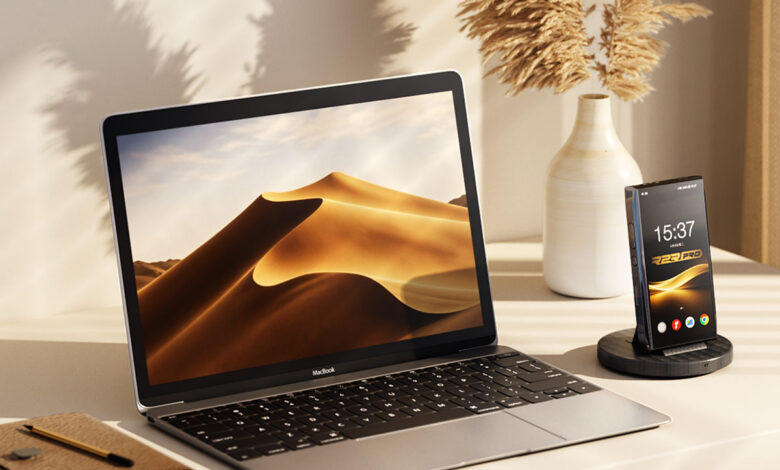
- The FiiO M25 R2R is a portable high resolution music player built around FiiO's in-house 24+5-bit R2R PRO DAC, a fully balanced four-path audio section, up to 2 × 1.700 mW at 32 ohms from the 4,4 mm Pentaconn socket, a 31-band PEQ with AUTO EQ, and a Qualcomm Dragonwing QCS6490 running Google Android. It costs around € 1.250,- in German specialist retail in black or silver, with broader European availability expected in November or December 2026.
Resistor-ladder conversion is enjoying a revival in high-end digital audio players, and the FiiO M25 R2R puts it front and centre. The Chinese manufacturer FiiO Electronics Technology Co. Ltd. has developed its own 24+5-bit R2R PRO architecture, pairing a traditional circuit principle with elaborate digital control. Its sibling, the FiiO M25 VERITA, relies on a modern delta-sigma configuration from AKM, whereas the FiiO M25 R2R is meant to win people over with a distinct technical concept and the tuning options that come with it.

Key Facts FiiO M25 R2R Portable High Resolution Music Player
- Portable High Resolution Music Player with discrete R2R DAC architecture
- In-house developed 24+5-bit R2R PRO resistor network
- Segmented conversion with thermometer coding of the upper five bits
- Fully balanced signal path with four independent signal paths
- Qualcomm Dragonwing QCS6490, 8 GB RAM and 128 GB storage
- XMOS XU316 USB audio processor and sixth-generation DAPS
- Up to 2 × 1.700 mW into 32 ohms via 4,4 mm Pentaconn
- Hi-res audio up to 32 bit and 768 kHz, plus DSD512
- 31-band PEQ, AUTO EQ and dedicated R2R voicings
- 6.500 mAh battery with up to 14,5 hours of playback
Two M25s, two ways of converting
FiiO has chosen to release its new M25 in two technically quite different versions, and the choice is a notable one. Both are priced in the same bracket, so buyers are not nudged towards either by cost. The FiiO M25 VERITA uses AKM converters; the FiiO M25 R2R, also sold as the FiiO M25 R2R PRO, does away with a conversion chip altogether and builds the DAC from discrete resistors. For enthusiasts who enjoy comparing different approaches to D/A conversion, that is an unusual opportunity in a mobile player.






How R2R conversion works
Most current DACs are delta-sigma designs. A classic R2R converter takes another route: a network of carefully matched resistors turns each digital value into a corresponding analogue voltage or current, depending on how the resistors are connected.
The difficulty lies in precision. Even a small deviation in an individual resistor value can introduce linearity errors and distortion, and the problem becomes harder to manage as resolution rises.
FiiO’s answer: 24+5 bits, segmented
FiiO’s response is a bespoke architecture it calls 24+5-bit R2R PRO. The upper five bits are processed through 31 resistors using what is known as thermometer coding, so the structure is segmented rather than purely binary-weighted.
The aim of this arrangement is to curb the switching errors that tend to appear with large level changes and to improve linearity. In other words, FiiO wants to keep the character associated with R2R conversion whilst reducing its familiar weaknesses in distortion and conversion accuracy.
Voicing: Warm, Natural and a lot of EQ
The player offers two sound profiles designed specifically for this converter, Warm and Natural, each intended to give a different tonal flavour. It is worth remembering, however, that R2R as a principle does not dictate a particular sound. What you hear depends on the circuit implementation, the digital signal processing, the analogue output stage and the filters in use.
FiiO therefore adds a 31-band parametric equaliser and AUTO EQ. These let owners account for the quirks of the headphones they connect and make their own corrections. The result is a fairly unconventional form of D/A conversion paired with thoroughly modern digital tweaking.
Four paths, start to finish
The R2R converter sits inside a fully symmetrical audio section. From conversion through volume control to the headphone amplifier, four separate signal paths are maintained. FiiO’s intention is high channel separation and less mutual interference between the paths.
Together with an elaborate power supply and suitably dimensioned amplifier stages, the design aims for precise signal handling without sacrificing output.
Power for more than sensitive in-ears
The headline figure is 2 × 1.700 mW into 32 ohms from the balanced 4,4 mm Pentaconn socket. That is reached in Super High Gain mode with external power connected. In ordinary High Gain operation FiiO quotes 2 × 1.000 mW into 32 ohms. The M25 R2R is therefore not confined to very sensitive in-ear headphones; it also has reserves for more demanding models.
Clocking and power management
The sixth generation of FiiO’s own Digital Audio Purification System is on board here too. It combines a powerful FPGA with two specially matched femtosecond clock oscillators, and its job is to deliver digital audio data as accurately and with as much timing stability as possible. Jitter, in particular, is meant to be minimised.
A multi-stage power supply with separate domains for different circuit blocks supports this. FiiO wants the digital processing, the processor platform and the sensitive analogue circuitry to disturb one another as little as possible, which matters all the more in a discrete R2R design.
A full Android player underneath
Despite the unusual DAC, this is a feature-rich, modern digital audio player. It uses a Qualcomm Dragonwing QCS6490 with Snapdragon 778G architecture, supported by 8 GB of RAM and 128 GB of internal storage, and once again runs on Google Android. A microSD card of up to 2 TB can enlarge the music library.
The 5.5-inch display has a resolution of 1.080 × 2.160 pixels and handles both the Android interface and supported streaming apps. Beyond standard Android operation there are a Pure Music Mode, Apple AirPlay, Bluetooth reception and USB DAC operation.
Local playback covers PCM up to 32 bit and 768 kHz as well as DSD512, according to the manufacturer. Bluetooth 5.2 handles wireless transmission. When sending, the player supports aptX, aptX HD, aptX Adaptive, LDAC and LHDC, among others; when receiving, SBC and LDAC are available.
Connections, and use as a USB DAC
An integrated XMOS XU316 USB audio processor lets the M25 R2R act as an external DAC for computers, smartphones or tablets. R2R conversion is thus not restricted to locally stored music but can serve external digital sources as well.
Headphones connect via an unbalanced 3,5 mm stereo mini-jack or a balanced 4,4 mm Pentaconn socket. Either can double as a line output, and the 3,5 mm socket can also deliver coaxial S/PDIF. Two USB-C ports keep data and power separate, so the player can stay permanently in a compact desktop hi-fi system.
Battery life that defies the architecture
One might expect a discrete DAC to be thirstier than a highly integrated chip, yet FiiO quotes longer run times for this version than for the FiiO M25 with AKM DACs. The 6.500 mAh battery is rated for up to 14,5 hours through the unbalanced headphone output and up to 12,5 hours through the balanced one. These figures apply under defined test conditions and may differ in practice depending on volume, headphones, operating mode and other factors.
Fast charging of up to 30 W is supported, and under suitable conditions a full charge should take roughly two and a half hours.
All benefits at a glance
- A true in-house R2R DAC: discrete conversion built on a resistor network of FiiO’s own design.
- Smarter segmentation: thermometer coding aims to reduce the typical error sources of classic R2R concepts.
- Tailorable sound: Warm and Natural R2R profiles, plus PEQ and AUTO EQ, allow extensive adjustment.
- Fully balanced signal flow: four independent paths for precise processing and high channel separation.
- Plenty of power: capable amplification for demanding headphones as well as in-ears.
- Long time away from the socket: comparatively generous battery life for use on the move.
- Flexible role: works as an external USB DAC and as a source for stationary hi-fi systems.
- Modern streaming platform: a fast processor and generous memory for a wide range of playback apps.
Price and availability
The new FiiO M25 R2R comes in black and silver. German specialist retailers list the model, also known as the FiiO M25 R2R PRO, at around € 1.250,-. Broader availability in Europe is expected in November or December 2026.
The alternative FiiO M25 VERITA with AKM DAC architecture sits in the same price class, so buyers can choose between two different conversion concepts without the architecture itself adding a price premium.
Getting to the point
Offering the new M25 in two such different technical forms is a remarkable decision by FiiO. The FiiO M25 R2R in particular should appeal to demanding hi-fi enthusiasts who deliberately explore different approaches to D/A conversion and want a discrete R2R design in a versatile portable player. What makes it especially appealing is that FiiO has not simply fallen back on a conventional resistor ladder, but has engineered a technically ambitious in-house solution in the segmented 24+5-bit structure.
| Product | FiiO M25 R2R Portable High Resolution Music Player |
|---|---|
| Price | € 1.249,90 |
Technical Specifications
| Product | FiiO M25 R2R Portable High Resolution Music Player |
|---|---|
| Product type | Portable High Resolution Music Player |
| DAC | FiiO R2R PRO, discrete resistor network architecture |
| DAC concept | Segmented 24+5-bit R2R architecture |
| Audio architecture | Fully balanced, four independent signal paths |
| Processor | Qualcomm Dragonwing QCS6490 |
| Operating system | Google Android-based platform |
| RAM / internal storage | 8 GB / 128 GB |
| Storage expansion | microSD up to 2 TB |
| Display | 5.5 inches, 1.080 × 2.160 pixels |
| Audio resolution | PCM up to 32 bit and 768 kHz, DSD512 |
| USB audio processor | XMOS XU316 |
| Output power, balanced | Up to 2 × 1.700 mW into 32 ohms, Super High Gain |
| Headphone connections | 3,5 mm stereo mini-jack, 4,4 mm Pentaconn |
| Other audio outputs | Line out, balanced line out, coaxial S/PDIF |
| USB | 2 × USB-C |
| WiFi | 2.4 and 5 GHz, Apple AirPlay |
| Bluetooth | Bluetooth 5.2 |
| Bluetooth codecs, transmit | SBC, aptX, aptX HD, aptX Adaptive, LDAC, LHDC |
| Bluetooth codecs, receive | SBC, LDAC |
| Sound control | 31-band PEQ, AUTO EQ, R2R voicing profiles |
| Battery | 6.500 mAh |
| Battery life | Up to 14,5 hours, balanced up to 12,5 hours |
| Fast charging | Up to 30 W |
| Dimensions | 139,8 × 76 × 18 mm |
| Weight | Approx. 318 g |
| Colour options | Black, Silver |
| Brand | Guangzhou FiiO Electronics Technology Co. Ltd. |
|---|---|
| Manufacturer | FiiO |
| Distribution | NT Global Distribution GmbH |
| More about this manufacturer at HiFi BLOG |