

Silent Angel H1 Pure Music Hub combines streaming, dual DAC and music server in one compact digital control centre
The Silent Angel H1 Pure Music Hub pairs two ESS Sabre ES9039Q2M DACs with a network streamer that supports TIDAL Connect, Spotify Connect Lossless and Qobuz Connect. An internal M.2 NVMe slot accepts SSDs of up to 8 TB, and a 5.5-inch display and the VitOS Orbiter app take care of everyday operation. Silent Angel keeps the concept strictly digital, with no analogue inputs and no HDMI.

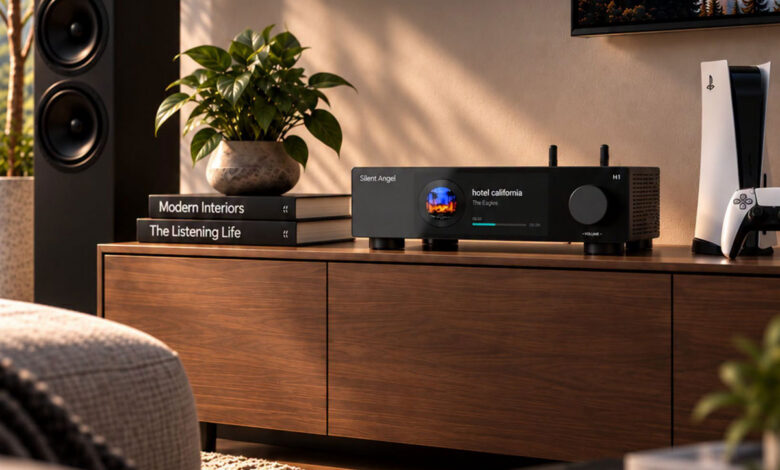
- The Silent Angel H1 Pure Music Hub is the first Lifestyle Hub from Silent Angel, combining a network streamer, a dual-mono DAC and a music server with balanced XLR and unbalanced Cinch outputs, TIDAL Connect, Spotify Connect Lossless and Qobuz Connect, and room for an internal NVMe SSD of up to 8 TB. It is operated through the VitOS Orbiter app for Apple iOS and Google Android and carries a US list price of US$ 849,-, while the distributor for German-speaking markets, IAD GmbH, has yet to announce a European price.
Ask a digital HiFi enthusiast what their system consists of and the answer often reads like a shopping list: a streamer here, a DAC there, and perhaps a separate drive for the music collection. Silent Angel wants to fold all of that into a single box with the new Silent Angel H1 Pure Music Hub. It is the first model in a product category the manufacturer calls the Lifestyle Hub, or LSH, and it joins network streaming, D/A conversion and local music storage behind a 5.5-inch display. According to Silent Angel, the H1 is meant to fit equally well into a traditional HiFi system, onto a desk or into a modern media setup.

Key Facts Silent Angel H1 Pure Music Hub
- Network streamer, DAC and music server in a single device
- Dual-mono design with two ESS Sabre ES9039Q2M DACs
- XMOS XU316 USB audio processor
- Quad-core RK3568 processor with 4 GB of DDR4 RAM
- VitOS operating system, controlled via the VitOS Orbiter app
- TIDAL Connect, Spotify Connect Lossless and Qobuz Connect
- TuneIn Internet Radio, AirPlay and DLNA renderer
- Internal M.2 NVMe PCIe 3.0 slot for SSDs of up to 8 TB
- USB-B input for PCM up to 32 bit 768 kHz and native DSD up to DSD512
- Balanced XLR and unbalanced Cinch outputs
- 5.5-inch display with 1.280 × 720 pixels
More than a network streamer
Silent Angel is careful not to describe the H1 as merely a network streamer. The company says the unit should be able to handle the entire digital source side of a system: streaming, playback of local files, D/A conversion and, via USB, the connection of external digital sources.
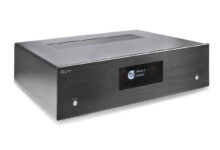


In practice, that means the Silent Angel H1 Pure Music Hub can go straight to an integrated amplifier, a preamplifier or a pair of active loudspeakers. Owners who already have a high-quality external DAC can instead use the H1 as a pure digital transport, either over USB audio or through the optical S/PDIF output.
The limits are set deliberately. There are no analogue inputs and no HDMI eARC, so the H1 does not try to be a universal switching hub for every audio and video source in the living room. It concentrates on digital music playback.


Two ESS Sabre ES9039Q2M in dual-mono configuration
Conversion is handled by two ESS Sabre ES9039Q2M chips, one for each channel. An XMOS XU316 of the third generation, with 16 cores, looks after the USB audio side. Silent Angel adds a two-stage jitter suppression that includes asynchronous sample rate conversion (ASRC) and is intended to keep timing errors in the digital signal to a minimum. The manufacturer expects the arrangement to deliver high channel separation, a low noise floor and precise spatial imaging.
The analogue output stage uses six Kmuse operational amplifiers developed by Silent Angel, together with two Texas Instruments OPA1612 devices.
Four separate supply rails
The power supply gets particular attention. The integrated low-ripple unit is split into four independent rails. The mainboard runs from 12 V, the DAC and operational amplifier stages are fed with ±15 V, and a further 5 V rail goes directly to the DAC chips. By separating the circuits in this way, Silent Angel hopes to limit interaction between the individual function blocks and to give the sensitive audio sections the cleanest possible supply voltage.


VitOS: a lean platform for music
The software foundation is VitOS, Silent Angel’s own operating system. It runs on a Rockchip RK3568 quad-core ARM processor clocked at up to 2 GHz, with 4 GB of DDR4 RAM alongside. The system itself sits on an internal 32 GB memory card.
Silent Angel says it kept VitOS tightly focused, avoiding unnecessary background processes so that audio data can be passed on bit-perfectly to the following signal processing. Configuration, library management and playback control all take place in the VitOS Orbiter app for smartphones and tablets.
Streaming through the Connect protocols
On the streaming side, the manufacturer relies on native Connect implementations. The H1 supports TIDAL Connect, Spotify Connect Lossless and Qobuz Connect, supplemented by TuneIn Internet Radio, AirPlay and a DLNA renderer function. Because of the Connect approach, listeners choose music in the streaming provider’s own app while playback runs directly on the Silent Angel H1.
Up to 8 TB of music on board
The H1’s second main role is that of a music server. Inside the chassis is an M.2 slot for NVMe PCIe 3.0 SSDs with a capacity of up to 8 TB. Collections stored on USB 3.0 drives or on NAS systems on the network can be added as well.
VitOS scans the available files and builds a music library that can be searched by album and other metadata. CUE files are supported, so that single-file albums can be split into individual tracks automatically. As a result, the H1 works not only as a streaming client but also as the central source for a large locally stored collection.
High-resolution formats up to DSD512
The USB-B input is where the H1 handles its highest resolutions. It accepts linear PCM up to 32 bit 768 kHz and native DSD up to DSD512. The USB audio output likewise carries linear PCM up to 32 bit and 768 kHz, with DSD up to DSD256 sent as DoP. The optical S/PDIF output is specified for linear PCM up to 24 bit and 192 kHz.
Supported file formats include FLAC, WAV, AIFF, ALAC, DXD, DFF and DSF.
Balanced or unbalanced, wired or wireless
The internal DAC can be used through balanced XLR or unbalanced RCA outputs. Silent Angel specifies an output level of 4.5 Vrms at the XLR sockets and up to 2.5 Vrms at the Cinch pair. That allows the H1 to serve as a digital source for an integrated amplifier or preamplifier, and it also suggests a direct connection to active loudspeakers, provided their volume control and the system as a whole are designed for it.
For network connections, the H1 offers Gigabit Ethernet and dual-band WiFi 6 on 2.4 and 5 GHz.
A display without touch
A 5.5-inch HD display with 1.280 × 720 pixels dominates the front panel and shows cover artwork, lyrics and metadata. Silent Angel has expressly left out touch functionality. As the manufacturer explains it, this is meant to prevent additional capacitive electronics inside the unit from introducing interference into sensitive audio circuits. Operation therefore runs through the VitOS Orbiter app.
The enclosure is made of aluminium with a matt, blasted finish. A subtle illumination linked to the volume setting completes the front.
All benefits at a glance
- Three roles, one chassis: the H1 combines the streamer, DAC and music server of a modern digital HiFi chain in one device.
- Separate conversion per channel: two ESS Sabre ES9039Q2M chips handle the left and right channels independently.
- Direct app control of streaming: TIDAL Connect, Spotify Connect Lossless and Qobuz Connect let you pick music in the provider’s own app, with AirPlay and DLNA on top.
- Room for a large library: an internal NVMe SSD of up to 8 TB, plus USB 3.0 drives and NAS shares, allows very large local collections.
- Analogue or digital, as you prefer: XLR and Cinch outputs serve the H1 as a complete source, while USB audio and S/PDIF let it act as a transport for an external DAC.
- Resolution headroom: PCM up to 32 bit 768 kHz and native DSD up to DSD512 arrive via USB-B.
- Purpose-built software: VitOS was written by Silent Angel specifically for digital music playback.
- Information at a glance: the front display shows cover art, lyrics and metadata directly on the unit.
Price and availability
Silent Angel unveiled the Silent Angel H1 Pure Music Hub recently and quoted a US list price of US$ 849,-. For Europe, no official price has yet been issued by IAD GmbH, the distributor responsible for the German-speaking market. We will add the details as soon as they are available.
Getting to the point
With the H1, Silent Angel takes an interesting route. Instead of treating streamer, music server and DAC as separate components, it merges exactly those functions that a purely digital HiFi chain needs together. The ability to house up to 8 TB of local storage inside the unit sets the H1 apart from many conventional network players. At the same time, the concept stays refreshingly clear: no analogue inputs, no HDMI and no attempt to double as a preamplifier. The Silent Angel H1 Pure Music Hub concentrates entirely on digital music and, on paper, offers a remarkably comprehensive package for it.
| Product | Silent Angel H1 Pure Music Hub |
|---|---|
| Price | US$ 849,- |
Technical Specifications
| Product | Silent Angel H1 Pure Music Hub |
|---|---|
| Characterisation | Network streamer, DAC and music server |
| Operating system | Silent Angel VitOS |
| Processor | Rockchip RK3568 quad-core ARM, up to 2 GHz |
| Memory | 4 GB DDR4 |
| System storage | 32 GB |
| DAC | 2 × ESS Sabre ES9039Q2M |
| USB audio processor | XMOS XU316, 3rd generation, 16-core |
| Operational amplifiers | 6 × Silent Angel Kmuse, 2 × Texas Instruments OPA1612 |
| Display | 5.5 inches, 1.280 × 720 pixels, no touch functionality |
| Internal storage | M.2 NVMe PCIe 3.0 SSD, up to 8 TB |
| External storage | USB 3.0, NAS |
| Network | Gigabit Ethernet, dual-band WiFi 6 (2.4/5 GHz) |
| Streaming | TIDAL Connect, Spotify Connect Lossless, Qobuz Connect, TuneIn Internet Radio |
| Network protocols | AirPlay, DLNA renderer |
| USB-B input | PCM up to 32 bit 768 kHz, native DSD up to DSD512 |
| USB audio output | PCM up to 32 bit 768 kHz, DSD up to DSD256 |
| Optical output | PCM up to 24 bit 192 kHz |
| Analogue outputs | XLR balanced, Cinch unbalanced |
| XLR output level | 4.5 Vrms |
| XLR THD+N | < 0.00008 % at 1 kHz |
| XLR signal-to-noise ratio | 129 dB at 1 kHz |
| RCA output level | 2.5 Vrms |
| RCA THD+N | < 0.0001 % at 1 kHz |
| RCA signal-to-noise ratio | 126 dB at 1 kHz |
| File formats | including FLAC, WAV, AIFF, ALAC, DXD, DFF, DSF |
| Power supply | Integrated low-ripple power supply with four separate supply rails |
| Power consumption | 25 W |
| Dimensions | 280 × 220 × 77,7 mm |
| Enclosure | Aluminium |
| Control | Silent Angel VitOS Orbiter app for Apple iOS and Google Android |
| Brand | Silent Angel |
|---|---|
| Manufacturer | Thunder Data Co. Ltd. |
| Distribution Austria | IAD GmbH |
| Distribution Germany | IAD GmbH |
| Distribution Switzerland | AudioSphere GmbH |
| More about this manufacturer at HiFi BLOG |