

AVM Evolution PH 3.3 and AVM Evolution PH 5.3 – Two New Phono Preamplifiers with Modular Adaptation to MM and MC
The AVM Evolution PH 3.3 and AVM Evolution PH 5.3 accept MM and MC cartridges, offer six equalisation curves and can be fitted with an extra MM Cinch, MC Cinch or MC XLR input module. The PH 3.3 uses transistors throughout, whereas the PH 5.3 has a valve line stage for which AVM quotes a life of roughly 20.000 hours. We separate AVM's claims from the hard specification and show which settings can be changed without opening the case.

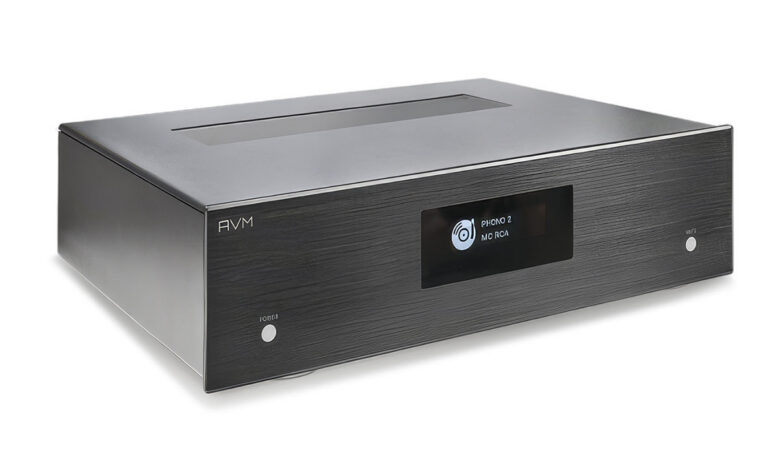
- Anyone with an MM or MC cartridge, or with several tonearms on one turntable, can tune the solid-state AVM Evolution PH 3.3 or the AVM Evolution PH 5.3 with its valve line stage through five gain steps, six MC impedances or six MM capacitances and a spare slot for an MM RCA, MC RCA or MC XLR module, all controlled from the front panel or the supplied AVM RC 3 PH remote. Six equalisation curves, a switchable 30 Hz subsonic filter, Cinch and XLR outputs, a 15 V / 1.5 A turntable supply and a screwless aluminium chassis complete the package, which AVM says is made in Malsch and available immediately from specialist dealers.
Valve or transistor? With the AVM Evolution PH 3.3 and the AVM Evolution PH 5.3, AVM Audio Video Manufaktur GmbH puts that question to phono buyers in its most direct form. Both preamplifiers take over key technical ideas from the AVM Evolution PH 8.3, both offer extensive adjustment options and a modular input concept, and both do the essential job of raising a cartridge’s tiny output voltage to line level. What differs is only the character of the output stage, and that is left for the owner to decide.

Key Facts AVM Evolution PH 3.3 and AVM Evolution PH 5.3
- AVM Evolution PH 3.3: signal processing based entirely on transistors
- AVM Evolution PH 5.3: line stage with valves developed by AVM
- MM and MC cartridges supported
- Five gain steps
- Six impedance values for MC
- Six capacitance values for MM
- Six equalisation curves
- Switchable subsonic filter, 30 Hz, 12 dB per octave
- Mono/stereo switch and phase inversion
- Module slot for MM Cinch, MC Cinch or MC XLR
- Cinch and XLR outputs
- Galvanically isolated 15 V / 1.5 A supply for the turntable
- Aluminium chassis, 431 mm wide
- Manufactured at AVM’s plant in Malsch
Deciding between the two
Apart from the output, the two models are near-twins. Equipment, controls, connections and the range of cartridge adjustments are essentially the same, so the decision has nothing to do with budget or trim level.





The AVM Evolution PH 3.3 stays with transistors from input to output. As AVM puts it, that gives a transparent, fast and particularly low-noise presentation. The AVM Evolution PH 5.3 hands the final stage to a valve line stage of AVM’s own design, which the manufacturer says produces a warmer, more spacious and livelier sound. AVM puts the service life of the valves at about 20.000 hours and credits its proprietary circuit design for that figure.


Fitting the cartridge, now and later
Both preamplifiers work with MM and MC pickups. The base unit provides an Cinch MM input and a slot for a second, modular input, and that slot is what makes these two models more than a simple phono stage. It takes an MM module with RCA connectors, an MC module with Cinch connectors, or a balanced MC module with XLR connectors.
Consider three typical situations. A listener with a single cartridge simply chooses the module that suits it. Someone who runs two tonearms, or two cartridges of different types, can fit both inputs to one unit. And an MM owner who moves to MC later can add the appropriate module rather than replace the phono stage altogether. AVM itself calls the slot part of a design meant for long-term use.
The adjustment range is broad. For MC cartridges there are six termination impedances, from 30 Ohm to 1 kOhm, with input sensitivity configurable between 55 µV and 550 µV. The MM module offers six capacitance values from 50 pF to 400 pF and input sensitivities between 0.5 mV and 5 mV. Five gain steps are provided, and the basic sensitivity can additionally be moved in five increments from -10 dB to +10 dB.
Working with the settings
Not every parameter is hidden behind a jumper or a switch on the back panel. According to AVM, gain, load, phase invert and sub filter are handled through the menu, from the front of the unit or with the infrared remote. The AVM RC 3 PH is supplied. For anyone who swaps cartridges regularly, that means the relevant values can be changed without touching the electronics.
Other adjustments include switching between mono and stereo and inverting the phase. Six equalisation curves are listed, so the units are not limited to today’s usual RIAA characteristic. The technical data gives its turnover frequencies as 50 Hz, 500 Hz and 2.120 Hz, or time constants of 3.180 µs, 318 µs and 75 µs, but the product documentation does not name the other five curves.
There is also a subsonic filter that can be switched in at 30 Hz with a slope of 12 dB per octave, intended to reduce low-frequency interference from warped records or mechanical resonances.


Connections, build and origin
Outputs come in two forms on both models. The unbalanced Cinch output has an output resistance of 50 Ohm and a maximum output voltage of 7 V, and the balanced XLR output has 100 Ohm and 14 V. A galvanically isolated supply of 15 V at up to 1.5 A is available for a suitably designed turntable.
The styling follows the current AVM Evolution Series. The chassis is a screwless precision aluminium case, 431 mm wide, and buyers can specify aluminium silver, brushed black or the CELLINI Edition with a chrome-plated, hand-polished front. Each unit measures 431 × 130 × 390 mm and weighs 12 kg. AVM says both models are built at its factory in Malsch, in Baden-Württemberg, and are subject to several quality checks and a run-in period of several days before delivery.
All benefits at a glance
- Your choice of sound: One platform, two output stages, so the decision is about taste rather than features.
- Both cartridge families covered: Whether the turntable carries MM or MC, the same design can be adapted to it.
- Loading set in defined steps: Impedance for MC and capacitance for MM are selected from fixed values, alongside adjustable gain.
- Inputs that can grow: The spare slot accepts three module types, so a new cartridge or tonearm does not call for a new preamplifier.
- Adjustment from the listening seat: The front panel and the supplied remote cover gain, load, phase invert and sub filter.
- More than RIAA, and rumble control: AVM cites five additional equalisation curves, and the 30 Hz subsonic filter can be switched in when needed.
- Balanced or unbalanced: XLR outputs deliver up to 14 V, RCA up to 7 V.
- German manufacture: AVM says the units are built by hand in Malsch.
Price and availability
AVM lists the AVM Evolution PH 3.3 at € 4.990,- and the AVM Evolution PH 5.3 with valve line stage at € 5.990,-. According to the manufacturer, both models should be available immediately from specialist dealers.
Getting to the point
A phono stage often stays in a system longer than the cartridge it was bought for, and that is the thinking behind much of what AVM has done here. Fine-grained loading, an input slot that accepts three module types and menu control from the front panel or remote all anticipate a setup that will change. That leaves only one decision to be made at the outset, and it is a matter of sound: an all-transistor output in the AVM Evolution PH 3.3 or a valve line stage in the AVM Evolution PH 5.3. Everything else on these two preamplifiers can be revisited later.
| Product | AVM Evolution PH 3.3 and AVM Evolution PH 5.3 |
|---|---|
| Price | AVM Evolution PH 3.3 € 4.990,- AVM Evolution PH 5.3 € 5.990,- |
Technical Specifications
| Product | AVM Evolution PH 3.3 | AVM Evolution PH 5.3 |
|---|---|---|
| Characterisation | Phono preamplifier, solid-state | Phono preamplifier with valve line stage |
| Cartridges | MM and MC | MM and MC |
| Gain | -10 / -5 / 0 / +5 / +10 dB | -10 / -5 / 0 / +5 / +10 dB |
| Subsonic filter | 30 Hz, 12 dB/octave, switchable | 30 Hz, 12 dB/octave, switchable |
| Mono/stereo | switchable | switchable |
| Phase inversion | yes | yes |
| Equalisation | 6 curves; RIAA: 50 Hz / 500 Hz / 2,120 Hz | 6 curves; RIAA: 50 Hz / 500 Hz / 2,120 Hz |
| Base unit inputs | Cinch MM + modular input | Cinch MM + modular input |
| Expansion module | MM Cinch, MC Cinch or MC XLR | MM Cinch, MC Cinch or MC XLR |
| MC sensitivity | 55 / 100 / 170 / 315 / 550 µV | 55 / 100 / 170 / 315 / 550 µV |
| MC impedance | 1.000 / 500 / 300 / 100 / 50 / 30 Ohm | 1.000 / 500 / 300 / 100 / 50 / 30 Ohm |
| MC overload limit | 2.5 mV | 2.5 mV |
| MM sensitivity | 0.5 / 0.9 / 1.6 / 2.8 / 5 mV | 0.5 / 0.9 / 1.6 / 2.8 / 5 mV |
| MM capacitance | 50 / 100 / 150 / 200 / 300 / 400 pF | 50 / 100 / 150 / 200 / 300 / 400 pF |
| MM overload limit | 25 mV | 25 mV |
| Outputs | Cinch, XLR | Cinch, XLR |
| Output resistance RCA | 50 Ohm | 50 Ohm |
| Output resistance XLR | 100 Ohm | 100 Ohm |
| Max. output voltage RCA | 7 V | 7 V |
| Max. output voltage XLR | 14 V | 14 V |
| Turntable supply | 15 V / 1.5 A, galvanically isolated | 15 V / 1.5 A, galvanically isolated |
| Mains voltage | 100 to 240 V AC, 50/60 Hz | 100 to 240 V AC, 50/60 Hz |
| Max. power consumption | 25 W | 25 W |
| Standby | 0.45 W | 0.45 W |
| Dimensions | 431 × 130 × 390 mm | 431 × 130 × 390 mm |
| Weight | 12 kg | 12 kg |
| Finishes | Silver, Black, CELLINI | Silver, Black, CELLINI |
| Brand | AVM |
|---|---|
| Manufacturer | AVM Audio Video Manufaktur GmbH |
| Distribution | AVM Audio Video Manufaktur GmbH |
| More about this manufacturer at HiFi BLOG |