

Klipsch The Fives II – Compact Active Speakers with Onkyo Technology, Dolby Atmos and Network Streaming
A traditional-looking pair of Klipsch speakers can now take charge of a decidedly modern living room. The Klipsch The Fives II unite a two-way active stereo system with Google Cast, Apple AirPlay 2, Spotify Connect, TIDAL Connect and Qobuz Connect, while HDMI 2.1 caters for televisions and games consoles. A phono input, USB-C Audio and an optical input ensure that records, computers and established digital sources have not been forgotten.


- The Klipsch The Fives II place an unusually broad choice of sources inside a compact pair of active speakers, spanning network streaming, television sound, gaming, vinyl and computer audio. Dolby Atmos with virtual height channels extends their remit beyond conventional stereo, while the additional HDMI input and video pass-through distinguish the system from many active speakers designed primarily for music.
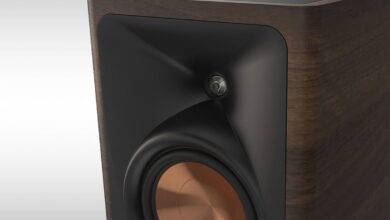
Wood veneer, removable fabric grilles and a conspicuous Tractrix horn give the Klipsch The Fives II the visual vocabulary of classic HiFi. Yet Premium Audio Company LLC. has designed this second generation to remain at the centre of the room when listening gives way to a film, a television series or a games console. The familiar exterior now conceals a system that reaches well beyond the usual source-and-amplifier arrangement.

That breadth is the point. Working with Onkyo, Klipsch has brought elements associated with AV receivers into two compact loudspeaker enclosures, while retaining the directness of an active stereo pair. The result is not a miniature multichannel installation: it is a space-conscious system that seeks to make music, television and gaming equally straightforward, with a record player still welcome alongside the newest network services.


Key Facts Klipsch The Fives II
- Active stereo speaker pair with Onkyo electronics and an integrated network-streaming platform
- Two-way bass-reflex design with a 25 mm titanium LTS tweeter on a Tractrix horn and a 5,25-inch Jet Cerametallic mid/bass driver in each speaker
- Frequency response of 50 Hz to 25 kHz at ±3 dB; maximum sound pressure level of 103 dB for the stereo pair at one metre
- Hi-res Audio playback up to 24 Bit 96 kHz
- Dolby Atmos reproduction using virtual height channels
- HDMI 2.1 input and output with ARC/eARC, CEC, 8K pass-through and 4K at 120 Hz
- Google Cast, Apple AirPlay 2, Spotify Connect, TIDAL Connect and Qobuz Connect
- Dual-band WiFi, Ethernet and Bluetooth 5.4 with SBC and AAC
- Phono and line inputs on RCA, optical digital input, USB-C Audio and USB-A
- Subwoofer output, 5-band equaliser and illuminated remote control
- MDF cabinets with real-wood veneer in Walnut, Ebony or Red Oak
The AV Receiver Moves Inside the Speakers
The collaboration with Onkyo concerns the part of the system that must make this broad remit possible. Klipsch describes the new electronics architecture as being based on AV-receiver technology, covering central duties such as signal processing, decoding and sound optimisation. Instead of asking the owner to connect a separate AV receiver, the loudspeakers themselves manage both traditional audio sources and modern video components.
Dolby Atmos belongs to this expanded brief, although its implementation needs to be understood correctly. The Fives II do not employ upward-firing drive units. Both cabinets radiate forwards, and signal processing creates virtual height channels intended to carry the presentation beyond the normal stereo plane. Klipsch is therefore addressing listeners who want access to an immersive film soundtrack without installing additional loudspeakers around the room.
This is an intentionally compact interpretation of home cinema rather than a substitute for a discrete multichannel speaker array. Its attraction lies in allowing a conventional stereo pair to accept a considerably wider role, while keeping cabling, equipment and installation under control.


HDMI 2.1 Goes Beyond a Simple TV Return Channel
Many active speakers provide HDMI eARC for receiving sound from a television. The Fives II add a separate HDMI input for a source component and an HDMI output to the display. ARC or eARC carries television audio back to the speakers, while CEC allows their volume to be adjusted with the television remote control. A source connected directly to the speakers can pass its video signal onwards to the screen.
Klipsch specifies 8K pass-through and support for 4K video at 120 Hz. HDR10+, Dolby Vision and the BT.2020 colour space are included, as are three functions of particular relevance to current games consoles: VRR for a variable refresh rate, ALLM for automatic low-latency mode and QFT for quicker frame transport. HDCP 2.3 is also listed in the specifications. This makes the HDMI section part of the wider system concept rather than an input fitted solely for convenience.
Native Streaming Without an External Network Player
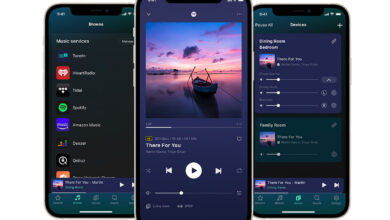
The Fives II can join the home network through Ethernet or dual-band WiFi at 2.4 GHz and 5 GHz. Their platform supports Google Cast and Apple AirPlay 2, alongside Spotify Connect, TIDAL Connect and Qobuz Connect. Listeners can therefore hand playback to the speakers from the services’ familiar applications instead of adding a separate network player or adopting an unfamiliar interface for everyday listening.
Hi-res Audio is supported at up to 24 Bit 96 kHz. Bluetooth 5.4 provides the more immediate alternative when a device is not connected to the home network, with SBC and AAC named as the available codecs. The two wireless routes serve different situations: network streaming can form part of the permanent installation, while Bluetooth is useful when a guest simply wants to play something from a smartphone.
This combination also clarifies the system’s place in the living room. It is not merely an active loudspeaker with Bluetooth appended to it, but a network-capable source in its own right. Spotify Connect, TIDAL Connect and Qobuz Connect are particularly important here because they keep service selection and control within apps that many users already know.


Familiar Klipsch Ingredients, Revised at the Front
Each loudspeaker uses a vented 25 mm titanium LTS tweeter coupled to a Tractrix horn, together with a 5,25-inch Jet Cerametallic mid/bass driver. The two-way enclosure is reflex-loaded through a rear port. Klipsch quotes a frequency response of 50 Hz to 25 kHz at ±3 dB and a maximum sound pressure level of 103 dB for the stereo pair measured at a distance of one metre.
The second generation introduces a one-piece BMC baffle. According to Klipsch, its greater density and rigidity are intended to reduce unwanted resonance, while rounded contours are designed to improve dispersion away from the principal listening axis. That latter point matters in a room where the speakers must serve several seats rather than one carefully chosen listening position.
Klipsch does not provide a confirmed amplifier-power figure for The Fives II. Leaving that field open is preferable to attaching an unsupported number to a system whose practical role is already defined more clearly by its acoustic data, connectivity and operating options.
Vinyl, Computers and Existing Digital Sources Remain Welcome
Network services and HDMI do not exhaust the input selection. A phono input with an integrated phono preamplifier accepts a suitable record player, while a separate RCA line input accommodates another analogue source. Digital equipment can be connected by optical input, USB-C Audio or USB-A. A computer can therefore sit alongside an existing CD player with a compatible digital output, rather than forcing the owner to choose between new and established sources.
An RCA output permits the addition of an active subwoofer if more low-frequency reach is required. Communication between the two loudspeakers remains wired, and Klipsch includes a four-core speaker cable measuring four metres. The supplied accessories also comprise a 2 m mains cable, an illuminated remote control with two AAA batteries and a 1.5 m HDMI cable.
Three Routes to Everyday Control
A metal control and metal button on the top panel provide direct access to volume and source selection. The supplied remote uses illuminated buttons, a small but useful detail when the system is being operated during a film in subdued light. HDMI CEC adds another everyday option by allowing television volume control without reaching for a second handset.
Music, Movie and Direct modes adapt operation to different content, while a dialogue-enhancement function and a 5-band equaliser provide further adjustment. The Klipsch Connect Plus App acts as a virtual remote control and gives the listener access to the equaliser from the seating position.
The control concept is consequently as varied as the source list. A quick change can be made at the cabinet, television viewing can remain centred on the TV remote, and more detailed sound adjustments belong in the app. No single interface is made responsible for every situation.


Three Real-Wood Finishes, Including a Lighter Alternative
Klipsch offers the MDF cabinets in Walnut, Ebony and Red Oak real-wood veneers. The Red Oak version takes a visibly lighter approach, combining its veneer with a white baffle and removable light-grey grilles. It gives the range an alternative to the darker presentation of the Walnut and Ebony models without changing the underlying system.
Each speaker measures 181 mm wide, 327 mm high and 273,1 mm deep. The primary loudspeaker weighs 8,26 kg, while the secondary unit is listed at 7,16 kg. Klipsch identifies the optionally available Klipsch KS-28 as the matching speaker stand.
The Most Important Advantages at a Glance
- One system for music and television: Amplification, network streaming and TV connectivity are integrated into the stereo pair.
- Streaming from familiar apps: Spotify Connect, TIDAL Connect and Qobuz Connect allow listeners to continue using the services’ own applications.
- A dedicated HDMI input for a source: Video pass-through permits a games console or another player to be connected directly to the speakers.
- Dolby Atmos with limited installation effort: Virtual height channels reproduce the format through two forward-facing loudspeakers.
- A direct route for vinyl: The integrated phono preamplifier can remove the need for another component when a suitable record player is used.
- Sound can be adapted to the material: Listening modes, dialogue enhancement and a 5-band equaliser provide practical adjustment.
- More bass remains an option: The line-level subwoofer output makes it possible to add an active subwoofer.
- Convenient control after dark: An illuminated remote and HDMI CEC simplify operation during television and film viewing.
Price & Availability
Klipsch first presented its latest generation of active loudspeakers, including The Fives II, at CES 2026 alongside the larger Klipsch The Sevens II and Klipsch The Nines II. The speakers are now due to reach specialist retailers. The Klipsch The Fives II cost € 1.399,- per pair and are available in Walnut, Ebony and Red Oak.
Getting to the Point
The most convincing aspect of the Klipsch The Fives II is not any single format or socket, but the coherence of their intended role. The additional HDMI input, extensive video pass-through and direct support for Spotify Connect, TIDAL Connect and Qobuz Connect allow one compact stereo pair to serve music, film and gaming without a separate amplifier or network player.
Dolby Atmos adds virtual spatial effects, but the broader source choice is likely to matter more from day to day. By retaining phono, line-level and optical connections alongside modern streaming and HDMI 2.1, Klipsch has made the second-generation Fives unusually accommodating without obscuring their identity as a proper stereo loudspeaker system.
| Product | Klipsch The Fives II |
|---|---|
| Price | € 1.399,- |
Technical Specifications
| Product | Klipsch The Fives II |
|---|---|
| Product type | Active loudspeaker system, stereo pair |
| Acoustic design | Two-way bass-reflex system with rear port |
| Drivers per speaker | 25 mm titanium LTS tweeter with Tractrix horn; 5,25-inch Jet Cerametallic mid/bass driver |
| Frequency response | 50 Hz to 25 kHz, ±3 dB |
| Maximum sound pressure level | 103 dB for the stereo pair at 1 m, manufacturer specification |
| Amplifier power | No confirmed manufacturer specification |
| Hi-res Audio | Up to 24 Bit 96 kHz |
| Dolby Atmos | Reproduction using virtual height channels |
| HDMI | HDMI 2.1 input and output; ARC/eARC and HDMI CEC |
| Video pass-through | 8K, 4K at 120 Hz, HDR10+, Dolby Vision, BT.2020, VRR, ALLM, QFT, HDCP 2.3 |
| Network | WiFi 802.11ac, 2.4/5 GHz, 2 × 2 MIMO; 10/100 Mbit/s Ethernet |
| Streaming | Google Cast, Apple AirPlay 2, Spotify Connect, TIDAL Connect, Qobuz Connect |
| Bluetooth | Version 5.4, A2DP, SBC and AAC |
| Analogue inputs | Phono on Cinch; line-level on Cinch |
| Further digital connections | Optical digital input, USB-C Audio, USB-A |
| Subwoofer output | Cinch, line level |
| Sound functions | Music, Movie and Direct modes; dialogue enhancement; 5-band equaliser |
| Operation | On-device controls, illuminated remote control, Klipsch Connect Plus App, HDMI CEC |
| Connection between speakers | Wired; 4 m four-core cable supplied |
| Cabinet | MDF with real-wood veneer and one-piece BMC baffle |
| Finishes | Walnut, Ebony, Red Oak |
| Dimensions per speaker | 181 × 327 × 273,1 mm (W × H × D) |
| Weight | Primary speaker: 8,26 kg; secondary speaker: 7,16 kg, according to the data sheet |
| Supplied accessories | Speaker pair, 2 m mains cable, remote control with two AAA batteries, 4 m speaker cable, 1.5 m HDMI cable |
| Optional accessory | Klipsch KS-28 speaker stands |
| Brand | Klipsch |
|---|---|
| Manufacturer | Premium Audio Company LLC. |
| Distribution Austria | Audio Tuning Vertriebs GmbH |
| Distribution Germany | Premium Audio Company Germany GmbH |
| Distribution Switzerland | novis electronics AG |
| More about this manufacturer at HiFi BLOG |