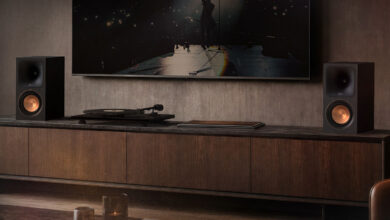


Klipsch The Sevens II – Active Speakers with Dirac Live and Dolby Atmos
A supplied measurement microphone, 6.5-inch mid/bass drivers and the option to connect the two speakers wirelessly or at up to 24 Bit 96 kHz by cable distinguish Klipsch The Sevens II within the company’s new active range. HDMI 2.1 with eARC, integrated streaming and a broad selection of analogue and digital inputs extend their remit from a self-contained music system to television sound and gaming.

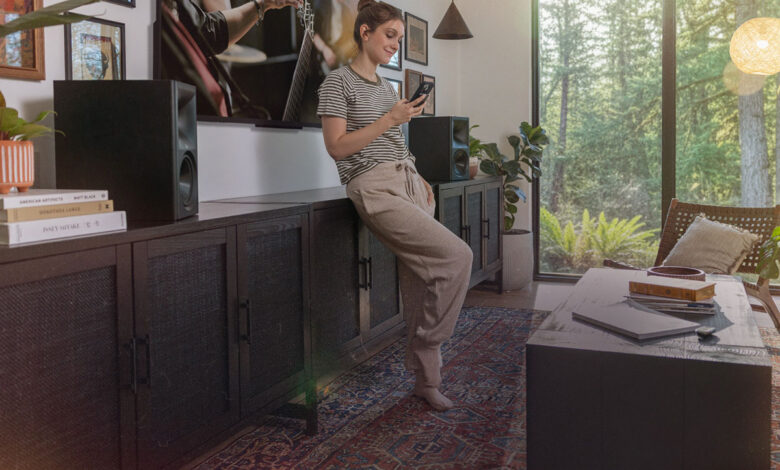
- Klipsch The Sevens II treat the listening room as part of the system: Dirac Live and a supplied microphone provide room correction, while the owner can choose between a cable-free audio link across the room and a wired connection supporting up to 24 Bit 96 kHz. Onkyo-developed electronics, Dolby Atmos with virtual height channels, comprehensive streaming and HDMI 2.1 make the pair equally relevant beside a record player, a network connection or a television.
An active stereo pair can remove the amplifier, streamer and several interconnects from a living-room system, yet it cannot remove the room itself. Klipsch Group Inc. addresses that stubborn part of the equation directly with Klipsch The Sevens II. The measurement microphone in the box is therefore no incidental accessory: together with Dirac Live, it allows the loudspeakers to account for acoustic conditions that furniture, doors and the position of a television may impose.

That practical thinking extends to the link between the two cabinets. The Sevens II can communicate wirelessly when a cable across the room would be awkward, or use the supplied CAT6 lead when the higher supported resolution takes precedence. It is a choice with a clear technical consequence rather than a cosmetic convenience, and one that gives the larger model a distinct place in Klipsch’s second-generation active loudspeaker series.

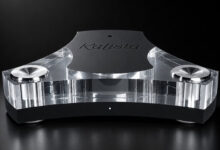
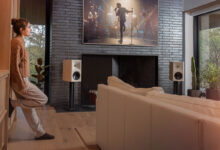
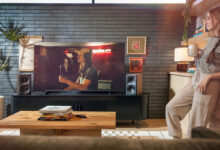

Key Facts Klipsch The Sevens II
- Active two-way bass-reflex system with one vented 25 mm titanium LTS tweeter in a Tractrix horn and one 6.5-inch Jet Cerametallic mid/bass driver per loudspeaker
- Frequency response from 39 Hz to 25 kHz at ±3 dB; maximum sound pressure level of 106 dB for the stereo pair at a distance of one metre
- Dirac Live with a restricted licence and supplied measurement microphone
- Wireless link between the speakers at 48 kHz; wired operation at up to 24 Bit 96 kHz
- Onkyo electronics, Dolby Atmos with virtual height channels and a 5-band equaliser
- HDMI 2.1 input and output with ARC/eARC, CEC, 8K passthrough and 4K at 120 Hz
- Google Cast, Apple AirPlay 2, Spotify Connect, TIDAL Connect and Qobuz Connect
- Dual-band WiFi, Ethernet and Bluetooth 5.4 with SBC and AAC
- Phono and line inputs on Cinch, optical and coaxial digital inputs, USB-C Audio, USB-A and a subwoofer output
- Real-wood veneer in Walnut, Ebony and Red Oak; Klipsch Connect Plus app and illuminated remote control
Dirac Live moves the room into the setup process
Room correction is the decisive addition when The Sevens II are compared with the smaller model in the range. The supplied microphone records the response at the listening position, while the Klipsch Connect Plus app guides the owner through the Dirac Live setup. A correction curve derived from these measurements is intended to reduce irregularities caused by the room.
This goes further than turning bass and treble controls by ear, which matters particularly when the loudspeakers must work in a room already shaped by everyday use. There is, however, an important limit to the package: Klipsch supplies a restricted Dirac Live licence rather than the unrestricted full-range version. Room correction also does not make careful placement irrelevant; positioning remains the sensible first step before measurement begins.


Wireless convenience or the higher wired resolution
Klipsch leaves the physical relationship between the two loudspeakers to the owner. Their wireless audio connection operates at 48 kHz and removes the need to run a signal cable between the left and right sides of the room. Both cabinets still require mains power, so wireless in this context applies to the audio link rather than to the entire installation.
The primary loudspeaker can be assigned to the left or right channel in the app. This makes it easier to place the cabinet carrying the source connections beside the existing equipment, instead of arranging the room around a fixed channel assignment.
For playback at up to 24 Bit 96 kHz, the pair must be joined with the four-metre CAT6 cable included in the package. The choice is therefore explicit: less visible cabling with the 48 kHz wireless link, or the maximum supported inter-speaker resolution via cable. The dedicated sockets used for that connection should not be confused with the separate Ethernet port for the home network.
A larger driver brings greater low-frequency reach
Each Klipsch The Sevens II enclosure combines a 6.5-inch Jet Cerametallic mid/bass driver with a vented 25 mm titanium LTS tweeter mounted in a Tractrix horn. The two-way cabinet uses a rear-firing bass-reflex port. Klipsch specifies a frequency response of 39 Hz to 25 kHz at ±3 dB and a maximum sound pressure level of 106 dB for the stereo pair measured at one metre.
Those figures explain the model’s position above Klipsch The Fives II. According to the manufacturer’s specifications cited in the German source article, the smaller system reaches down to 50 Hz and delivers a maximum level of 103 dB. The Sevens II therefore offer greater bass extension and additional level reserves on paper, alongside Dirac Live and the wireless inter-speaker connection. Many of the network and television functions are shared, but these are tangible reasons to consider the larger pair.
The new single-piece BMC baffle is intended to reduce unwanted resonances through its density and stiffness. Klipsch also attributes more even dispersion away from the central listening axis to its rounded contours. In a living room with several seats, behaviour away from one carefully chosen sweet spot can be just as relevant as the response measured directly in front of the pair.


Onkyo electronics put more of the system inside the speaker
Klipsch first showed the new generation at CES 2026, where The Fives II, The Sevens II and The Nines II established the broader direction of the range. Electronics developed with Onkyo move duties normally divided between traditional HiFi components and an AV receiver into the active loudspeakers themselves.
Dolby Atmos processing is one result. The Sevens II use signal processing to create virtual height channels from the stereo pair; no additional upward-firing or ceiling speakers form part of the arrangement. Its spatial effect will consequently remain dependent on the room and listening position, a distinction worth making when comparing the system with a discrete multichannel installation.
Three listening modes – Music, Movie and Direct – accompany dialogue enhancement and a 5-band equaliser. These controls allow the same loudspeaker pair to change role without requiring a separate processor for each source.
HDMI 2.1 serves television, video sources and gaming
The HDMI section comprises one input for a source and one output for the television. ARC or eARC returns television audio to the speakers, while CEC allows their volume to be adjusted with the television remote. A games console or another HDMI source can connect directly to The Sevens II, with the picture passed onwards to the screen.
Video passthrough covers 8K and 4K at 120 Hz as well as HDR10+, Dolby Vision and BT.2020. VRR, ALLM and QFT address variable refresh rates, automatic switching to a low-latency picture mode and faster frame transport respectively. This specification gives the system a credible role in a modern television and gaming setup without turning it into a conventional AV receiver and passive speaker combination.
Streaming without a separate network player
Spotify Connect, TIDAL Connect and Qobuz Connect allow music to be sent from the familiar service apps. Google Cast and Apple AirPlay 2 provide further routes, while the network connection can be made over 2.4 GHz or 5 GHz WiFi or through Ethernet. A separate network player is therefore unnecessary for the supported services and protocols.
Klipsch has not made that network focus an excuse to discard existing sources. A dedicated phono input with an integrated phono preamplifier sits alongside a separate line input, optical and coaxial digital inputs, and USB-C Audio for a computer. USB-A caters for storage media, Bluetooth 5.4 supports the SBC and AAC codecs, and an Cinch output provides a connection for an active subwoofer.


Real-wood finishes and controls that remain within reach
At 381 mm high, 206.38 mm wide and 317.5 mm deep per cabinet, Klipsch The Sevens II need a meaningful amount of space. Their MDF enclosures are finished in real-wood veneer, with Walnut, Ebony and Red Oak available. The Red Oak version combines its veneer with a white baffle and removable light-grey grilles. Klipsch names the optional KS-24 stands as the matching support.
A metal control and button on the top panel provide direct access to volume and source selection. The illuminated remote remains usable in a darkened room, while the Klipsch Connect Plus app handles initial configuration, remote operation, equaliser settings and the Dirac Live measurement process from the listening position.
The Most Important Advantages at a Glance
- Correction tailored to the listening room: Dirac Live can reduce room-related irregularities within the supported correction range.
- Greater freedom when positioning the pair: The wireless link can eliminate the signal cable running between the two loudspeakers.
- Hi-res Audio through the wired connection: The supplied CAT6 cable enables operation at up to 24 Bit 96 kHz.
- More low-frequency scope than the smaller model: The lower specified bass limit supports use as a self-contained stereo system.
- Streaming from familiar service apps: Spotify Connect, TIDAL Connect and Qobuz Connect provide direct access without a separate network player.
- One central connection point for television and sources: HDMI eARC and an additional HDMI input cover film sound and gaming without a separate AV receiver.
- Existing components remain useful: Phono, line, digital and USB inputs accommodate a record player, CD player or computer.
- Configuration from the listening seat: The Klipsch Connect Plus app guides measurement and provides access to playback adjustments.
Price & Availability
Klipsch The Sevens II are priced at € 1.999,- per pair. Walnut, Ebony and Red Oak finishes are offered, and the new active loudspeaker systems from Klipsch are arriving at specialist retailers now.
Getting to the Point
The most persuasive aspects of Klipsch The Sevens II concern the realities of installing a serious stereo system in a shared living space. Dirac Live addresses the acoustic compromises of that space, while the optional wireless link deals with one of its most visible practical obstacles. Neither feature is presented without a trade-off: the included Dirac Live licence is restricted, and the wireless connection is limited to 48 kHz, whereas the cable supports up to 24 Bit 96 kHz.
That transparency strengthens rather than weakens the proposition. Combined with the specified bass extension, comprehensive streaming, HDMI facilities and the unusually broad input selection, The Sevens II are aimed at listeners who want one active pair to serve music, television and existing sources without abandoning either placement flexibility or meaningful system configuration.
| Product | Klipsch The Sevens II |
|---|---|
| Price | € 1.999,- |
Technical Specifications
| Product | Klipsch The Sevens II |
|---|---|
| Product type | Active stereo loudspeaker pair |
| Acoustic design | Two-way bass-reflex system with rear-firing port |
| Drivers per loudspeaker | 25 mm titanium LTS tweeter in a Tractrix horn; 6.5-inch Jet Cerametallic mid/bass driver |
| Frequency response | 39 Hz to 25 kHz, ±3 dB |
| Maximum sound pressure level | 106 dB for the stereo pair at a distance of 1 m, manufacturer specification |
| Amplifier power | Not stated in the manufacturer documents examined for the German source article |
| Room correction | Dirac Live, restricted licence; measurement microphone supplied |
| Connection between loudspeakers | Wireless at 48 kHz or wired at up to 24 Bit 96 kHz |
| Spatial audio | Dolby Atmos with virtual height channels |
| HDMI | HDMI 2.1 input and output; ARC/eARC, CEC, HDCP 2.3 |
| Video passthrough | 8K, 4K at 120 Hz, HDR10+, Dolby Vision, BT.2020, VRR, ALLM, QFT |
| Network | WiFi 802.11ac, 2.4/5 GHz, 2 × 2 MIMO; Ethernet 10/100 Mbit/s |
| Streaming | Google Cast, Apple AirPlay 2, Spotify Connect, TIDAL Connect, Qobuz Connect |
| Bluetooth | Version 5.4, A2DP, SBC and AAC |
| Analogue inputs | Phono on Cinch; line on Cinch |
| Further digital connections | Optical and coaxial digital inputs, USB-C Audio, USB-A |
| Further connections | Measurement microphone input, Cinch output for an active subwoofer |
| Sound functions | Music, Movie and Direct modes, dialogue enhancement, 5-band equaliser |
| Operation | Control and button on the cabinet, illuminated remote control, Klipsch Connect Plus app, HDMI CEC |
| Enclosure | MDF with real-wood veneer; single-piece BMC baffle |
| Finishes | Walnut, Ebony, Red Oak |
| Dimensions per loudspeaker | 206.38 × 381 × 317.5 mm (W × H × D) |
| Weight | Primary loudspeaker 10,73 kg; secondary loudspeaker 10,4 kg |
| Power supply | Mains connection required for both loudspeakers; 100–240 V, 50/60 Hz |
| Supplied accessories | Loudspeaker pair, two mains cables, remote control with batteries, measurement microphone, HDMI cable, 4 m CAT6 inter-speaker cable |
| Optional accessory | Klipsch KS-24 loudspeaker stands |
| Brand | Klipsch |
|---|---|
| Manufacturer | Premium Audio Company LLC. |
| Distribution Austria | Audio Tuning Vertriebs GmbH |
| Distribution Germany | Premium Audio Company Germany GmbH |
| Distribution Switzerland | novis electronics AG |
| More about this manufacturer at HiFi BLOG |