

FiiO AIR AMP Streaming Power Amplifier – Network Player, DAC and Class D Amplifier in the Smallest of Spaces
Calling the FiiO AIR AMP a power amplifier tells only part of the story. Behind its compact front panel sits a network player, DAC, preamplifier and Class D output stage, complemented by Roon Ready, Apple AirPlay, Bluetooth 5.2 with LDAC and playback from NAS and USB storage. With the supplied 48 V/5 A power supply, it delivers a specified 2 × 120 W into 4 Ohms.

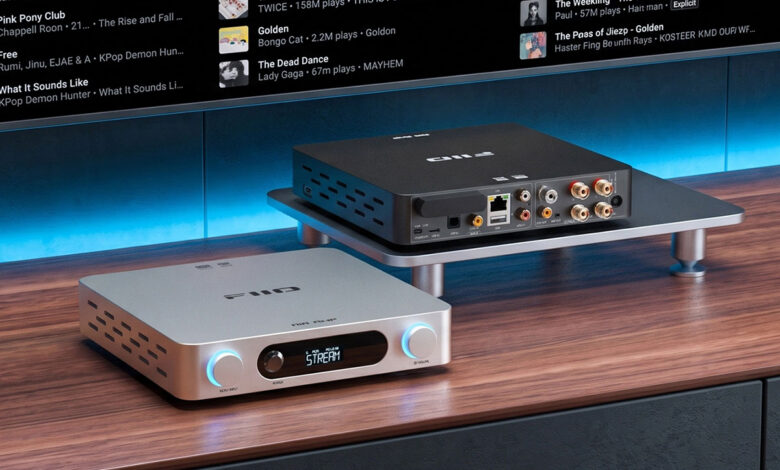
- The FiiO AIR AMP is conceived as the single electronic component in a modern system built around passive loudspeakers. It handles streaming, local files, digital and analogue sources, volume control and power amplification, while Sub Out and Pre Out leave room for later expansion. Its unusually broad feature set is attractive at € 269,90, although listeners relying on Spotify Connect, TIDAL Connect or Qobuz Connect should note that FiiO does not list these protocols.
Passive loudspeakers remain appealing precisely because they do not dictate the electronics used with them. The drawback is familiar: once streaming, conversion, source selection and amplification are assembled from separate components, a supposedly simple stereo system can quickly occupy an entire shelf. Guangzhou FiiO Electronics Technology Co. Ltd. approaches that problem from the opposite direction with the FiiO AIR AMP.

Officially described as the FiiO AIR AMP Streaming Power Amplifier, this 207 mm wide component is much closer to an integrated streaming hub than its name suggests. It can retrieve music from a network or USB storage, accept several external sources, convert digital signals, control volume and drive passive loudspeakers directly. Add a pair of speakers and, for many users, the system is complete.guan


Key Facts FiiO AIR AMP Streaming Power Amplifier
- Highly integrated desktop audio solution
- Texas Instruments TPA3255 Class D amplifier with PFFB
- 2 × 120 W into 4 Ohms and 2 × 90 W into 8 Ohms with the supplied 48 V/5 A power supply
- ESS ES9020Q DAC and XMOS XU316
- USB Audio up to 32 Bit 768 kHz and native DSD512
- Roon Ready, Apple AirPlay and QPlay, plus local playback from NAS and USB storage
- Bluetooth 5.2 with SBC and LDAC
- USB, optical S/PDIF, coaxial S/PDIF and analogue RCA inputs
- Loudspeaker outputs, Sub Out and Pre Out
- Gigabit Ethernet and dual-band WiFi at 2.4 GHz and 5 GHz
- AUTO EQ, ten-band PEQ and separate bass and treble controls
- FiiO Control App, web interface and infrared remote control
A Complete System Hidden Behind a Modest Name
The useful way to understand the FiiO AIR AMP is not to start with its power rating, but with the number of separate jobs it removes from a conventional system. A network bridge is unnecessary, digital sources do not require an external converter, and the unit itself provides source selection and volume control before feeding its own power stage. This is an integrated amplifier in functional terms, with streaming placed at the heart of the design.
That distinction also explains the provision of both Sub Out and Pre Out. The former makes a compact 2.1 system possible, while the latter allows the FiiO AIR AMP to serve active loudspeakers or an external power amplifier. The product can therefore begin as a self-contained amplifier and remain useful if the rest of the system changes.


Streaming and Local Music Without an Additional Player
Network playback is available through Gigabit Ethernet or dual-band WiFi at 2.4 GHz and 5 GHz. FiiO specifies Roon Ready, Apple AirPlay and QPlay; the latter mainly addresses QQ Music and is consequently of greater relevance in China than in Europe. For many hifi.blog readers, Roon Ready and Apple AirPlay will be the more important parts of the list.
The FiiO AIR AMP is not restricted to cloud-based playback. Through the FiiO Control App, it can access music stored on a NAS via UPnP, and it can play files held on USB flash drives or external hard disks connected via USB-A or USB-C. Local playback and streaming are supported at up to 32 Bit 384 kHz and DSD256, so a separately maintained music library can be accommodated without another hardware component.
There is, however, a conspicuous gap in the published feature set. FiiO does not currently name Spotify Connect, TIDAL Connect or Qobuz Connect. Anyone accustomed to selecting the amplifier directly from the respective service’s native app should take this into account before deciding whether Roon, Apple AirPlay or playback through the FiiO software provides the preferred route.
Seven Ways In, Rather Than Seven Input Sockets
FiiO describes seven input options, but the figure needs a little interpretation. It includes operating modes as well as physical connections: USB Audio, optical S/PDIF, coaxial S/PDIF, Bluetooth and analogue RCA are joined by network streaming and local file playback. The claim therefore does not mean that seven separate input sockets are fitted to the rear panel.
Even so, the selection covers the sources likely to appear in a compact stereo or desktop arrangement. A computer can use USB Audio, digital components can connect via optical or coaxial S/PDIF, and an analogue source has access to the RCA input. Two sensitivity settings are provided for the analogue input, helping the amplifier accommodate sources with different output levels.
Bluetooth 5.2 offers SBC and LDAC. It is the fastest route for casual playback from a phone or tablet, while LDAC provides the more ambitious wireless option where the source device supports it. Bluetooth complements the network functions rather than replacing them.
A Digital Platform Built for Hi-res Audio
FiiO combines an XMOS XU316 USB interface with an ESS ES9020Q DAC. Via USB Audio, the system accepts PCM at up to 32 Bit 768 kHz and native DSD512. Coaxial S/PDIF handles up to 24 Bit 192 kHz and DSD64, whereas optical S/PDIF is specified up to 24 Bit 96 kHz.
Those limits vary with the connection, but they are generous for a product at this price and of this scale. More importantly, the range of interfaces makes the AIR AMP usable not only as a streaming receiver, but also as the central converter for a computer, digital transport or other conventional source.


The Relevant Power Figure Is 2 × 120 W
With the supplied 48 V/5 A power supply, FiiO rates the AIR AMP at 2 × 120 W into 4 Ohms and 2 × 90 W into 8 Ohms, in each case at THD+N below 1 per cent. These are substantial figures for a chassis measuring only 207 × 188 × 42 mm, and they position the amplifier beyond the narrow role of powering tiny desktop speakers. According to the manufacturer, conventional bookshelf loudspeakers and smaller to medium-sized floorstanding designs also fall within its intended scope.
An optional 48 V/10 A power supply raises the quoted maximum to 2 × 235 W into 4 Ohms or 2 × 150 W into 8 Ohms. Those numbers require context: in the detailed specification, FiiO states them at THD+N below 10 per cent. They cannot be compared directly with the ratings for the supplied power supply at below 1 per cent THD+N. The standard figures of 2 × 120 W and 2 × 90 W are therefore the more meaningful indication of everyday capability.
Why PFFB Matters More Than the Amplifier Chip Alone
The output stage is based on the Texas Instruments TPA3255, a familiar Class D device in compact HiFi amplifiers. Naming the chip, however, reveals less than examining how it is implemented. FiiO uses Post-Filter Feedback, abbreviated to PFFB, in the AIR AMP.
In this arrangement, feedback is taken after the output filter. The stated aim is to reduce distortion and limit the extent to which a loudspeaker’s changing impedance affects the amplifier’s frequency response. FiiO also attributes lower background noise and more consistent behaviour with different loudspeakers to this circuit approach. These remain manufacturer claims until verified in a test, but they address an aspect of compact Class D design that is more consequential than the chip designation on its own.
Equalisation That Goes Beyond Bass and Treble
Signal processing is unusually extensive for such a small amplifier. The FiiO Control App and browser-based interface provide preset curves, AUTO EQ and a ten-band parametric equaliser. Separate bass and treble controls are available when only a quick tonal correction is required.
This gives owners several levels of intervention. The simple controls can compensate for taste or a particular recording, whereas the PEQ permits more targeted adjustment to a loudspeaker and its placement. It is not presented as a full room-correction system, but it offers considerably greater precision than the conventional tone controls found on many integrated amplifiers.
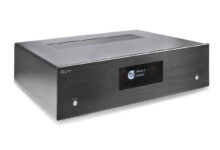
Operation is not tied exclusively to a smartphone or web browser. Two rotary controls on the front panel provide direct access at the unit, a 1,1 inch LCD shows status information, and an infrared remote control is included. The remote covers functions including input selection, volume and switching between EQ presets.
Compact Enough for the Desk, Equipped for the Living Room
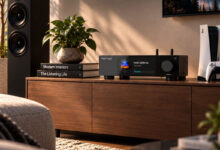
At approximately 207 × 188 × 42 mm and 930 g, the FiiO AIR AMP takes up little more space than many desktop DACs or headphone amplifiers. That makes it easy to place beside a monitor, inside a shallow shelf or in a restrained living-room system where a conventional full-width amplifier would dominate the furniture.
FiiO offers black and silver finishes. The small LCD and twin rotary controls give the front panel a functional character, while the rear accommodates the network, source and output connections needed for the broader system role. Its size may suggest a specialist desktop component, but the connection set and loudspeaker power are designed for use well beyond the desk.
The Most Important Advantages at a Glance
- One component instead of several: Network player, DAC, preamplifier functions and power amplification share one enclosure.
- Useful output with the supplied power supply: The specified 2 × 120 W into 4 Ohms is the relevant standard configuration, not an optional upgrade.
- Network and local libraries covered: Roon Ready, Apple AirPlay, NAS access and USB storage support several ways of reaching a music collection.
- Conventional sources remain welcome: USB, optical S/PDIF, coaxial S/PDIF, Bluetooth and analogue RCA broaden the system beyond streaming.
- Room for system expansion: Sub Out supports a 2.1 setup, while Pre Out enables an external power amplifier or active loudspeakers.
- Detailed tonal adjustment: AUTO EQ, ten-band PEQ and basic bass and treble controls offer different levels of signal shaping.
- Flexible control: Front-panel operation, the FiiO Control App, a web interface and the supplied remote cover different situations.
- Very small footprint: Its 207 × 188 × 42 mm enclosure is suitable for a desk, shelf or discreet living-room installation.
Price & Availability
The FiiO AIR AMP is offered in black and silver. NT Global Distribution GmbH currently lists the FiiO AIR AMP at € 269,90, although it was shown as not yet in stock at the time of research.
Getting to the Point
The most interesting aspect of the FiiO AIR AMP is the amount of conventional system building it makes optional. For € 269,90, it brings together a Roon Ready network player, Apple AirPlay, local playback, an ESS DAC, high-resolution USB Audio, flexible equalisation and an amplifier capable of a specified 2 × 120 W into 4 Ohms with the power supply in the box. That is an unusually complete starting point for passive loudspeakers, and its Pre Out and Sub Out prevent the compact format from becoming a dead end.
The specification still calls for a measured reading. The headline 2 × 235 W available with the optional power supply is quoted at a substantially higher distortion threshold and should not distract from the more credible standard rating. Native Spotify Connect, TIDAL Connect and Qobuz Connect would also make the streaming section more convincing for European users. Even with those qualifications, the AIR AMP is a sharply focused answer to a familiar request: a proper passive-loudspeaker system without a stack of electronics.
| Product | FiiO AIR AMP Streaming Power Amplifier |
|---|---|
| Price | € 269,90 |
Technical Specifications
| Product | FiiO AIR AMP Streaming Power Amplifier |
|---|---|
| Description | Compact streaming amplifier with integrated network player, D/A converter, preamplifier functions and Class D power amplifier |
| Amplifier | Texas Instruments TPA3255, Class D |
| Circuit | PFFB – Post-Filter Feedback |
| Output power, 48 V/5 A | 2 × 120 W into 4 Ohms, THD+N < 1 % |
| Output power, 48 V/5 A | 2 × 90 W into 8 Ohms, THD+N < 1 % |
| Output power, optional 48 V/10 A | 2 × 235 W into 4 Ohms, THD+N < 10 % |
| Output power, optional 48 V/10 A | 2 × 150 W into 8 Ohms, THD+N < 10 % |
| Frequency response | 20 Hz to 40 kHz, attenuation < 2,4 dB |
| THD+N, 48 V/5 A | < 0,002 % at 1 kHz/-15 dBV into 8 Ohms |
| Dynamic range | ≥ 110 dB, A-weighted |
| Signal-to-noise ratio | ≥ 110 dB, A-weighted |
| Noise level | < 80 µV, A-weighted |
| DAC | ESS ES9020Q |
| USB Audio interface | XMOS XU316 |
| Main processor | Ingenic X2000 |
| USB Audio | Up to 32 Bit 768 kHz, native DSD512 |
| Local playback | Up to 32 Bit 384 kHz, DSD256 |
| Streaming | Up to 32 Bit 384 kHz, DSD256 |
| Coaxial S/PDIF | Up to 24 Bit 192 kHz, DSD64 |
| Optical S/PDIF | Up to 24 Bit 96 kHz |
| Streaming protocols | Roon Ready, Apple AirPlay, QPlay |
| Local playback sources | NAS, USB flash drive, external hard disk via USB-A or USB-C |
| Bluetooth | Bluetooth 5.2, SBC, LDAC |
| Input options | USB, optical S/PDIF, coaxial S/PDIF, Bluetooth, analogue RCA, streaming, local playback |
| Outputs | Loudspeakers, Sub Out, Pre Out |
| Network | Gigabit Ethernet, dual-band WiFi at 2.4 GHz and 5 GHz |
| Tone and EQ | AUTO EQ, ten-band PEQ, bass and treble controls |
| Control | FiiO Control App, web interface, front-panel controls, infrared remote control |
| Display | 1,1 inch LCD |
| Power supply | DC 48 V/≥5 A |
| Supplied power supply | 48 V/5 A |
| Finishes | Black, silver |
| Dimensions | Approx. 207 × 188 × 42 mm |
| Weight | Approx. 930 g |
| Brand | Guangzhou FiiO Electronics Technology Co. Ltd. |
|---|---|
| Manufacturer | FiiO |
| Distribution | NT Global Distribution GmbH |
| More about this manufacturer at HiFi BLOG |