

A visit at Karan Acoustics in Novi Sad – How Emil Karan Is Leading His Father's Life's Work into the Future with Uncompromising Quality and New Perspectives
Karan Acoustics has been building handmade preamplifiers, phono stages and power amplifiers in Novi Sad since 1986. Its current Master Collection pairs massive, CNC-machined aluminium chassis with fully balanced, DC-coupled circuitry, and every unit is listened to for several days before it ships. We went to the workshop to find out how Emil Karan is carrying his father's legacy forward with the same rigour and some fresh ideas of his own.

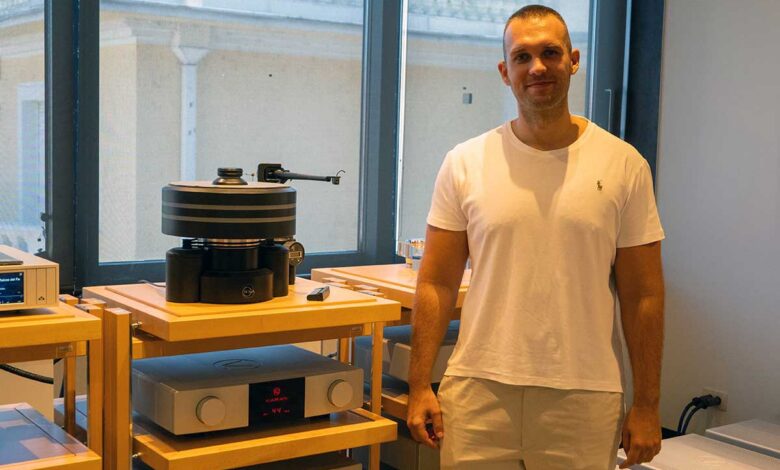
- The Karan Acoustics Master Collection, built by a seven-strong team in Novi Sad, comprises the LINEa and LINEb line preamplifiers, the PHONOa and PHONOb phono stages, and the POWERa and POWERb stereo and mono power amplifiers, with the "a" models as the most elaborate versions and the "b" models as more compact siblings. All are hand-assembled in CNC-machined aluminium chassis made in Serbia, use fully balanced, DC-coupled circuits that, according to the manufacturer, dispense with global negative feedback, and leave the workshop only after electrical measurements, several days of listening and Emil Karan's personal approval.
Some companies make their character felt within minutes of your arrival. You sense that what they build is more than the output of a development department and a production line. Karan Acoustics, the high-end HiFi manufacturer that Milan Karan founded in Novi Sad, Serbia, in 1986, is one of them. Our visit brought us face to face with a philosophy that has spent four decades chasing the best possible sound, technical refinement and lasting reliability. What impressed us most was how naturally that outlook is now carried by Emil Karan. The founder’s son took charge of a company with a worldwide reputation while still young, and he runs it with colleagues who, for the most part, already worked alongside his father. Preserving the past for its own sake does not interest him. He regards the philosophy he inherited as a duty: to steer Karan Acoustics into the future with the same consistency, but with new ideas and a sober view of today’s difficulties.

So this was far more than a routine factory tour. It was a close look at the culture of a family firm whose passion for music and engineering is visible in everything it makes.


Key Facts Karan Acoustics
- Karan Acoustics was founded in 1986 by Milan Karan in Novi Sad, Serbia, and celebrates its 40th anniversary in 2026.
- The company is now run by Emil Karan, the founder’s son, and specialises in high-quality analogue amplifier electronics.
- A team of seven combines long experience, craft skills and broad technical knowledge.
- The current Master Collection includes line-level preamplifiers, phono preamplifiers, and stereo and mono power amplifiers.
- Each category is offered in an “a” and a “b” version, giving different levels of specification within one consistent development philosophy.
- Massive aluminium chassis, machined with CNC technology in Serbia, define both construction and appearance.
- Hand assembly, extensive measurements and listening checks lasting several days are a fixed part of the quality process.
- Rising material, energy and component costs, and the long-term availability of specialised parts, pose considerable challenges.
Table of Contents
A group of seven people in Novi Sad
Follow the international high-end HiFi scene for a while and the same names keep appearing: the USA, Japan, Germany, Britain, Italy. Yet outstanding audio engineering is not the preserve of those traditional centres. Novi Sad, Serbia’s second-largest city, proves the point. For forty years Karan Acoustics has worked there on its own idea of uncompromising music reproduction.
The firm is remarkably small. Seven people take care of development, manufacturing, testing and every administrative chore that comes with running an internationally active maker of high-quality audio components. Six of them already worked for Milan Karan; only one colleague has arrived since Emil Karan became managing director.
That continuity is worth a great deal. These employees know many of today’s design solutions from more than drawings and specifications, and some of them watched those solutions come into being. They tried out improvements with Milan Karan and built up experience that no development document can fully capture. In a small workshop this is a real advantage, because proven solutions can be carried on by people who understand why they work.
The trust within the team was obvious during our visit. Emil Karan describes the company as a community in which long friendships and personal loyalty count for a lot. He does not mean it sentimentally, and it is easy to see why. With so few people, the result is only as good as each person’s sense of responsibility and care. Work is not passed anonymously from station to station, as it may be on a large industrial line. Everyone here knows the products and their quirks, and knows what the name Karan Acoustics is supposed to stand for. For Emil Karan, that means a crew that backs his father’s technical legacy out of conviction.


Built by hand, signed off by the boss
A high-end HiFi manufacturer’s real quality cannot be read off a data sheet, and good parts or heavy casework are not enough either. What counts is the sum of every decision made in development and production. That is where Karan Acoustics stands out.
We saw how much attention goes to details that a buyer may never notice. Component choice and placement, signal routing, the mechanical mounting of assemblies and the power supply design are never treated as separate questions. Each is seen as one piece of a whole in which mechanical, electrical and sonic behaviour ought to work together. Getting that right takes time and experience, and above all a readiness to keep challenging solutions that look simple.
The effort is unusual even in this segment. Units are assembled by hand, parts are selected and tested with care, and every finished amplifier has to get through an extensive series of checks. Electrical measurements are only the start: each device is also auditioned for several days. Only when the results live up to expectations is it released.
The decision to release rests with Emil Karan in person. No unit leaves the building without his approval. In a firm this size, that shows how closely management remains tied to the quality of every single product.
Made of Aluminium, with highest precision and excellent design
The casework impressed us just as much. With the current Master Collection, the exterior matches the engineering inside. The styling is modern, elegant and timeless: clean lines, balanced proportions and a largely reduced look give the amplifiers a calm authority and need no showy effects to draw the eye.
The sheer solidity of the chassis suggests permanence and value that are rare even in this exclusive class. The aluminium elements are machined with great precision, the surfaces are flawless and each joint has been handled with care.
The same thoroughness applies to visual details many manufacturers would shrug off. On the Master Collection the screws are largely concealed; a single visible screw remains on the rear panel. The result is a strikingly clean, almost monolithic appearance. It looks self-evident, yet it demands a great deal of design and production effort: the housing parts must fit together exactly while also providing mechanical stability, heat dissipation and access for assembly and service. Karan Acoustics clearly does not go looking for easy answers.
Why the chassis are machined in Serbia
The aluminium chassis are not produced cheaply in the Far East. They are made by high-precision CNC machining in Serbia. The choice reflects a clear principle: the mechanical design should follow the company’s own ideas in full, with no commercial pressure imposing limits.
The enclosures are made of high-grade aluminium, and their material thickness and construction go far beyond what it would take simply to hold the electronics. Weight and visual impact are not the point. Karan Acoustics treats the chassis as an integral part of the overall concept, and mechanical stability, vibration behaviour, shielding of sensitive circuits from external influences and thermal properties all feed into its design.
The same thinking applies to how the units stand. The Master Collection uses specially chosen equipment feet from Critical Mass Systems, which are intended to reduce unwanted mechanical influences on the sensitive electronics. Even the fixing and positioning of the circuit boards inside the cases gets special attention. A chassis that merely looks expensive and feels solid is not enough here; every constructional detail is meant to contribute to the result.
Rising costs of solid aluminium
Admirable as this approach is, it carries a heavy financial load, and this was one of the most revealing parts of our visit. It showed how much work stands behind products whose quality listeners tend to take for granted.
Machining massive aluminium chassis with high-precision CNC technology is expensive at the best of times. Higher raw material prices and energy costs have made things markedly worse in recent years. Producing aluminium consumes a great deal of energy, and depending on the design, much of the original block is cut away during machining. Anyone who commissions such heavy, elaborate enclosures feels these trends at once.
Savings would of course be possible: simpler constructions, thinner material or production in cheaper regions. Emil Karan rules all of them out. We were told plainly that there has never been a serious attempt to dilute the company’s quality standards for cost reasons. For him, the uncompromising construction is not a feature that can be swapped out; it is the company’s identity. Cutting costs there would put at risk the very qualities on which the international reputation of Karan Acoustics rests. The consequence is considerable financial pressure, which is especially hard to bear for a company with seven employees.
The price of rare components
Sourcing high-quality electronic parts has become at least as difficult as having the enclosures made. Changes in global procurement markets have caused serious problems for small, specialised manufacturers. Supply shortages, steep price increases and the withdrawal of individual component series can throw even carefully planned production off course.
Karan Acoustics has an added difficulty: many of its components are selected against very strict criteria, and some are made to the company’s own specifications, so they cannot simply be replaced by something off the shelf. What we heard about the price of individual parts was striking. Components that look entirely unremarkable, and whose importance a layperson would hardly grasp, can cost € 10,-, € 50,- or even € 100,- a piece. A preamplifier or power amplifier that needs several of them quickly accumulates substantial material costs.
The price is often not even the main worry. The real issue is whether exactly the parts that were chosen for their electrical properties and behaviour in a given circuit remain available. A substitute with similar data sheet values will not necessarily behave the same way in a real circuit. For a manufacturer that has refined its circuits over many years, such a swap can have far-reaching consequences.
Stockpiling for the long term
To secure long-term production and serviceability, Karan Acoustics has to hold large stocks of certain components. That sounds like a routine logistical decision, but for a company of this size it is a serious financial commitment.
It is not just a matter of having parts for the next production runs. Cover for warranty cases and later repairs matters just as much. A company that builds high-quality amplifiers meant to give their owners pleasure for many years also has to keep spare parts available for as long as it can. That can mean buying large quantities of individual components even though the demand will only materialise over several years. Capital is tied up, sometimes on a substantial scale, and the money is spent at the time of purchase while the investment returns only gradually, through sales of finished products.
A small family business feels this keenly. Large industrial groups can usually fit such sums into their purchasing budgets, whereas a manufacturer like Karan Acoustics has to plan its finances much more tightly. That it accepts this anyway shows how long its horizon is: the company is thinking of a product’s entire lifespan, not just the next production cycle.
What if parts disappear from the market
It gets harder still when certain components can no longer be bought at all. Electronic parts are regularly revised, replaced by successors or dropped from the catalogue. Makers of large production runs can often cope by altering the design; with highly specialised circuits, it can become a genuine problem.
When a familiar part vanishes, Karan Acoustics therefore has to be inventive. Finding any technically suitable substitute is not the goal. The company first has to establish which properties of the original component actually govern the behaviour of the whole circuit, and only then can it judge whether an alternative is suitable. That can mean reworking sections of a circuit, trying new combinations of parts and running extensive measurement and listening comparisons. It may take considerable development time, even though the owner of the amplifier will never see the change.
The company also treats such situations as a chance to improve on what it had. If a change is forced on it anyway, the result should at least equal the previous quality and, ideally, allow further refinement in places. It is another sign of how deeply the drive for continuous improvement runs through the firm.


The Karan Audio Master Collection
The current Karan Audio Master Collection reflects the stage of development that Karan Acoustics has reached after decades of experience. Its introduction began in 2020, and further models followed in stages until early 2022.
For Milan Karan, this generation was in a sense the summing-up of everything he had learned since founding the company. Emil Karan was already closely involved in the development of production processes and quality assurance at that point. The Master Collection therefore also marks the handover between generations that still shapes the company today.
The structure of the range is worth a closer look. Karan Acoustics deliberately concentrates on the categories in which it has built up expertise over decades: line-level preamplifiers, phono preamplifiers, and stereo and mono power amplifiers. Instead of serving as many segments as possible, it keeps to a compact but rigorously developed portfolio.
Within each category the company distinguishes between an “a” and a “b” version. They are not two unrelated product families. Everything belongs to the Master Collection and rests on the same development philosophy. The “a” versions are the most elaborately realised flagship models, while the “b” versions take over the key constructional and sonic principles with somewhat less extensive effort. That allows different levels of specification without giving up the technical identity of Karan Acoustics.


The Karan Acoustics LINEa and LINEb preamplifiers
The line-level preamplifiers Karan Acoustics LINEa and Karan Acoustics LINEb show the concept very clearly. The LINEa is the more elaborate model and is built as a two-piece system with a separate power supply. Housing the supply separately gives extra scope to keep the sensitive audio circuitry away from interference from the supply electronics.
The LINEb puts preamplifier and power supply in a single chassis. It is more compact, but follows the same basic design principles.
Both use fully balanced circuitry and offer four balanced XLR and two unbalanced RCA inputs, with two balanced XLR outputs each for passing the signal on. Volume control gets special attention too. Karan Acoustics uses a fully balanced design with carefully selected resistors and relay-controlled switching, intended to set the level as exactly as possible.
That even the supposedly smaller LINEb is an exceptionally high-quality design says a lot about the company’s thinking. Different variants are meant to serve different needs without calling the core quality principles into question.


Karan Acoustics PHONOa and PHONOb phono stages
Analogue playback clearly matters to Karan Acoustics, as its phono preamplifiers show. The Karan Acoustics PHONOa and Karan Acoustics PHONOb carry the company’s demanding standards into an area where even the slightest interference can have a considerable effect.
The PHONOa is the most elaborate version, with a separate power supply and extensive connection options. It has three unbalanced RCA and three balanced XLR inputs, so several analogue sources or cartridge configurations can be connected. The PHONOb follows a more compact concept with an integrated power supply and one RCA and one XLR input.
Both offer extensive gain adjustment and a choice of equalisation curves. As well as today’s RIAA standard, they cover the historical EMI, Decca, Columbia and Teldec curves, which can matter for anyone playing older record releases. The two phono stages show that Karan Acoustics does not limit its analogue expertise to its most powerful amplifiers. The whole signal chain is treated with the same care.


Karan POWERa and POWERb power amplifiers
The Master Collection is at its most striking among the power amplifiers. Karan Acoustics offers stereo and mono models, each as a POWERa and a POWERb, which makes four amplifiers in total: the Karan Acoustics POWERa Stereo, POWERb Stereo, POWERa Mono and POWERb Mono.
The output figures alone show what the manufacturer is aiming for. The POWERb Stereo delivers 2 x 450 watts into 8 ohms, and the even more elaborate POWERa Stereo 2 x 650 watts into 8 ohms. The mono models go further: the POWERb Mono manages 1.200 watts into 8 ohms, while the POWERa Mono, rated at 2.100 watts into 8 ohms, belongs to an exceptional power class.
It would nevertheless be wrong to judge these amplifiers by such numbers. In the view of Karan Acoustics, what matters is driving demanding loudspeakers with authority under very different operating conditions. The company relies on generously dimensioned power supplies, low internal resistance and large energy reserves. Output power is not an end in itself; the idea is that even in complex musical passages there is enough in reserve for undistorted dynamics.
The mechanical effort this involves is illustrated by the POWERa Stereo, which weighs 105 kg. Each POWERa Mono also weighs 105 kg. Figures like these show the class in which Karan Acoustics operates with the current Master Collection.
The special circuit design
For all the fascination of the massive construction, the real distinction of these products lies in their electronics. For decades Karan Acoustics has pursued a clearly defined philosophy built on fully balanced circuit structures, high speed and the most direct signal handling possible. The audio circuits are DC-coupled throughout. According to the manufacturer, there are no coupling capacitors in the audio signal path and no global negative feedback, with the aim of preserving the timing and dynamic qualities of the music signal as accurately as possible.
Thermal and electrical operating behaviour also plays a part. The power amplifiers use a technology called Sliding Bias, in which the quiescent current of the output stages is adjusted to the demands of the signal. The intention is to gain the sonic benefits of Class A-oriented operation without permanently producing the high power dissipation that a comparable design with constantly high quiescent current would cause.
The power supplies get exceptional attention as well. Generous transformers, large capacitance reserves and elaborate filtering and regulation stages are meant to give the circuits stable conditions in every relevant operating state.
The circuit boards are also worth noting. Karan Acoustics uses special substrate materials and comparatively thick copper layers, which the manufacturer quotes as 75 µm for the preamplifiers and 120 µm for the power supplies and power amplifiers. Internal wiring is made of high-quality copper conductors from Cardas Audio. Decisions like these are typical of the company’s broad idea of quality, in which the entire amplifier circuit, including its mechanical environment, is regarded as one connected system.
Measuring and listening, measuring and listening…
High-end HiFi keeps returning to the question of how much weight objective measurements and subjective listening impressions should carry in product development. At Karan Acoustics the two are not seen as rivals. Electrical measurements, extensive listening comparisons and long-term reliability tests are all fixed parts of a development process designed to judge every change as thoroughly as possible.
A modified circuit that posts convincing numbers on the test bench is not enough. What matters just as much is how the change affects real music reproduction. The varied tastes of Milan Karan and his son Emil Karan, who shared listening sessions across many genres, play an important role here. Classical music places different demands on spatial imaging, dynamics and tonal differentiation than electronic music does, while jazz and blues can show particularly well how convincingly an amplifier conveys rhythm, timbre and the interplay between musicians.
In the philosophy of Karan Acoustics, a truly good amplifier must meet all of these demands equally. Reproducing music convincingly in all its variety is the focus of every development effort. That the process sometimes takes a long time is clearly accepted in Novi Sad as a matter of course. In the end, the result is what counts.
From medical equipment and broadcast technology to amplifiers
The company’s story differs from that of many other manufacturers. Milan Karan did not come from consumer electronics. He had worked in the maintenance and servicing of complex medical equipment and demanding television broadcast technology: jobs that call for exceptionally sound knowledge of electronic circuits and the utmost precision, not least because reliability in such applications is never a side issue.
What actually drove him to found his own company, though, was something else: his love of music. Milan Karan was a DJ from an early age, immersed himself in sound and electronics, and eventually developed an integrated amplifier for himself. What started as a personal project became the beginning of a remarkable company history. The results were convincing, other music lovers took an interest, and he decided to develop and build amplifiers professionally. In 1986, Karan Acoustics was born.
Looking back, it seems almost inevitable that such a personal approach to music reproduction would produce a company whose products still carry a clearly recognisable signature. Even the very first amplifier followed a rule that has never been abandoned: a product leaves the workshop only when its creator is fully convinced by it.
Consistency as a principle
Forty years in business is an enormous amount of experience in an industry like high-end HiFi. Over that time technical progress, shifting market conditions, new materials, changed manufacturing methods and, not least, fresh sonic insights have transformed the industry.
The history of Karan Acoustics, however, is not one of dramatic changes of direction or constantly shifting concepts. Milan Karan formed firm ideas early on about how an amplifier must be built to reproduce music as faithfully as possible. Impressive measurements and high output power were never his sole concern. What mattered was how all of an amplifier’s qualities work together: speed, control, dynamics, tonal naturalness, spatial precision and the ability to render even complex musical structures with convincing ease. Reliability and longevity were at least as important, since an amplifier that delights the ear but causes trouble after a few years would hardly have met his standards.
He refined his designs with remarkable persistence. Instead of dropping working concepts early, he concentrated on improving them. New components, altered circuit details and mechanical improvements were tested, compared and adopted only if they promised genuine progress. As a result, individual product generations stayed in the range for long periods while being improved all the time. That is far from a given in the fast-moving electronics market: the point is not to present something new as often as possible but to perfect what exists as far as seems technically and sonically sensible. This attitude is still the foundation of Karan Acoustics.
Growing up with the brand
Of everything in Novi Sad, it was the meeting with Emil Karan that stayed with us most. Those who know the international high-end HiFi industry are used to traditional manufacturers being led by people with several decades of professional experience. By comparison, Emil Karan is remarkably young. It would still be a basic mistake to conclude from this that he lacks experience or an understanding of what this company demands.
For Emil Karan, high-end HiFi began long before most young people have any notion of what career they might choose. Music, amplifiers, loudspeakers, electronic circuits and debates about sonic nuance were part of daily family life. As a child he visited his father at the company, spent time listening to music with him, and got to know, as a matter of course, the world Milan Karan had built with such passion.
He likes to recall the joint listening sessions in which classical music played a major part. The range was wide, though: jazz, blues and electronic music belonged to it as well, because Milan Karan always insisted that an amplifier should convey the character and atmosphere of a recording convincingly, whatever the genre. Those early experiences undoubtedly shaped Emil Karan. They created an emotional bond with the company that goes well beyond being the founder’s son.
From production floor to management
Emil Karan joined the company properly around 2016. Alongside his studies in information technology, he took an increasingly active role in the family business. That same year he travelled to the HIGH END show in Munich for the first time, together with his father and colleagues, which also gave him a sense of how the company was positioned internationally and what demanding music lovers and specialist dealers expected of the brand.
The way he prepared for his current role is notable. He started in production, then spent a long period in quality control, and took on duties in organisation and management only step by step. He therefore came to know Karan Acoustics from the inside: not just through conversations with his father or through business figures, but through hands-on work with the products, their development, their assembly and the problems that go with them. That makes a decisive difference. Anyone who has seen how much effort a particular design solution takes, who knows how hard it is to obtain exceptionally good components and who understands why even apparently minor production details need close attention will inevitably see the running of such a manufacturer differently.
The impression we took away was of a young entrepreneur who is fully aware of his responsibility. Emil Karan approaches present-day challenges with striking clarity, combining respect for his father’s life’s work with a thoroughly pragmatic view of the future.
Tradition with room to move
Taking over a family business is demanding in any case. It is harder when the founder was not only the entrepreneur but also the principal designer and the defining personality behind every product. With the death of Milan Karan an era came to an end. His son, however, did not inherit a company that lives off the memory of past successes. Karan Acoustics has a clearly defined technical philosophy, knowledge accumulated over decades and a team that knows these principles from first-hand experience. For Emil Karan, that is an exceptionally valuable basis.
Keeping his father’s philosophy alive does not mean, for him, resisting technological change or carrying on existing solutions without questioning them. Quite the reverse: continuous development was always a central part of Milan Karan’s work, and his son carries that thought forward consistently. New materials, better components, refined manufacturing methods and further findings from measurements and listening comparisons are taken into account all the time. What remains decisive is that each change serves a clear purpose and stays within the company’s fundamental quality standards.
It is a sensible reading of what tradition can mean in a technology-driven business: the past provides the foundation, the future calls for further answers. That may well be one of the greatest strengths of Karan Acoustics today. The brand has an unmistakable identity without shutting itself off from what is possible now.
The main task for Emil Karan in the coming years is to preserve this unique position while creating the conditions for long-term commercial success. He will certainly face challenges his father did not know in this form: international supply chains have become more complex, high-quality components are sometimes harder to get, and the costs of materials, energy and manufacturing have risen considerably. At the same time, customers’ expectations and the conditions of the international high-end HiFi market are shifting. He therefore does not see himself merely as the custodian of an exceptional tradition. His training in information technology, his early involvement in production and quality assurance, and the management experience he has gathered since give him a solid basis for developing the company organisationally as well. Add a well-established team with decades of experience and a deep personal attachment to the brand, an advantage no company can acquire at short notice, and the combination of proven knowledge and fresh perspectives could prove decisive.
What stands out is the matter-of-fact way Emil Karan talks about his responsibility. His aim is not to continue his father’s work unchanged but to give its underlying convictions life under today’s conditions. There is no doubt that this demands a great deal of personal commitment. Yet the enthusiasm with which he tackles his tasks suggests that Karan Acoustics, in its second generation as well, is driven by the same passion that led to its founding.
Why manufacturers like this matter
During the visit we kept asking ourselves what place a company like Karan Acoustics holds in an increasingly globalised electronics industry. Commercially, it would be much easier to rely on standardised production, cheaper materials and the largest possible volumes. Such approaches have long been followed in the high-end segment too, and there is nothing wrong with that in principle, as different business models can produce excellent products. Karan Acoustics has deliberately chosen another route.
Maximum unit numbers and the shortest possible product cycles are not the priority. The company concentrates on developing a manageable number of exceptionally high-quality amplifiers and building them with the greatest possible care. This kind of specialisation only works if everyone involved believes in what they are doing. It needs employees willing to give apparently trivial details great attention, customers who value the difference between ordinary series production and painstaking craftsmanship, and a management prepared to put long-term quality ahead of short-term commercial gain.
At Karan Acoustics all of these conditions seem to come together in a remarkable way. It does not make the brand a manufacturer for a broad public, but that is part of its identity.
FAQ – Karan Acoustics – Key questions about the high-end HiFi manufacturer
What makes Karan Acoustics so special?
Karan Acoustics is one of the few high-end HiFi manufacturers that pursues development and production with exceptional consistency. Founded in 1986 and based in Novi Sad, Serbia, the company focuses on analog amplifier electronics, treating circuit design, component selection, mechanical construction, and craftsmanship as a unified whole. Particularly noteworthy is its uncompromising quality philosophy, which remains steadfast even under challenging economic conditions.
Who is behind Karan Acoustics today?
Karan Acoustics was founded in 1986 by Milan Karan, who played a pivotal role in shaping the company for decades. Today, his son Emil Karan runs the business. Although remarkably young compared to many other executives in the high-end HiFi industry, he has known the company since childhood and has been actively involved in its operations since around 2016. He is supported by a seven-member team, most of whom previously worked alongside his father.
Where are Karan Acoustics amplifiers manufactured?
Development, manual assembly, and quality control take place at the company’s headquarters in Novi Sad, Serbia. Even the solid aluminum chassis are not mass-produced cheaply in the Far East; instead, they are manufactured in Serbia using high-precision CNC technology. In doing so, Karan Acoustics consciously prioritizes an elaborate manufacturing process characterized by high quality standards and strict oversight of every production step.
What products does Karan Acoustics offer?
The Master Collection lineup includes the LINEa and LINEb line-level preamplifiers, the PHONOa and PHONOb phono preamplifiers, and the POWERa Stereo, POWERb Stereo, POWERa Mono, and POWERb Mono power amplifiers. With this range, Karan Acoustics focuses specifically on high-end analog amplification electronics, offering solutions for demanding stereo systems across a wide variety of configurations.
What distinguishes the Line a from the Line b?
The designations “a” and “b” denote different performance tiers within the Karan Acoustics Master Collection. The “a” models represent top-tier solutions featuring highly elaborate designs, while the “b” variants adopt key technical principles but feature slightly less complex construction. For instance, the LINEa preamplifier utilizes a separate power supply unit, whereas the LINEb integrates the power supply into the main chassis. Both variants adhere to the same fundamental design philosophy.
Why are Karan Acoustics amplifiers so elaborate and costly?
The exceptional level of effort involved begins with the massive, precision-machined aluminum chassis and extends to the meticulous selection of electronic components, some of which are particularly expensive. This is complemented by lengthy development processes, manual assembly, extensive measurements, and multi-day listening tests for every single unit. Karan Acoustics deliberately prioritizes superior material and manufacturing quality rather than designing products with the aim of minimizing production costs.
How does Karan Acoustics ensure long-term quality?
Each amplifier is carefully assembled by hand and subsequently undergoes comprehensive electrical testing as well as multi-day listening evaluations. Furthermore, the company stocks significant quantities of select electronic components to safeguard production and future servicing capabilities for the long term. Each unit receives final approval personally from Emil Karan—a remarkable example of direct accountability for quality.
What are Karan Acoustics’ plans for the future?
Emil Karan aims to continuously build upon his father’s technical and entrepreneurial legacy. Proven circuit designs, superior build quality, and natural musicality remain the cornerstones, while new materials, manufacturing capabilities, and technical insights are constantly incorporated. The combination of the seasoned team’s decades of experience and the fresh perspectives of the company’s new leadership forms the foundation for the continued evolution of this Serbian high-end HiFi manufacturer.
Our verdict: A visit to be remembered…
Our visit to Karan Acoustics in Novi Sad was exceptional in many respects. The manufacturing quality, the technically demanding designs and the timelessly elegant styling of the current Master Collection naturally impressed us. More lasting still was the impression of the conviction with which this small company follows its own path.
This is high-end HiFi in which exceptional effort is not just a sales argument but the basis of every decision. You sense that the people at work here regard quality as a personal obligation and are prepared to take on considerable technical, practical and financial strain for it.
Emil Karan impressed us most. Despite his youth, he approaches the great responsibility of continuing his father’s life’s work with notable seriousness, technical understanding and a very clear idea of what Karan Acoustics should stand for in future. That a team of long-serving employees stands beside him, and has shared this philosophy for decades, seems an exceptionally fortunate starting point.
Milan Karan created a company that has earned a firm place in the international high-end HiFi world through consistency, innovation and a deep love of music. His son has now taken on the task of writing the next chapters of that story. After our impressions in Novi Sad, music lovers can follow with great interest how Karan Acoustics develops over the coming years, because it shows how alive a great tradition can be when a new generation carries it on with the same passion and the courage to keep developing.
| Theme | Visiting Karan Acoustics |
|---|---|
| Karan Acoustics |
| Brand | Karan Acoustics |
|---|---|
| Manufacturer | Karan Acoustics |
| Distribution | Karan Acoustics |
| More about this manufacturer at HiFi BLOG |