

Klipsch The Nines II – 8-inch Active Speakers with Onkyo Technology, Dirac Live and Integrated Streaming for Music and Home Cinema
With bass extension specified down to 31 Hz, Klipsch The Nines II make a serious case for building a complete music system around two active loudspeakers. Yet size is only part of the distinction: balanced XLR/TRS connections accommodate professional or high-quality analogue sources, while Dolby Atmos, DTS:X, DTS Virtual:X and HDMI 2.1 broaden the brief to film and gaming. Dirac Live, direct access to the major Connect services and a choice of wired or wireless communication between the cabinets complete Klipsch’s flagship active model.

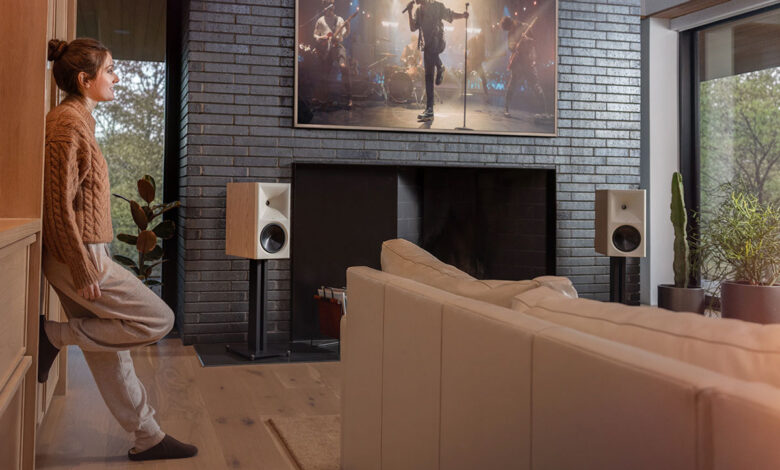
- Klipsch The Nines II are the largest model in the active speaker family first shown at CES 2026, pairing eight-inch Jet Cerametallic mid/bass drivers with a stated 31 Hz lower frequency limit. They also add features absent from the smaller members of the range, notably DTS:X, DTS Virtual:X and balanced XLR/TRS inputs, while retaining Dirac Live, comprehensive streaming, HDMI 2.1 and the choice of wired or wireless links between the two loudspeakers.
Some active speaker simplify a HiFi system by removing the external amplifier. Klipsch The Nines II pursue a rather more ambitious version of that idea: they are equipped to receive a turntable, computer, network stream, television, games console and even a balanced studio or HiFi source without placing another control centre between the music and the loudspeaker.

Premium Audio Company LLC. has given the flagship of the new Klipsch active range the physical scale to match that role. Each cabinet stands just over 46 cm high and contains an eight-inch mid/bass driver, while the electronics developed with Onkyo deal with spatial audio, video pass-through and network playback. The proposition is therefore not merely a larger edition of The Fives II or The Sevens II. It is the point at which the family begins to look like a genuinely comprehensive two-speaker system for music and home cinema.



Key Facts Klipsch The Nines II
- Active two-way bass-reflex system with an 8-inch Jet Cerametallic mid/bass driver and a vented 25 mm titanium LTS tweeter in a Tractrix horn per loudspeaker
- Frequency response from 31 Hz to 25 kHz at ±3 dB; maximum sound pressure level of 107 dB for the stereo pair at a distance of one metre
- Onkyo electronics with Dolby Atmos, DTS:X and DTS Virtual:X
- Dirac Live with a restricted licence and supplied measurement microphone
- Balanced XLR/TRS inputs, plus phono and line inputs on RCA
- HDMI 2.1 input and output with ARC/eARC, CEC, 8K pass-through and 4K at 120 Hz
- Google Cast, Apple AirPlay 2, Spotify Connect, TIDAL Connect and Qobuz Connect
- Dual-band WiFi, Ethernet and Bluetooth 5.4 with SBC and AAC
- Wireless connection between the loudspeaker at 48 kHz or wired operation at up to 24 Bit 96 kHz
- Optical and coaxial digital inputs, USB-C Audio, USB-A and an RCA subwoofer output
- Real-wood veneer in Walnut, Ebony and Red Oak
More Than the Largest Driver in the Range
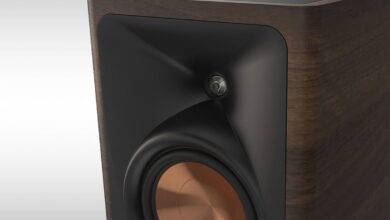
The eight-inch Jet Cerametallic mid/bass driver is the most obvious reason why The Nines II occupy the top position in this family. It works with a vented 25 mm titanium LTS tweeter loaded by a Tractrix horn, and the two-way enclosure uses a rear-facing bass-reflex port. Klipsch specifies a frequency response of 31 Hz to 25 kHz within ±3 dB and a maximum sound pressure level of 107 dB for the pair at one metre.
The lower figure is particularly significant. A claimed 31 Hz gives the speakers enough extension on paper to cover much of the musical bass range without automatically calling for a subwoofer. An Cinch output nevertheless remains available for owners who want additional low-frequency energy, especially with film soundtracks.
Both drivers are mounted in a single-piece BMC baffle. Its density and stiffness are intended to suppress unwanted resonance, according to Klipsch, while the rounded contours are designed to improve dispersion away from the central listening axis. That combination matters in a system likely to serve a sofa rather than a single tightly defined seat.


The Family Resemblance Stops at Several Important Details
Klipsch introduced The Fives II, The Sevens II and The Nines II together at CES 2026. All three combine active stereo loudspeakers with network streaming and extensive television connectivity, but their differences reach beyond cabinet dimensions and driver diameter.
The Fives II use 5,25-inch mid/bass drivers and establish the common platform around Onkyo electronics, Dolby Atmos and HDMI 2.1. The Sevens II move to 6,5-inch drivers, add Dirac Live and allow the audio link between the cabinets to operate wirelessly. The Nines II retain those facilities, enlarge the drivers to eight inches and introduce DTS:X, DTS Virtual:X and balanced analogue inputs.
This progression gives prospective owners a clearer basis for choosing between the models. The flagship is not simply intended for someone who wants more cabinet and more bass; it is also the version prepared for balanced source equipment and the broader selection of supported spatial-audio formats.
Balanced Inputs Open the Door to a Different Kind of System
Two combination sockets on the primary loudspeaker accept XLR or TRS connectors for the left and right channels. A compatible preamplifier, DAC or audio interface can therefore feed the speakers through a balanced analogue connection. This is a notable addition in an active range otherwise shaped mainly around domestic sources, and it makes The Nines II relevant to a music-production workspace as well as a living-room installation.
Conventional HiFi equipment has not been displaced. A separate line input on Cinch sits beside a phono input with its own phono preamplifier, allowing a suitable turntable to connect directly. Optical and coaxial digital inputs can accommodate components such as a CD player, USB-C Audio provides the route from a computer, and USB-A supports playback from storage media.
The breadth of this input panel is central to the product’s identity. The Nines II can begin as an autonomous streaming system, take over an existing collection of source components or sit downstream of a balanced front end without requiring the owner to abandon one route in favour of another.
Spatial Audio includes DTS:X as well as Dolby Atmos
Klipsch and Onkyo base the internal electronics on an architecture derived from AV-receiver technology. In The Nines II, that platform processes Dolby Atmos and DTS:X, while DTS Virtual:X supplies virtual surround and height effects. Music, Movie and Direct modes, dialogue enhancement and a 5-band equaliser provide additional choices for different material and listening situations.
The physical arrangement remains a pair of forward-radiating stereo loudspeakers. There are no upward-firing drive units and no rear speakers, so Dolby Atmos height information and the virtual effects are created by signal processing rather than separate channels placed around the room. Their effectiveness will consequently depend on room conditions and listening position, and the result should not be confused with a discrete multichannel installation.
That distinction does not diminish the purpose of the feature. It defines it accurately: The Nines II accept current immersive sound formats while preserving the installation discipline of a two-speaker system.
HDMI 2.1 Makes the Speakers Part of the Video Chain
The HDMI implementation goes beyond receiving television sound through eARC. One HDMI input connects a video source directly to the loudspeakers, and the HDMI output passes its picture onwards to the television. ARC or eARC carries audio in the opposite direction, while CEC allows the TV remote to control loudspeaker volume during everyday viewing.
Klipsch specifies 8K pass-through and 4K at 120 Hz, together with HDR10+, Dolby Vision and the BT.2020 colour space. VRR, ALLM and QFT address variable refresh rates, automatic low-latency operation and faster frame transport. Those facilities are especially relevant to a current games console, where audio integration should not become a bottleneck for the video signal.
This gives the HDMI section a structural role in the system rather than treating it as an isolated convenience socket. A television and one external video source can use The Nines II as their audio centre, while the picture continues to the display with the listed gaming and HDR functions intact.


Dirac Live Addresses the Room, Within the Supplied Licence
A loudspeaker reaching down to a claimed 31 Hz inevitably interacts with the room. Klipsch therefore includes a measurement microphone and Dirac Live, with setup handled through the Klipsch Connect Plus App. Measurements taken in the listening area are used to create a correction intended to reduce response irregularities caused by the room.
The package includes a restricted Dirac Live licence; the German source does not identify an unrestricted full-range licence as part of the purchase. That boundary deserves to remain visible, particularly because the name Dirac Live alone does not describe the extent of correction supplied with every product.
Electronic correction is also an addition to sensible positioning rather than a reason to ignore it. The rear bass-reflex ports, the cabinet dimensions and the considerable low-frequency reach all make physical placement an important part of installing The Nines II before the measurement process begins.
Streaming Covers the Services Most Listeners Already Use
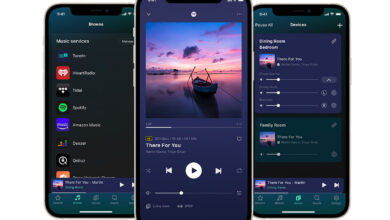
Spotify Connect, TIDAL Connect and Qobuz Connect allow listeners to select music within the respective service apps and hand playback to the loudspeakers. Google Cast and Apple AirPlay 2 provide broader platform-based routes. The network connection can be made through dual-band WiFi at 2,4 GHz or 5 GHz, or by 10/100 Mbit/s Ethernet.
Bluetooth 5.4 offers a direct wireless alternative and supports the SBC and AAC codecs. It is useful for an occasional source or a guest’s device, while the integrated network platform is the more permanent route for the supported streaming services.
Source selection and sound settings are available in the Klipsch Connect Plus App. A physical control and button on the loudspeaker, an illuminated remote control and HDMI CEC ensure that basic operation does not depend on reaching for a phone every time.
Wireless Between the Cabinets, Hi-res by Cable
The two loudspeakers can exchange audio wirelessly at 48 kHz, removing the need for a signal cable to cross the room. Both cabinets still require mains power, so this option concerns only their audio connection. It nevertheless provides useful freedom when furniture or room layout makes a visible inter-speaker cable undesirable.
The supplied four-metre CAT6 cable raises the supported connection to 24 Bit 96 kHz. Its dedicated Speaker Link sockets are separate from the Ethernet connection used for the home network. Owners are therefore choosing between simpler placement with the wireless link and the higher available resolution of the wired connection.
That decision is refreshingly explicit. Wireless operation is not presented as technically identical to the cable, and the cable is included rather than left as a later purchase.


Substantial Cabinets in Three Real-Wood Finishes
Each loudspeaker measures 244,5 mm wide, 460,38 mm high and 374,65 mm deep. The primary cabinet weighs 14,9 kg, while the secondary unit is listed at 14,43 kg in the German data sheet. These are substantial enclosures, so a supporting surface must provide both the necessary footprint and sufficient load capacity. Klipsch names the optional KS-24 as the matching loudspeaker stand.
The MDF cabinets are offered with real-wood veneer in Walnut, Ebony or Red Oak. Red Oak combines the lighter timber with a white baffle and removable light-grey grilles, creating a visibly brighter alternative to the two darker versions without changing the shape or acoustic configuration.
The Most Important Advantages at a Glance
- Bass extension suited to a self-contained music system: The specified 31 Hz lower limit reduces the automatic need for a separate subwoofer.
- Balanced source equipment connects directly: XLR/TRS inputs accommodate a compatible preamplifier, DAC or audio interface.
- Broader spatial-audio support: Dolby Atmos, DTS:X and DTS Virtual:X allow the pair to process a wider range of immersive material.
- Correction for the actual listening room: Dirac Live and the supplied microphone address room-related response irregularities within the included licence.
- Streaming remains inside familiar apps: Spotify Connect, TIDAL Connect and Qobuz Connect work without a separate network player.
- The link between the speakers can suit the room: Wireless operation reduces visible cabling, while the supplied cable supports up to 24 Bit 96 kHz.
- Television and a video source share one audio centre: HDMI eARC, a dedicated HDMI input and comprehensive video pass-through cover film and gaming.
- Established sources remain part of the system: Phono, line, optical, coaxial and USB connections accommodate equipment from several generations.
Price & Availability
Klipsch The Nines II are available now at a price of € 2.499,- per pair. Buyers can choose Walnut, Ebony or Red Oak real-wood veneer. Their arrival also completes the active speaker family first presented at CES 2026, with Klipsch The Fives II and Klipsch The Sevens II likewise available.
Conclusion
Klipsch The Nines II justify their flagship position through decisions that alter how the system can be used, not merely through a larger cabinet. The 31 Hz specification gives the pair credible independence from a subwoofer for music, balanced inputs extend the choice of front ends, and support for DTS:X adds another practical distinction from the smaller models.
There is a physical price for that scope: cabinets more than 46 cm high and nearly 37,5 cm deep need deliberate placement. For listeners able to provide the space, however, The Nines II bring an unusually broad collection of HiFi, streaming and video duties into two enclosures. Their strongest argument is not minimalism for its own sake, but the absence of obvious functional compromise when reducing an ambitious system to a stereo pair.
| Product | Klipsch The Nines II |
|---|---|
| Price | € 2.499,- |
Technical Specifications
| Product | Klipsch The Nines II |
|---|---|
| Product type | Active stereo loudspeaker pair |
| Acoustic design | Two-way bass-reflex system with rear-firing port |
| Drivers per loudspeaker | 8-inch Jet Cerametallic mid/bass driver; vented 25 mm titanium LTS tweeter in a Tractrix horn |
| Frequency response | 31 Hz to 25 kHz, ±3 dB |
| Maximum sound pressure level | 107 dB for the stereo pair at a distance of 1 m, manufacturer specification |
| Amplifier power | Not stated in the manufacturer documents examined for the German source article |
| Signal processing | Electronics platform with Onkyo technology |
| Spatial audio | Dolby Atmos with virtual height channels, DTS:X, DTS Virtual:X |
| Room correction | Dirac Live, restricted licence; measurement microphone supplied |
| Sound functions | Music, Movie and Direct modes; dialogue enhancement; 5-band equaliser |
| Connection between loudspeakers | Wireless at 48 kHz or wired at up to 24 Bit 96 kHz |
| HDMI | HDMI 2.1 input and output; ARC/eARC, CEC, HDCP 2.3 |
| Video pass-through | 8K, 4K at 120 Hz, HDR10+, Dolby Vision, BT.2020, VRR, ALLM, QFT |
| Analogue inputs | Balanced stereo pair through XLR/TRS combination sockets; phono on Cinch; line on Cinch |
| Further digital connections | Optical and coaxial digital inputs, USB-C Audio, USB-A |
| Further connections | Measurement microphone input, Cinch subwoofer output, Speaker Link |
| Network | WiFi 802.11ac, 2,4/5 GHz, 2 × 2 MIMO; Ethernet 10/100 Mbit/s |
| Streaming | Google Cast, Apple AirPlay 2, Spotify Connect, TIDAL Connect, Qobuz Connect |
| Bluetooth | Version 5.4, A2DP, SBC and AAC |
| Operation | Control and button on the loudspeaker, illuminated remote control, Klipsch Connect Plus App, HDMI CEC |
| Cabinet | MDF with real-wood veneer; single-piece BMC baffle |
| Finishes | Walnut, Ebony, Red Oak |
| Dimensions per loudspeaker | 244,5 × 460,38 × 374,65 mm (W × H × D) |
| Weight | Primary loudspeaker 14,9 kg; secondary loudspeaker 14,43 kg, according to the German data sheet |
| Supplied accessories | Loudspeaker pair, two mains cables, remote control with batteries, measurement microphone, HDMI cable, 4 m CAT6 inter-speaker cable |
| Optional accessory | Klipsch KS-24 loudspeaker stands |
| Brand | Klipsch |
|---|---|
| Manufacturer | Premium Audio Company LLC. |
| Distribution Austria | Audio Tuning Vertriebs GmbH |
| Distribution Germany | Premium Audio Company Germany GmbH |
| Distribution Switzerland | novis electronics AG |
| More about this manufacturer at HiFi BLOG |