

Luxman B-100 CENTENNIAL – Reference Mono Power Amplifier with Class A up to 25 Watts and 1.000 Watts Peak Output
The Luxman B-100 CENTENNIAL is no nostalgic exercise marking 100 years of Luxman Corporation. It is a new reference mono power amplifier built around current delivery, low output impedance and firm electrical control of demanding loudspeakers. Each amplifier weighs 61,5 kg, operates in Class A up to 25 watts into 8 ohms and can briefly supply as much as 1.000 watts into 1 ohm.


- A 1.250 VA transformer, 160.000 µF of reservoir capacitance and sixteen parallel amplifier sections reveal where Luxman Corporation has concentrated its efforts with the Luxman B-100 CENTENNIAL.
The Luxman B-100 CENTENNIAL does not look back sentimentally over a century of company history. Luxman Corporation has instead used its anniversary to develop a new reference mono power amplifier for the Luxman CENTENNIAL Series, with current delivery, low output impedance and the controlled operation of difficult loudspeaker loads defining the engineering brief. The headline figures show the extent of that approach: each amplifier weighs 61,5 kg, remains in Class A up to 25 watts into 8 ohms and can deliver a short-term maximum of 1.000 watts into 1 ohm.

Key Facts Luxman B-100 CENTENNIAL
- Product: Reference mono power amplifier from the Luxman CENTENNIAL Series
- Amplifier technology: LIFES 1.1 with 4×4 output configuration
- Operating mode: Class A up to 25 watts into 8 ohms, Class A/B above this level
- Output: 125 watts into 8 ohms, 250 watts into 4 ohms and a short-term maximum of 1.000 watts into 1 ohm
- Power supply: 1.250 VA EI-core transformer and 160.000 µF reservoir capacitance
- Connections: Cinch, XLR, two loudspeaker terminal groups for bi-wiring, trigger input and output
- Dimensions and weight: 440 × 243 × 651 mm, 61,5 kg
- Price: € 52.990,- per pair
Four output modules, each with four parallel amplifier paths
Luxman describes the topology of the B-100 CENTENNIAL as a 4×4 output configuration. Four output modules are used, each comprising four parallel three-stage Darlington push-pull amplifier paths. Spreading the load across this large number of parallel output transistors is intended to increase both current delivery and the linearity of the output stage.



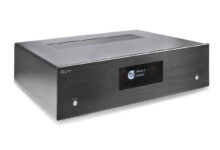

With its bias current set accordingly, the mono power amplifier operates in Class A up to an output of 25 watts into 8 ohms. Once more power is required, it changes to Class A/B operation. Rated output is 125 watts into 8 ohms and doubles to 250 watts into 4 ohms, while Luxman specifies a short-term maximum of 1.000 watts into 1 ohm.
This progression is particularly relevant when driving loudspeakers with widely varying impedance curves. Rather than concentrating on the highest possible figure into 8 ohms, Luxman has designed the amplifier specifically to provide substantial current into low-impedance loads.


LIFES 1.1 represents Luxman’s latest amplifier generation
The amplifier circuit is based on LIFES 1.1, or Luxman Integrated Feedback Engine System. Developed as the successor to the company’s long-established ODNF circuit, the concept first appeared in the Luxman M-10X in 2021.
LIFES compares the input and output signals and, according to Luxman, feeds back only the distortion components identified in this process. For version 1.1, the input stage of the differential error amplifier has been arranged in parallel. Luxman states that this further reduces distortion while limiting interference with the original music signal.
The quoted measurements are suitably ambitious. Luxman specifies total harmonic distortion of no more than 0.0014 per cent at 1 kHz into 8 ohms and no more than 0.04 per cent between 20 Hz and 20 kHz. The signal-to-noise ratio is rated at 119 dB to IHF-A.


160.000 µF for sudden power demands
At the centre of the power supply is a purpose-designed 1.250 VA EI-core transformer. Its flat copper windings are intended to reduce losses and provide close magnetic coupling. The transformer is shielded and mechanically isolated from the chassis by damping material, occupying the left-hand section of the enclosure.
It is joined by sixteen custom-made reservoir capacitors, each rated at 10.000 µF, giving a total capacitance of 160.000 µF. The capacitors are divided into two vertically arranged banks of eight and connected to the power supply by lines kept both short and equal in length.
This provision is not simply a consequence of the amplifier’s rated output. Fast transients and low loudspeaker impedances require a power supply capable of delivering energy without a significant drop in voltage.
A damping factor exceeding 1.000
Luxman has also worked to minimise impedance between the output stage and the loudspeaker terminals. Newly developed output wiring, generously dimensioned coils and six parallel loudspeaker relays with a total of twelve contact points are intended to reduce transition losses. Busbars provide the direct connection to the loudspeaker terminals.
Luxman quotes a damping factor of 1.000 at 1 kHz and 2.300 at 50 Hz, measured using the EIAJ current injection method. These figures leave little doubt about the priority given to the electrical control of connected loudspeakers.
Gold-plated tracks without a protective coating
Luxman uses what it calls Peel-Coat circuit boards throughout the audio circuitry. The 100 µm-thick gold-plated copper tracks are left without the conventional protective coating, avoiding the effects that Luxman attributes to its dielectric properties.
The tracks also follow rounded paths. Sharp 90-degree corners are avoided to reduce unwanted inductive effects, particularly at high frequencies. For the internal input connections, Luxman is using cables made from high-purity 7N Class D.U.C.C. copper for the first time.


61,5 kg supported by a multi-layer chassis base
The mechanical structure follows Luxman’s Loopless Chassis concept. It is designed to avoid closed ground loops within the enclosure and the resulting electrical interference.
Two bonded steel plates measuring 2.3 and 3.2 mm form the base. Together, they provide a 5,5 mm-thick foundation for the transformer, capacitor bank and amplifier modules. Specially shaped cast-iron feet are intended to isolate the amplifier from external vibration while allowing internally generated vibration to dissipate.
The enclosure measures 440 mm wide, 243 mm high and 651 mm deep, including the rear connections. At 61,5 kg per mono power amplifier, both placement and supporting furniture will need to be planned accordingly.
Large analogue meter and Centennial emblem
The front panel adopts the three-dimensional design language of the Luxman CENTENNIAL Series. A 15 mm-thick front plate with bevelled sides is paired with a 5 mm-thick aluminium top cover featuring extensive ventilation apertures.
A large analogue meter occupies the centre of the front panel, its design recalling the earlier Luxman B-10. White LEDs provide warm-looking illumination, while a chrome-plated Centennial emblem beside the Luxman logo identifies the amplifier as an anniversary model.
Cinch, XLR and bi-wiring terminals
A proprietary Luxman RCA socket handles the unbalanced input, while the balanced connection is provided by a Neutrik XLR socket. Input sensitivity is 1.12 V for 125 watts into 8 ohms, with input impedance specified at 51 kOhms via RCA and 55 kOhms via XLR.
Two pairs of generously sized loudspeaker terminals allow direct bi-wiring. They accept bare cable, banana plugs and suitable spade connectors. Trigger input and output connections permit coordinated switching with compatible components. Luxman also includes the JPA-17000 mains cable developed specifically for the B-100 CENTENNIAL.
The most important advantages at a glance
- Substantial current delivery: Up to 1.000 watts into 1 ohm is available briefly for demanding loudspeaker loads.
- Class A at moderate output levels: The first 25 watts into 8 ohms are delivered entirely in Class A.
- Dedicated mono construction: Each loudspeaker is driven by its own amplifier and power supply.
- Low output impedance: Busbars and parallel relays support close electrical control of the loudspeaker.
- Large energy reserves: A total reservoir capacitance of 160.000 µF stabilises the supply during sudden dynamic demands.
- Flexible connection options: RCA and XLR inputs are provided, with direct support for bi-wiring.
- Mechanical stability: The substantial chassis base and cast-iron feet reduce unwanted vibration.
- System integration: Trigger connections allow compatible components to be switched together.
Price & Availability
The Luxman B-100 CENTENNIAL is scheduled to become available through authorised Luxman retailers from September 2026. The recommended retail price is € 52.990,- per pair.
Getting to the point
Luxman could have defined an anniversary amplifier with little more than a commemorative emblem and an exceptionally substantial enclosure. With the B-100 CENTENNIAL, however, the decisive work lies where it has direct technical relevance: in the 4×4 output stage, the low-impedance signal path and a power supply designed not to reach its limits prematurely when faced with difficult loudspeaker loads. At € 52.990,- per pair, it plainly belongs to the highest price category, but its construction and output figures make Luxman Corporation’s claim to a new reference position within its amplifier range entirely clear.
| Product | Luxman B-100 CENTENNIAL |
|---|---|
| Price | € 52.990,- per pair |
Technical Specifications
| Product | Luxman B-100 CENTENNIAL |
|---|---|
| Type | Mono power amplifier |
| Amplifier circuit | LIFES 1.1 |
| Output configuration | Four modules, each with four parallel three-stage Darlington push-pull amplifier paths |
| Operating mode | Class A up to 25 watts into 8 ohms, Class A/B above this level |
| Rated output | 125 watts into 8 ohms, 250 watts into 4 ohms |
| Maximum output | 1.000 watts into 1 ohm, short-term |
| Input sensitivity | 1,12 V for 125 watts into 8 ohms |
| Gain | 29 dB |
| Input impedance | RCA: 51 kOhms; XLR: 55 kOhms |
| Frequency response | 20 Hz to 20 kHz: +0/-0.1 dB; 1 Hz to 180 kHz: +0/-3 dB |
| Total harmonic distortion | Maximum 0.0014 per cent at 1 kHz into 8 ohms; maximum 0.04 per cent from 20 Hz to 20 kHz into 8 ohms |
| Signal-to-noise ratio | 119 dB, IHF-A |
| Damping factor | 1.000 at 1 kHz; 2.300 at 50 Hz |
| Mains transformer | 1.250 VA EI-core transformer |
| Reservoir capacitance | 16 × 10.000 µF, 160.000 µF in total |
| Analogue inputs | 1 × RCA, 1 × XLR |
| Loudspeaker terminals | Two terminal groups for bi-wiring |
| Control connections | Trigger input and output |
| Dimensions | 440 × 243 × 651 mm |
| Weight | 61,5 kg |
| Supplied accessories | Luxman JPA-17000 mains cable |
| Brand | Luxman Corporation |
|---|---|
| Manufacturer | Luxman Corporation |
| Distribution | IAD GmbH |
| More about this manufacturer at HiFi BLOG |