

Wharfedale Heritage Centre – The Missing Voice of the Heritage Series
Some loudspeaker families are not meant to be expanded carelessly, and Wharfedale’s Heritage Series is one of them. Its appeal lies not merely in styling, but in a very particular sense of tonal ease, warmth and long-term listenability. The Wharfedale Heritage Centre arrives as a deliberate answer to that problem, giving owners of Wharfedale Linton, Wharfedale Super Linton and Wharfedale Denton a matching centre speaker intended to preserve the line’s identity in 3.1 and 5.1 systems.


- The Wharfedale Heritage Centre is not a generic centre speaker in a retro cabinet, but a targeted addition for one of the most characterful loudspeaker families in the current market. Its significance lies in system integration: it is meant to carry dialogue, music and on-screen action through the middle without breaking the tonal spell of the main speakers.
There are loudspeaker families one can expand almost at will. Then there are those that live by a rather more delicate balance. The Wharfedale Linton, Wharfedale Super Linton and Wharfedale Denton, all part of the Wharfedale Heritage Series, belong firmly in the latter category. Their appeal has never rested on spectacle for its own sake, but on a very particular mixture of warmth, composure and visual permanence. These are loudspeakers with a settled manner, and that makes any move into multi-channel territory more demanding than it first appears.

That is precisely why the Wharfedale Heritage Centre is a noteworthy arrival. Wharfedale is not merely adding another box to the catalogue. It is introducing a component that has to do something rather more subtle: carry the tonal identity of the series into the middle of the screen, where dialogue, presence and spatial coherence so often stand or fall.



Key Facts
- Centre speaker developed specifically for the Wharfedale Heritage Series
- Voiced for models such as Wharfedale Linton, Super Linton and Denton
- Three-way concept with a dedicated midrange section
- Designed for clear speech reproduction and a cohesive front soundstage
- Cabinet styling in keeping with the Heritage Series, with classic fabric grille
- Available in Walnut, Mahogany and Black Oak
- Market launch from May 2026
- Recommended retail price: € 799,-
The missing piece in a proper Heritage home cinema system
For many owners of these loudspeakers, the need has been obvious for some time. In stereo, the Wharfedale Heritage Series has little to prove. But the moment one begins to think beyond two-channel listening, whether for film sound, concert films or simply more accomplished television sound, the question of the centre channel becomes unavoidable. And it is here that many otherwise promising systems begin to unravel. If dialogue sits apart from the rest of the presentation, if voices seem pasted into the middle rather than naturally anchored there, the illusion breaks rather quickly.
The Wharfedale Heritage Centre is clearly intended to prevent exactly that. It is not being presented as a universal solution for any home cinema system. Its purpose is narrower and, for that reason, more compelling. Owners of Wharfedale Linton, Wharfedale Super Linton or Wharfedale Denton who wish to build a 3.1 or 5.1 system are being offered a centre speaker designed to continue the voice of those loudspeakers, not fight against it. In practical terms, that matters enormously. It means speech, music and effects stand a far better chance of sounding cut from the same cloth across the entire front stage.


A three-way design where it counts
Wharfedale has opted for a three-way configuration, and that is more than a line on a specification sheet. In a centre speaker, the midband does the heavy lifting. This is where the intelligibility of speech lives, where the shape and density of a human voice are defined, and where the system’s ability to lock dialogue to the screen is most severely tested. A dedicated midrange section therefore suggests a very deliberate engineering decision rather than a cosmetic one.
That midrange unit is partnered by two bass drivers and a soft dome tweeter. In principle, such an arrangement should allow the centre channel to behave with greater composure under real-world demands, keeping dialogue clearly placed and tonally believable without sharpening it into something thin or insistent. That distinction is important. Plenty of centre speakers impress in a showroom by pushing voices forward with exaggerated presence. Far fewer remain convincing over an entire evening’s viewing.
For film, live performance recordings and premium television alike, the centre channel carries a disproportionate share of what actually matters. If voices are not resolved cleanly, or if they sound detached from the left and right channels, even an otherwise capable system can feel oddly disjointed. The Wharfedale Heritage Centre is evidently designed to avoid that outcome and instead create a front stage that behaves as one continuous acoustic event.
Voicing over theatrics
Construction alone, however, is never the full story. The success of a centre speaker depends just as much on how it has been voiced. Wharfedale describes the Heritage Centre as aiming for speech that is clear, intelligible and natural, without tipping into hardness or obvious emphasis. Sensible on paper, certainly, but also exactly the right ambition for a loudspeaker intended to sit alongside models known for long-term listenability rather than instant fireworks.
That is likely to resonate with existing Heritage owners. The Wharfedale Heritage Series has earned its reputation not by sounding demonstrative, but by sounding assured. Its strengths lie in tonal substance, ease and a kind of calm musical confidence that does not need to advertise itself every few seconds. A centre speaker that adopts that same attitude is far more valuable in practice than one that chases sheer vocal spotlighting. Good home cinema is not built on etched dialogue alone. It depends on continuity, on tonal agreement, on the sense that the middle channel belongs exactly where it is.


Cabinet design in keeping with the series
Wharfedale has also kept faith with the broader design language of the range. The cabinet uses different wood materials, internal bracing and damping materials intended to control resonance. There is also a rear-firing bass reflex system. None of that is unusual in isolation, but the combination points to the sort of controlled, full-bodied presentation a centre speaker ought to deliver if it is to sound substantial without becoming overblown.
That balance is crucial in domestic use. A centre speaker must have enough authority to support the image, yet it should never dominate the soundstage or call undue attention to itself. Its job is not to perform as a soloist. Its job is to hold the centre with quiet conviction. When done properly, the benefit extends well beyond dialogue-heavy films. Concert recordings gain in solidity, television productions in intelligibility, and multi-channel music in coherence. The loudspeaker disappears not because it does little, but because it does exactly what is required.
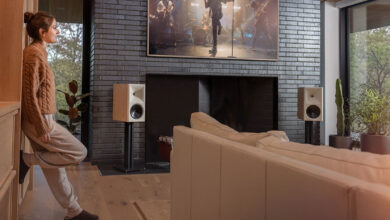
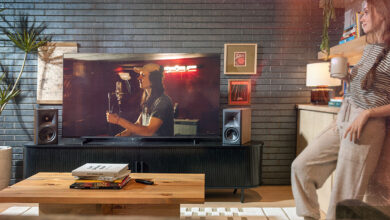
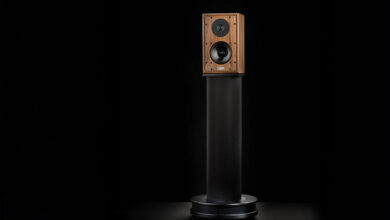
Visually, the Wharfedale Heritage Centre remains very much part of the family. It is offered in Walnut, Mahogany and Black Oak, each with a black baffle and matching fabric grille. That matters more than aesthetics alone might suggest. Buyers drawn to the Wharfedale Heritage Series tend to value systems as complete objects, chosen not only for sound but for how persuasively they live in a room. In that respect, the new centre speaker looks less like an accessory and more like a proper continuation of the series.
Sized sensibly for real systems
At 550 x 250 x 300 mm, the Wharfedale Heritage Centre appears to have been proportioned with a degree of realism. Centre speakers are often forced into awkward compromises. Make them too compact and they lose weight, scale and tonal authority. Make them too large and they become difficult to place, visually intrusive and impractical for furniture-based installations. Wharfedale seems to have aimed for the sensible middle ground here: enough cabinet volume to give the centre channel proper substance, without making it disproportionately dominant beneath a display.
That will matter to the very people most likely to buy it. Existing owners of Wharfedale Linton, Wharfedale Super Linton and Wharfedale Denton are unlikely to be looking for a showpiece centre speaker with an aggressively cinematic personality. They are more likely to want something that integrates gracefully into an already considered system. On that front, the dimensions suggest a product designed with real rooms and real ownership in mind.
Price and availability
The Wharfedale Heritage Centre is expected to reach authorised dealers from May 2026. Recommended retail price is € 799,-. That places it in a range that feels serious, but still entirely plausible as a targeted upgrade for existing Wharfedale Heritage Series owners. And that, in many ways, is the point. The appeal here is not that one can add just any centre speaker to a Heritage-based system. It is that one can add the right one.
Conclusion
With the Wharfedale Heritage Centre, Wharfedale has done something more intelligent than simply filling a gap in the line-up. It has addressed a very specific need within one of its most characterful loudspeaker families, and it has done so in a way that appears consistent with the values that made the series attractive in the first place. This is not a centre speaker that seems determined to shout for attention. Its promise is subtler, and arguably more valuable: to close the front stage, stabilise it and preserve the essential character of Wharfedale Linton, Wharfedale Super Linton and Wharfedale Denton when a system moves beyond stereo. For anyone building a more complete Heritage-based home cinema system, that is the real story.
| Product | Wharfedale Super Linton |
|---|---|
| Price | € 799,- |
Technical data
| Product | Wharfedale Heritage Centre |
|---|---|
| Characterisation | Centre speaker for the Wharfedale Heritage Series; designed for tonally coherent multichannel extensions with a focus on natural voices, a cohesive front image and visual consistency within the series |
| Product type | Centre speaker |
| Series | Wharfedale Heritage Series |
| Application | 3.1 and 5.1 systems, home cinema, TV sound, concert recordings, multichannel music |
| Design | Three-way construction; intended to provide a cleaner division of the frequency range and to reproduce voices more clearly, more stably and more naturally in the centre |
| Driver configuration | dedicated midrange section, two woofers, high-frequency dome; this configuration is intended to support speech intelligibility, tonal balance and coherent transitions to the front loudspeakers |
| Cabinet concept | cabinet made of different wood-based materials with internal bracing and damping materials; intended to reduce resonance and support a calmer, more controlled presentation |
| Bass reflex system | rear-firing bass reflex system; intended to provide more body and foundation without making reproduction unnecessarily thick |
| Tuning | tuned to Wharfedale Linton, Wharfedale Super Linton and Wharfedale Denton; important for a homogeneous front soundstage without an audible break in the sonic image |
| Finishes | Walnut, Mahogany, Black Oak |
| Front design | black baffle with matching cloth grille |
| Dimensions | 550 x 250 x 300 mm |
| Brand | Wharfedale |
|---|---|
| Manufacturer | IAG Group Ltd. |
| Distribution | IAD GmbH |
| More about this manufacturer at HiFi BLOG |