

Arcam A50 Signature Dual-Mono Class G Integrated Amplifier – New HiFi flagship for Arcam’s 50th anniversary
Arcam has chosen its 50th anniversary not for a nostalgic reissue, but for a new integrated amplifier with genuine flagship intent. The Arcam A50 Signature Dual-Mono Class G Integrated Amplifier combines the brand’s long-standing Class G expertise with a fully dual-mono architecture, extensive digital connectivity and a proper MM/MC phono stage. Presented by Harman Luxury Audio Group at HIGH END Vienna 2026, it is designed to sit at the centre of a serious modern HiFi system.


- The Arcam A50 Signature is not a decorative anniversary piece, but a technical statement for the Arcam Radia Series. Its significance lies in the way it brings together dual-mono Class G amplification, analogue credibility, digital convenience and contemporary wireless standards in one integrated amplifier.
The long-established English brand Arcam celebrates its 50th anniversary with an integrated amplifier that is not conceived as a backward glance, but as a technical statement for the present day. The new Arcam A50 Signature Dual-Mono Class G Integrated Amplifier was presented by Harman Luxury Audio Group at HIGH END Vienna 2026 and will take its place at the top of the Arcam Radia Series. According to the manufacturer, it was developed in collaboration with Arcam co-founder John Dawson, whose signature appears on the rear panel and on the circuit boards inside the unit. The new amplifier is intended to connect Arcam’s long amplifier tradition with the way many listeners build systems today – from vinyl and CD to HDMI eARC, USB-C Audio, Bluetooth with Snapdragon Sound and Auracast. The Arcam CD25 Compact Disc Player, presented at the same time, completes the system idea, although this report is centred firmly on the A50 Signature as the anniversary model and new HiFi flagship.

Key Facts Arcam A50 Signature
- New flagship of the Arcam Radia Series for the brand’s 50th anniversary
- First integrated Arcam amplifier with a fully dual-mono Class G architecture
- 2 × 150 Watt into 8 Ohm and 2 × 220 Watt into 4 Ohm, according to the manufacturer
- ESS ES9039Q2M DAC with USB-C Audio, HDMI eARC/ARC and S/PDIF
- Integrated Class A MM/MC phono stage for vinyl playback
- Bluetooth 5.4 with aptX, aptX HD, aptX Lossless, LE Audio and Auracast
- Available from the third quarter of 2026 at a price of € 2.799,-
Arcam A50 Signature – amplifier heritage without a retro gesture
Arcam is one of those British HiFi brands whose story is inseparable from amplification. The company was founded in 1976 as A&R Cambridge, later shortened to Arcam, yet the “A” for Amplification remained central to the identity of the brand. For its 50th anniversary, Arcam is not revisiting that history with a retro-styled component, but with an integrated amplifier designed to answer contemporary system demands.




That makes the Arcam A50 Signature less of a commemorative object than a clear statement of position. It sets out to show what a serious integrated amplifier can be today: powerful enough for more demanding loudspeakers, carefully organised internally, open to analogue and digital sources, and flexible enough to bring TV sound, streaming bridges, computers, headphones and turntables into one coherent HiFi system.
The fact that Arcam developed the A50 Signature together with co-founder John Dawson gives the model symbolic force. More important, however, is the engineering beneath that signature. According to the manufacturer, the aim was not to revive earlier amplifier concepts, but to translate Arcam’s amplifier philosophy into a modern platform.


Dual-Mono Class G – the core of the new Arcam A50 Signature
At the centre of the Arcam A50 Signature is what the manufacturer describes as the first fully dual-mono Class G architecture in an integrated amplifier from the brand. Each channel is executed as its own amplifier section, with its own circuit board, output stage, separate Class G lifter stages, individual voltage regulation and dedicated transformer windings.
This strict separation is intended to minimise crosstalk and improve channel separation. The internal layout follows the same logic: the power supply is positioned centrally, while the analogue signal path, digital circuitry and power sections are physically separated from one another. Even the rear panel reflects the concept, with the loudspeaker terminals positioned at opposite ends of the chassis.
Class G has been a defining part of Arcam amplifier engineering for many years. The principle combines high efficiency with the ambition of particularly clean operation at low and medium output levels, while still providing additional reserves when greater power is required. In the A50 Signature, this platform is presented by the manufacturer as its most comprehensive implementation to date.
Arcam specifies continuous output at 2 × 150 Watt into 8 Ohm from 20 Hz to 20 kHz at 0,5 percent THD. Into 4 Ohm, the figure is stated as 2 × 220 Watt at 1 kHz. That places the A50 Signature clearly above the territory of conventional mid-class integrated amplifiers and positions it as a serious control centre for loudspeakers that ask for stronger amplification.
A digital and analogue hub for modern HiFi systems
The Arcam A50 Signature is not designed as a purist analogue amplifier, but as the central switching and amplification point of a present-day HiFi system. On the analogue side, it offers three Cinch inputs and one balanced XLR input pair. These are joined by an integrated Class A MM/MC phono stage, allowing the amplifier to work directly with turntables fitted with Moving Magnet or Moving Coil cartridges.
The digital side is similarly extensive. The A50 Signature provides HDMI eARC/ARC for integrating a television, USB-C Audio for computers or suitable mobile sources, plus S/PDIF optical and S/PDIF coaxial. Digital-to-analogue conversion is handled by an ESS ES9039Q2M DAC which, according to the manufacturer, operates in a fully differential configuration and is supported by an ESS reference voltage regulator.
Via USB-C, the amplifier handles digital signals up to 32 Bit and 384 kHz. The other digital inputs support up to 24 Bit and 192 kHz, or 32 Bit, 24 Bit and 16 Bit depending on source and signal format. In practical terms, the A50 Signature covers both conventional digital HiFi sources and high-resolution playback from a computer.


Bluetooth 5.4, Qualcomm Snapdragon Sound and Auracast
Wireless playback on the Arcam A50 Signature is not treated as a casual add-on. Instead, Harman Luxury Audio Group uses current standards based on a chipset from specialist Qualcomm Inc. The amplifier supports Bluetooth 5.4 with A2DP Sink/Source, AVRCP, BLE, SBC, AAC, aptX, aptX HD and aptX Lossless. Bluetooth LE Audio and Auracast are also included, preparing the A50 Signature for newer Bluetooth use cases.
It is also notable that the amplifier supports both wired and wireless headphones, according to the manufacturer. The headphone output delivers a maximum of 2,5 V RMS into 32 Ohm or 5 V RMS into 300 Ohm, and is specified for loads from 16 Ohm to 2 kOhm. That should make the A50 Signature useful not only as the heart of a loudspeaker system, but also for more discreet listening sessions.
The system logic of the Arcam Radia Series
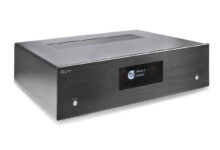
Visually, the A50 Signature follows the language of the Arcam Radia Series, with a dark glass front, clean lines, yellow accents and a relatively low chassis. Measuring 431 mm wide, 344 mm deep including loudspeaker terminals and 99 mm high including feet, it remains domestically manageable despite its powerful amplifier section. Weight is specified at 12 kg.
Together with the Arcam CD25 Compact Disc Player, also presented at HIGH END Vienna 2026, the A50 Signature forms the fourth phase of the Radia platform. According to the manufacturer, Arcam does not see the series as a loose collection of individual components, but as a coordinated system concept. In combination with the CD25, but also with streaming sources, television and turntable, the A50 Signature is intended to take the role of the central HiFi component.
All benefits at a glance
- Powerful integrated amplifier for more demanding loudspeakers
- Dual-mono layout for cleaner channel separation and reduced mutual interference
- Class G amplifier technology with strong reserves and efficient operation
- HDMI eARC/ARC for high-quality TV sound through the HiFi system
- USB-C Audio for high-resolution digital playback
- Integrated ESS DAC as the central digital section
- Class A MM/MC phono stage for flexible vinyl integration
- Balanced XLR input for high-quality analogue sources
- Bluetooth 5.4 with aptX Lossless, LE Audio and Auracast
- Support for both wired and wireless headphone use
Price and availability
The Arcam A50 Signature Dual-Mono Class G Integrated Amplifier celebrated its world premiere at HIGH END Vienna 2026. According to Harman Luxury Audio Group, market launch is planned for the third quarter of 2026 through authorised Arcam specialist retailers. The recommended retail price is stated at € 2.799,-. The Arcam CD25 Compact Disc Player, introduced at the same event, complements the Radia Series as the matching CD player and is covered separately.
Conclusion
The Arcam A50 Signature is exactly the sort of anniversary product that suits a brand with Arcam’s history: not a retro quotation, not a styling exercise, but a clearly positioned integrated amplifier with real technical substance. Its fully dual-mono Class G architecture gives it a distinct standing within the Arcam Radia Series, while HDMI eARC, USB-C Audio, the integrated phono stage and modern Bluetooth show that Arcam is not treating the classic integrated amplifier as a museum category. For many serious HiFi systems, the A50 Signature could become a particularly convincing centrepiece – powerful, versatile and unmistakably rooted in British amplifier thinking.
| Produkt | Arcam CD25 Compact Disc Player |
|---|---|
| Price | € 1.599,- |
Technical Data Arcam A50 Signature
| Product | Arcam A50 Signature |
|---|---|
| Characterisation | Dual-Mono Class G integrated amplifier |
| Amplifier principle | Class G, fully dual-mono architecture |
| Continuous output into 8 Ohm | 2 × 150 Watt, 20 Hz to 20 kHz, 0,5 percent THD |
| Continuous output into 4 Ohm | 2 × 220 Watt, 1 kHz |
| Harmonic distortion | 0,002 percent at 80 percent power, 8 Ohm, 1 kHz |
| D/A converter | ESS ES9039Q2M |
| Analogue inputs | 3 × Cinch, 1 × balanced XLR |
| Phono stage | Class A for MM and MC |
| Phono MM input impedance | 47 kOhm + 100 pF |
| Digital inputs | HDMI eARC/ARC, USB-C Audio, S/PDIF optical, S/PDIF coaxial |
| USB-C Audio | Up to 32 Bit and 384 kHz |
| Other digital inputs | Up to 24 Bit and 192 kHz |
| Supported bit depths | 32 Bit, 24 Bit and 16 Bit |
| Bluetooth | Bluetooth 5.4, A2DP Sink/Source, AVRCP, BLE |
| Bluetooth codecs and functions | SBC, AAC, aptX, aptX HD, aptX Lossless, LE Audio, Auracast |
| Headphone output | 2,5 V RMS into 32 Ohm, 5 V RMS into 300 Ohm |
| Headphone load range | 16 Ohm to 2 kOhm |
| Control connections | RS232, Trigger input, Trigger output, USB service |
| Maximum power consumption | 700 Watt |
| Standby power consumption | Less than 0,5 Watt |
| Dimensions | 431 × 344 × 99 mm |
| Weight | 12 kg |
| Supplied accessories | Power cable, remote control with 2 × AAA batteries, Quick Start Guide, safety instructions |
| Brand | Arcam |
|---|---|
| Manufacturer | Harman International Industries Ltd. |
| Distribution Austria | R.M.S. State of the Art Audio Products |
| Distribution Germany | Harman International Industries Ltd. |
| Distribution Switzerland | Harman International Industries Ltd. |
| More about this manufacturer at HiFi BLOG |