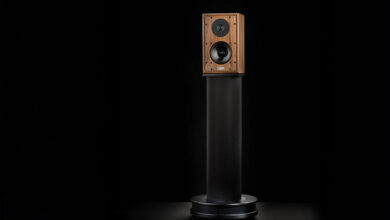


50 years of Arcam – Harman Luxury Audio Group celebrates British HiFi history at HIGH END Vienna 2026
Arcam’s 50th anniversary at HIGH END Vienna 2026 was not treated as a simple exercise in nostalgia. Harman Luxury Audio Group used the occasion to frame the brand’s story as one of continuity: from the Arcam A60 and early CD engineering to Class G amplification, streaming and the current Radia Series. With the Arcam A50 Signature Dual-Mono Class G Integrated Amplifier unveiled for the anniversary, and co-developed with co-founder John Dawson, the message was clear: Arcam is still building forward from its own foundations.


- Arcam’s story has always been less about spectacle than about engineering discipline, musical judgement and products that make sense in real systems. Its 50th anniversary at HIGH END Vienna 2026 showed why that approach still carries weight.
Arcam’s 50th anniversary at HIGH END Vienna 2026 was never presented by Harman Luxury Audio Group as a sentimental look back at a famous British HiFi name. It was framed more confidently than that: as the story of a Cambridge-born manufacturer that has carried its engineering instincts from the Arcam A60 through CD replay, digital conversion, Home Cinema, Class G amplification and today’s Radia Series without losing its central discipline. The unveiling of the Arcam A50 Signature Dual-Mono Class G Integrated Amplifier for the anniversary, co-developed with co-founder John Dawson, gave that story a timely product focus rather than a merely ceremonial one. Arcam has always been at its strongest when it refuses to separate serious engineering from musical usefulness, and that was precisely the point being made in Vienna. Fifty years on, the brand’s history still reads less like a museum piece than an active set of design principles.

Key Facts
- 50 years of Arcam as a central anniversary for Harman Luxury Audio Group at HIGH END Vienna 2026
- British HiFi brand with Cambridge origins and a long-standing focus on musically voiced electronics
- Arcam A60 as the amplifier that established the brand’s reputation and shaped its identity
- Early expertise in CD players, external DACs, DAB, streaming and audiophile AV electronics
- Class G amplifier technology as a defining engineering thread through the brand’s more recent history
- Arcam A50 Signature Dual-Mono Class G Integrated Amplifier introduced as the new anniversary flagship, developed with co-founder John Dawson
- HIGH END Vienna 2026 as a stage for the brand’s past, present and future
Cambridge as the starting point – the A60 and the beginning of a brand
The Arcam story begins in Cambridge in 1976, originally under the name Amplification and Recording Cambridge. John Dawson and Chris Evans, both shaped by music, electronics and the atmosphere surrounding the Cambridge University Tape Recording Society, were not designing for an abstract marketplace. They were working from a clear and rather personal conviction: a good amplifier should not flatter music into something spectacular, but reproduce it with credibility, cleanliness and life.


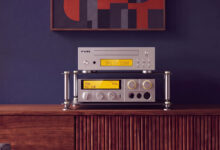

That idea became the Arcam A60. Initially built in modest numbers for friends and audio enthusiasts, it soon grew into one of the best-known British integrated amplifiers of its period. According to the company’s own history, more than 30,000 units were sold, and many are said to remain in use today. That figure is not merely an attractive anniversary statistic. It explains something essential about Arcam’s early role: the brand brought serious engineering and musical intent into a price class that allowed ambitious music lovers to enter proper HiFi without feeling excluded by it.
The Arcam T21 tuner followed as a natural partner to the A60, and even at that early stage one could see that Arcam was not interested only in isolated products. The thinking was more coherent than that. It was about matched electronics, dependable systems and equipment that could live in ordinary rooms while still being taken seriously by people who listened closely. That attitude would remain one of the company’s most recognisable strengths.
Digital technology as an extension, not a rupture
When the Compact Disc began to reshape the market in the 1980s, Arcam was among the British manufacturers that did not treat digital audio as a simple declaration of the future. In 1986, according to the company’s history, Arcam introduced the first CD player fully developed and manufactured in the United Kingdom. What mattered was not only the early commitment to the new medium, but the way Arcam approached it.
For Arcam, CD replay was never merely a matter of data retrieval or convenience. It was an audiophile discipline. Clocking, power supply, transport mechanics, digital-to-analogue conversion and the analogue output stage all had to work as one if music was to sound coherent rather than clinical. Two years later, that line of thought led to the Arcam Black Box, an external digital-to-analogue converter that became one of the important milestones in the brand’s history.
Arcam therefore made an early case for the idea that digital sources and traditional HiFi values were not opposing forces. While many manufacturers initially presented digital mainly as a functional leap, Arcam worked on preserving the musical subtleties of the signal across the entire chain. That experience would later inform not only CD players, but also DVD and Blu-ray players, streaming products and AV components.
Home Cinema with a HiFi conscience
From the mid-1990s onwards, Arcam extended its approach into Home Cinema with unusual consistency. The Arcam Xeta 1, introduced in 1995, marked an important step because it did not treat surround sound as a separate universe sitting beside stereo. The idea was rather different: multichannel replay should be engineered to serve film sound convincingly, while still retaining the musical instincts of a HiFi company.
For Arcam, this was a decisive point. The brand developed DVD players and later Blu-ray players in the United Kingdom, drawing on decades of CD engineering to handle picture and sound formats not only with functional competence, but with sonic ambition. In the AV field, that gave Arcam a profile clearly distinct from many products driven mainly by feature count.
Later AV receivers and processors followed the same logic. Dolby Atmos, Dirac Room Correction, modern HDMI architectures, 8K support, HDR10+, Dolby Vision, DTS and AURO-3D were not treated simply as boxes to be ticked. In Arcam’s hands, they became tools for more precise, more controlled and more musically convincing reproduction in the living room. Even in Home Cinema, Arcam wanted its HiFi roots to remain audible.


Class G as an engineering thread
One of the most important technical strands in more recent Arcam history is Class G. The amplifier technology was introduced in 2009 with the Arcam AVR600 and later carried into stereo components, including the Arcam A49, which arrived in 2014 as the brand’s first Class G stereo integrated amplifier. The principle suited Arcam’s character well: high power with very low distortion, but without reducing amplifier design to a numbers game.
For Arcam, Class G represents an engineering solution intended to combine efficiency, dynamic headroom and sonic control. In simplified terms, the circuit operates for much of the time from a lower supply voltage, switching to higher voltage rails only when the signal demands greater reserves. The benefit is a combination of clean operation at normal listening levels and more authoritative power delivery when music or film sound suddenly requires it.
That John Dawson has again played a central role in the new Arcam A50 Signature Dual-Mono Class G Integrated Amplifier is therefore more than an attractive anniversary detail. It connects current product development directly with the founder’s perspective from which Arcam emerged. The Arcam A50 Signature Dual-Mono Class G Integrated Amplifier was presented at HIGH END Vienna 2026 as the new HiFi flagship for the brand’s 50th birthday; a full examination of that model naturally belongs in a dedicated product article. What matters here is that Arcam has not used the anniversary simply to produce an object of remembrance. It has used it to continue an amplifier lineage that has been central to the brand for decades.
From DAB tuner to streaming – Arcam between source and system
Alongside amplifiers and disc players, Arcam has repeatedly made its mark wherever listening habits have changed. In 1999, according to the company’s history, the Alpha 10 became the world’s first DAB tuner for home use. In 2005, Arcam introduced the Solo Music, a compact, performance-led lifestyle system with integrated DAB that demonstrated how convenience and serious sound need not be natural enemies.
The rBlink Bluetooth DAC followed in 2012, bringing wireless replay into more traditional HiFi environments at a comparatively early stage. In 2017, the rSeries was expanded further to help integrate digital sources into existing systems at a higher quality level. Then, in 2019, the Arcam SA30 marked another significant step: an intelligent stereo integrated amplifier with Dirac Live, streaming functionality, Google Cast, Apple AirPlay 2, MQA support and Roon Endpoint capability.
These milestones show that Arcam did not ignore the changing nature of sources. The brand moved from FM and DAB through CD, DVD and Blu-ray to Bluetooth streaming and networked, multiroom-capable system architectures. The constant was the attempt not merely to play new formats, but to integrate them into systems that still made musical sense.
Arcam Radia Series – a new visual language, a familiar attitude
With the Radia Series in 2023, Arcam made a clear and visible shift in design and brand presentation. The new visual language felt fresher, more contemporary and more suited to modern living spaces than previous lines, yet it did not push the brand into generic lifestyle electronics. At the same time, the new brand message, “Be the Centre of the Music”, fitted the company’s history rather well.
The Radia Series was expanded over the following years. In 2024, the ST25, SA35 and SA45 added three powerful models to the range. In 2025, the Radia+ models A5+, A15+ and A25+ followed, with revised circuitry, refined components and improved power management. Arcam was therefore not treating the current family merely as a design refresh, but as a developing technical platform.
For Harman Luxury Audio Group, this matters because Arcam occupies a very specific role within a broader brand portfolio. It does not stand for demonstrative luxury. It stands for a distinctly British form of technical seriousness. Arcam’s appeal does not depend on grand gestures, but on the credibility of its solutions. That is precisely why the Vienna anniversary felt less like an obligatory birthday event and more like a plausible assessment of where the brand now stands.
John Dawson as a constant in the story
That John Dawson is visibly involved in product development again for Arcam’s 50th anniversary gives the occasion a particular charge. Many HiFi brands like to invoke their founding years, but relatively few can draw such a direct line between beginning and present. With Arcam, that line is not merely historical. It is technically tangible.
Dawson’s role in the further development of Class G amplifier technology shows that the brand is not simply retelling its origin story; it is continuing it through product work. That matters in a sector where retro styling and anniversary editions are often easier to announce than to justify technically. Arcam offers a different form of continuity: not the repetition of old products, but the development of an idea.
HIGH END Vienna 2026 provided a fitting stage for that. For Arcam, Vienna was not just an exhibition location, but also a symbol of transition: looking back with pride at what has been achieved, then turning back towards the future with clear intent. The quotation used in Arcam’s press communication for the Vienna presentation, alluding to Billy Joel’s “Vienna waits for you”, may have been intended with a wink, but it lands neatly enough. Arcam did not come to Vienna to put its past behind glass. It came to show that 50 years of brand history only matter if they lead to new products.
Conclusion
Fifty years of Arcam underline the value of technical continuity in an industry often tempted to define itself by the next standard, the next format or the next checklist feature. Arcam has rarely told its story through nostalgia alone. It has told it through products that respond to new formats, new listening habits and new domestic realities without losing sight of music as the point of the exercise. From the A60 to early CD players, external DACs, DAB, audiophile AV electronics, Class G, streaming and the Radia Series, there is a recognisable line running through the portfolio. That Harman Luxury Audio Group celebrated the anniversary at HIGH END Vienna 2026 with a new flagship amplifier and the involvement of John Dawson therefore does not feel like a ceremonial gesture. It feels more like a statement that Arcam regards its past not as a museum, but as an engineering obligation.
| Theme | 50 Jahre Arcam – British HiFi culture celebrates its birthday |
|---|---|
| Harman International Industries Ltd. |
| Brand | Arcam |
|---|---|
| Manufacturer | Harman International Industries Ltd. |
| Distribution Austria | R.M.S. State of the Art Audio Products |
| Distribution Germany | Harman International Industries Ltd. |
| Distribution Switzerland | Harman International Industries Ltd. |
| More about this manufacturer at HiFi BLOG |