

MUSE HiFi Muse 300 – Desktop DAC and headphone amplifier with ESS Technology ES9039 Ultra announced as a Kickstarter project
Desktop DACs have become increasingly capable, yet many still feel more like small technical boxes than fully developed desktop audio components. With the MUSE HiFi Muse 300, MUSE HiFi is taking a different route, combining an ESS Technology ES9039 Ultra DAC, headphone amplification, Bluetooth, a large 5 inch display and a dedicated operating system concept. The result is not yet a finished retail product, but it is already a rather interesting statement of intent.


- The MUSE HiFi Muse 300 is designed as more than a conventional DAC and headphone amplifier, placing display, operating system and desktop interaction at the centre of its concept. Key details are already known, though important specifications such as output power, supported audio formats, pricing and delivery remain open ahead of the Kickstarter launch.
MUSE HiFi is preparing a new desktop audio product with the MUSE HiFi Muse 300, which is due to launch shortly as a project on Kickstarter.com. The manufacturer describes it as the world’s first desktop DAC and headphone amplifier with its own operating system. Alongside the digital conversion stage based on an ESS Technology ES9039 Ultra DAC, MUSE HiFi is clearly placing particular emphasis on operation, visual feedback and desk-based integration. A large 5 inch display, three graphical user interfaces and an intuitive single-knob control concept are intended to set the MUSE HiFi Muse 300 apart from more conventional desktop DACs. At this stage, however, this remains an early announcement, with pricing, availability, output power and full details of supported audio formats still to be confirmed.

Key Facts
- Desktop DAC and headphone amplifier announced as a Kickstarter project
- According to MUSE HiFi, the world’s first desktop DAC/amp with its own operating system
- ESS Technology ES9039 Ultra DAC with HyperStream IV architecture
- Qualcomm QCC3095 specified as the Bluetooth chip
- Large 5 inch display as the main control and information interface
- Three UI themes: Cyberpunk, Minimalistic and ACG Style
- Designed for connection to PC and Mac
- S/PDIF coaxial, Cinch, XLR, 6,3 mm stereo jack and 4,4 mm Pentaconn
- Powered by an external 12 V power supply
- Desktop audio concept with its own operating layer
- A desktop DAC that wants to be operated, not merely installed
Desktop audio with its own control layer
With the MUSE HiFi Muse 300, MUSE HiFi is not simply announcing a routine refresh of an existing desktop component. The company is outlining a more integrated desktop audio concept in which DAC, headphone amplifier and graphical control surface are meant to work as one coherent device.

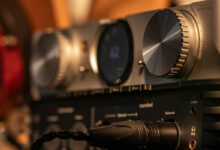
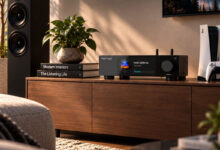
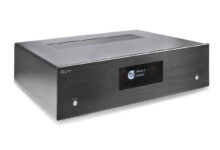

That distinction matters. Many compact desktop DACs still rely on small status displays, modest menu systems or functional rather than truly involving control logic. The MUSE HiFi Muse 300 takes a more interface-led approach. According to the manufacturer, its own operating system is intended to provide responsive operation, manage more complex processes and make interaction with the device more immediate.
How far that operating system extends in practice remains to be seen. It may be a control and display environment rather than a wider playback platform; equally, it could become the basis for additional convenience functions. For now, MUSE HiFi is speaking mainly about a fluid user interface, direct single-knob operation and new display options for desktop use.
ESS Technology ES9039 Ultra and Qualcomm QCC3095
MUSE HiFi has already disclosed several key elements of the technical platform. At the heart of the MUSE HiFi Muse 300 is an ESS Technology ES9039 Ultra DAC, based on the company’s HyperStream IV architecture. For wireless connectivity, the manufacturer specifies a Qualcomm QCC3095 Bluetooth chip, while system control is handled by a 32 bit Microcontroller Unit.
The analogue circuit also appears to be more clearly defined than a mere concept announcement would suggest. MUSE HiFi lists two Texas Instruments OPA1612 devices for the low-pass filter stage, two ESS ES9603Q devices for I/V conversion and a Texas Instruments NE5532A as an additional operational amplifier stage. Precise information on supported Linear PCM and DSD formats, as well as headphone output power, has not yet been provided.
Connectivity for the desk and the HiFi system
The MUSE HiFi Muse 300 is intended for use with PC and Mac, which places it firmly in the desktop audio category. In addition, S/PDIF coaxial is provided as a digital input, allowing external digital sources to be connected beyond the computer environment.
For integration into a conventional HiFi system, MUSE HiFi specifies both Cinch and XLR outputs. That means the MUSE HiFi Muse 300 should be able to serve both unbalanced and balanced analogue signal paths, depending on the rest of the system.
For headphones, the unit provides a 6,3 mm stereo jack and a 4,4 mm Pentaconn output. This gives it relevance for traditional full-size HiFi headphones as well as modern balanced headphone cabling in a desktop setup. Power is supplied via an external 12 V power supply.
5 inch display, three UI themes and single-knob control
The 5 inch display is one of the defining features of the MUSE HiFi Muse 300. According to MUSE HiFi, it is not intended merely to show basic status information, but to shape the way the device is used and perceived. The manufacturer also states that the display can be used as a second screen for a PC, although it has not yet provided more detailed information on how this function will be implemented.
The visual concept includes three graphical user interfaces. Cyberpunk adopts a neon-lit, technology-driven look; Minimalistic is designed around a cleaner and more restrained presentation; ACG Style uses brighter colours and anime-inspired elements. Users are expected to be able to switch between these themes, allowing the MUSE HiFi Muse 300 to be adapted visually to a workstation, living space or personal preference.
MUSE HiFi as a young audio brand
MUSE HiFi was founded in 2022 and positions itself as a research-driven company in the field of high-quality HiFi solutions. The brand refers to independent development, research and manufacturing, and aims to establish itself through product concepts that differ from the familiar mainstream pattern.
The MUSE HiFi Muse 300 fits that profile. It is not being presented merely as another DAC with a familiar feature set, but as a more software- and display-oriented desktop audio device. Whether that approach becomes genuinely useful will depend on execution, but the direction itself is certainly more distinctive than another small black box with a sampling-rate indicator.
All benefits at a glance
- Modern desktop audio concept combining DAC and headphone amplifier
- Own operating system as the central point of differentiation
- Large display for control, information and visual customisation
- Three UI themes for different setups and personal tastes
- Single-knob operation for direct control at the device
- ESS Technology ES9039 Ultra as a current DAC platform
- Bluetooth section based on Qualcomm QCC3095
- S/PDIF coaxial input for external digital sources
- Cinch and XLR outputs for integration into HiFi systems
- 6,3 mm stereo jack and 4,4 mm Pentaconn for headphone use
- External 12 V power supply
Price and Availability
The MUSE HiFi Muse 300 is expected to launch shortly as a project on Kickstarter.com. MUSE HiFi has not yet announced a specific campaign start date, Kickstarter supporter pricing, future retail pricing or delivery schedule. Regular availability through specialist retailers has also not been confirmed at this stage.
Conclusion
The MUSE HiFi Muse 300 is not yet a fully tangible production product, but an early announcement for a forthcoming Kickstarter project. Even so, the concept is notable because MUSE HiFi is not defining the desktop DAC solely through conversion technology and headphone amplification. Instead, the company is treating operating system, display, theme concept and control logic as central parts of the product.
With the ESS Technology ES9039 Ultra, Qualcomm QCC3095, S/PDIF coaxial, Cinch, XLR, 6,3 mm stereo jack and 4,4 mm Pentaconn, the technical basis already looks more concrete than a purely speculative concept. The crucial questions will be what MUSE HiFi reveals at campaign launch regarding output power, supported audio formats and the practical implementation of the operating system. The direction is interesting because desktop audio is increasingly shaped not only by sound quality, but also by usability, workstation integration and meaningful visual feedback.
| Product | MUSE HiFi Muse 300 |
|---|---|
| Price | N/A |
Technical Data
| Product | MUSE HiFi Muse 300 |
|---|---|
| Characterisation | Desktop DAC and headphone amplifier |
| DAC chip | ESS Technology ES9039 Ultra |
| DAC architecture | HyperStream IV |
| Bluetooth chip | Qualcomm QCC3095 |
| Main controller | 32 bit Microcontroller Unit |
| Low-pass filter | Texas Instruments OPA1612 × 2 |
| I/V conversion | ESS ES9603Q × 2 |
| Additional operational amplifier stage | Texas Instruments NE5532A |
| Operating concept | Own operating system according to the manufacturer |
| Control | Intuitive single-knob operation |
| Display | 5 inch display |
| UI themes | Cyberpunk, Minimalistic, ACG Style |
| Computer connection | PC and Mac |
| Digital input | S/PDIF coaxial |
| Analogue outputs | Cinch, XLR |
| Headphone outputs | 6,3 mm stereo jack, 4,4 mm Pentaconn |
| Power supply | External 12 V power supply |
| Additional function | Display intended to be usable as a second screen for a PC |