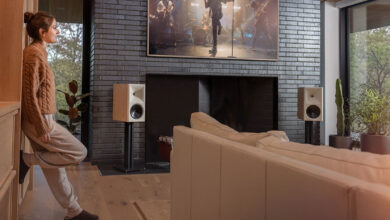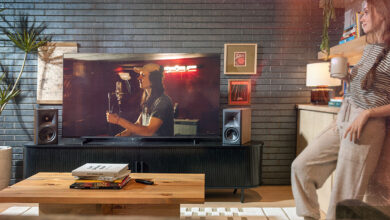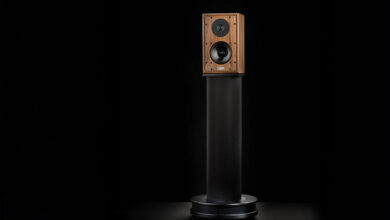


New firmware for CANVAS from CANVAS HiFi - Organic Master Tuning, new app and further refinements for sound, operation and room correction
The latest CANVAS firmware is not just another software refresh tucked away behind a version number. CANVAS HiFi is using it to reshape how the system sounds, how it is set up, and how naturally it fits into daily listening and TV use. With Organic Master Tuning, a fully redesigned app, improved room correction, and a series of smaller but telling operational refinements, CANVAS is being pushed towards a more mature and more complete real-world experience.


- CANVAS HiFi is treating software as a core part of system design rather than an afterthought. This new firmware does not simply add features, it tightens the relationship between sound, usability, room integration, and everyday practicality.
Modern audio systems are no longer judged by hardware alone. Drivers, amplification, cabinet engineering, and industrial design still matter, of course, but the lived quality of a product increasingly depends on software: how it behaves, how it is adjusted, how easily it integrates into the home, and how gracefully it responds to the small demands of everyday use. That is precisely where CANVAS HiFi has chosen to focus its attention with the latest firmware for CANVAS.

What makes this release noteworthy is not the headline count of new functions, but the consistency of its direction. CANVAS HiFi has not taken the easy route of adding a few superficial enhancements and declaring the job done. Instead, the company appears to have looked closely at the points where a technically ambitious product either becomes effortless in daily life or remains faintly unfinished. This firmware addresses voicing, app control, room correction, setup logic, switching behaviour, remote integration, and service handling in one broad move. That makes it less of a routine update and more of a meaningful second pass at product maturity.



Key Facts
- New firmware for CANVAS available now.
- New app with a completely redesigned user interface.
- Organic Master Tuning as an additional sound tuning alongside Neutral Master Tuning.
- Individual sound profiles for the three front grille variants.
- Loudness can now be switched on and off selectively.
- BACCH 3D Plus is intended to provide more spaciousness and better channel separation.
- Improved room correction with a choice of different room sizes.
- New Setup Guide for easier commissioning.
- Additional optimisations for input switching, remote control, Google Cast, and factory reset.
Organic Master Tuning adds a second sonic perspective
At the centre of the new release is Organic Master Tuning. With this, CANVAS HiFi is adding a second voicing alongside the existing neutral tuning, and that decision reveals quite a lot about how the company sees the role of the product. According to the manufacturer, Neutral Master Tuning remains the option intended for uncompromising accuracy under controlled conditions. Organic Master Tuning, by contrast, is said to take more account of real domestic spaces and the acoustic realities of everyday living environments.
That distinction matters. A system such as CANVAS is not used in a laboratory or a heavily treated control room. It is used beneath a television, in a living room, in an open-plan home, in spaces with reflective surfaces, furniture, compromises, and the sort of imperfect acoustics that define real listening far more often than ideal conditions ever do. In that context, Organic Master Tuning is not merely another listening preset. It signals a more grounded philosophy, one that accepts that domestic audio does not happen in theory but in rooms people actually inhabit.
For technically minded listeners, that makes this one of the most interesting aspects of the update. Rather than chasing effect for its own sake, CANVAS HiFi is addressing a more serious question: whether absolute neutrality is always the most convincing answer in a home environment, or whether a voicing shaped around real-world acoustics may, in many cases, produce the more coherent and satisfying result. The value here lies in the choice itself. CANVAS no longer asks the user to accept a single idea of correctness.


A redesigned app takes on a more central role
Alongside the firmware comes a new app, which CANVAS HiFi says has been developed from the ground up. That sounds like the kind of phrase companies reach for automatically, but in this case the change appears significant because the app is not a peripheral accessory. For a product that lives at the intersection of serious audio, streaming, television sound, and interior-friendly integration, software control is part of the ownership experience, not just an add-on.
The aim is said to be a clearer, more intuitive structure that is easier to navigate in everyday use. That may sound less glamorous than a new signal-processing feature, but it is often far more decisive in determining whether a system feels polished. Good sound may win attention; good control keeps frustration out of the room. On a product like CANVAS, which has to serve as both an audio component and a lifestyle-friendly media solution, usability has direct impact on perceived quality.
One of the most telling refinements is also one of the smallest. The app now remembers which device was connected last, eliminating the need to manually select the unit again after each restart. It is precisely this sort of detail that separates software written for demonstration from software written for ownership. The new app therefore looks less like cosmetic housekeeping and more like a deliberate attempt to make CANVAS feel more settled, more predictable, and simply easier to live with.
Fine-grain refinement: front grilles, loudness control, and BACCH 3D Plus
Another strength of the firmware is its willingness to deal with variables that many manufacturers tend to ignore or oversimplify. CANVAS HiFi now recognises that the three available front grille versions influence acoustic behaviour in different ways, and the new app therefore provides individual sound profiles for each one. That is a technically sensible move. If a product invites aesthetic choice, it should not pretend that those choices are acoustically irrelevant. The more sophisticated answer is to acknowledge the difference and compensate for it properly.
The same practical intelligence can be seen in the newly switchable loudness function. According to the manufacturer, disabling loudness can be especially useful with film sound and at lower listening levels, where speech intelligibility may improve. This is not a decorative feature. In real homes, many people do not listen at cinema levels, and the ability to adapt tonal behaviour to actual use cases has genuine value. It gives the owner a more precise way of tailoring performance instead of relying on a fixed assumption about how the system should behave.
CANVAS HiFi also introduces BACCH 3D Plus, described as an enhanced version of the established technology intended to improve channel separation and create a more expansive spatial presentation. That fits the wider strategy of the firmware rather well. The company is not only refining tonal balance; it is also working on perceived space, image construction, and the larger illusion of scale. In a product designed to combine living-room practicality with serious audio ambition, spatial believability is not a secondary concern.
Room correction and setup are being pushed towards real-life usability
Room correction is another area that has received close attention. CANVAS HiFi now adds three room-size categories that can be selected at the start of calibration. The stated aim is to make correction more efficient and better matched to the listening environment. That sounds modest, but it may prove highly relevant, because room correction systems only earn trust when they are understandable and when the process feels aligned with how people actually think about their spaces.
Too many calibration systems become intimidating the moment they leave the realm of marketing and enter the setup stage. By introducing a more legible structure, CANVAS HiFi appears to be making the process less abstract and more approachable. That matters because even sophisticated processing is of limited practical value if owners are discouraged from using it or unsure whether they are applying it correctly.
The new Setup Guide follows the same logic. Designed for all devices, it is intended to lead users through first-time installation step by step. For a product with responsibilities that span television integration, premium audio playback, networking, and software-based optimisation, that is a crucial part of the experience. The cleaner the initial setup, the more likely it is that the full capability of the system will actually be used rather than left dormant behind menus and assumptions.
Smarter behaviour in everyday TV and streaming use
Some of the most valuable work in this firmware may be found in the operational details. CANVAS HiFi has improved support for remote-control integration, allowing compatible remotes to access key functions directly. That is especially important in a living-room context. A system that is expected to function naturally within a television-based environment cannot behave like a precious specialist device that demands its own ritual every time it is used. Seamless control is part of the design brief.
Input switching has also been revised. According to the manufacturer, the system now reacts to a detected signal in roughly one second. That is a tangible improvement, particularly if CANVAS is used as a centre speaker in a Home Cinema system, where slow or awkward source switching quickly becomes irritating. The prioritisation of input selection has also been adjusted so that music streaming should remain possible even while the television is switched on. This is a good example of software shaped by actual user behaviour rather than theoretical feature mapping.
The handling of Google Cast is equally revealing. CANVAS HiFi has chosen to disable it by default. The explanation is technically plausible: if the system is constantly searching for Cast devices, network traffic and processor load remain elevated. Users who want Google Cast can still enable it, but it is no longer permanently active from the outset. That may not sound dramatic, but it suggests a more disciplined approach to resource management. Instead of leaving every possible feature running all the time, the company appears to be making deliberate choices about stability, efficiency, and overall system behaviour.
Roon Ready remains important, but this update has other priorities
CANVAS already forms part of a wider ecosystem that includes Roon Ready support and Hi-res Audio capability. That remains relevant for the platform as a whole, but it is not the centre of gravity here. This firmware is not about expanding the headline ecosystem story so much as refining the character and conduct of the product itself.
That distinction is worth making because it underlines the maturity of the release. CANVAS HiFi is not trying to redefine the platform through one large new badge. Instead, it is improving voicing, calibration, control, switching logic, and day-to-day fluency. Those are the areas that turn a capable product into one that feels genuinely sorted.
Service functions also become more sensible
The final layer of this update may be the least conspicuous, but it should not be underestimated. Factory reset can now be performed directly from standby, which should simplify service cases and reinstallation scenarios. Changes like this rarely lead the marketing conversation, yet they often determine whether a product is perceived as well engineered once real ownership begins.
That is perhaps the clearest reading of the entire firmware release. Its strength does not lie in spectacle. It lies in the accumulation of sensible corrections, better logic, and more careful behaviour. CANVAS HiFi appears to have looked beyond the obvious and concentrated on the small frictions that shape long-term satisfaction.
Conclusion
This new firmware for CANVAS from CANVAS HiFi is not a casual maintenance release. It is a substantial and carefully judged development step for a system that was already aiming higher than the ordinary soundbar category. Organic Master Tuning, the redesigned app, more flexible room correction, dedicated sound profiles for different front grille versions, and a long list of operational refinements all point in the same direction: greater maturity, greater coherence, and better real-world performance.
What makes the update persuasive is that it does not confuse novelty with progress. CANVAS HiFi is not simply adding more. It is improving what matters. And in a product built to succeed in actual homes rather than idealised listening rooms, that may be the most convincing form of software development there is.
| Product | CANVAS All-in-One System |
|---|---|
| Price | CANVAS 55″ from € 3.399,- CANVAS 65″ from € 3.499,- CANVAS 75″ from € 3.599,- CANVAS 77″ from € 3.649,- CANVAS 83″ from € 3.749,- CANVAS 85″ from € 3.759,- CANVAS Solo from € 2.990,- CANVAS Extra Front 55″ from € 150,- CANVAS Extra Front 65″ from € 180,- CANVAS Extra Front 75″ from € 200,- CANVAS Extra Front 77″ from € 210,- CANVAS Extra Front 83″ from € 445,- CANVAS Extra Front 85″ from € 455,- CANVAS Solo Extra Front from € 150,- |
| Brand | Canvas HiFi |
|---|---|
| Manufacturer | Canvas HiFi |
| Distribution | inveoo GmbH |
| More about this manufacturer at HiFi BLOG |