

McIntosh CS7500 AC – Streaming Preamplifier with Roon and HDMI ARC
Designed as the control centre of an ambitious stereo system, the McIntosh CS7500 AC brings together twelve analogue and digital inputs, current streaming platforms, Roon integration, a configurable MM/MC phono stage and flexible balanced and unbalanced outputs.

- McIntosh Laboratory Inc. is placing streaming at the heart of the preamplifier with the new McIntosh CS7500 AC 2-Channel Streaming Preamplifier. Apple AirPlay, Google Cast, Qobuz Connect, Spotify Connect, TIDAL Connect, Bluetooth and Roon sit alongside conventional analogue and digital sources rather than forming a separate digital annex. HDMI ARC, a 32 Bit Quad Balanced 8-channel DAC and several output options extend that central role from music playback to TV sound and systems with one or more subwoofers.
A modern stereo system may have fewer visible source components than its counterpart from twenty years ago, yet the demands placed on its preamplifier have hardly become simpler. Streaming services, local music libraries, a turntable, conventional digital players and increasingly the television all expect access to the same amplifier and loudspeakers. The component at the centre must therefore accommodate several generations of source technology without making the system feel fragmented.

This is precisely the role McIntosh Laboratory Inc. has defined for the McIntosh CS7500 AC. The company describes it as the McIntosh CS7500 AC 2-Channel Streaming Preamplifier, but that title only partly conveys its scope. It is a solid-state preamplifier, network player, D/A converter, configurable phono stage and TV-audio interface in one chassis, while preserving the freedom to select a separate power amplifier.

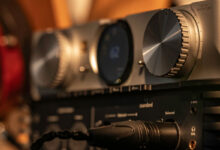
Key Facts McIntosh CS7500 AC 2-Channel Streaming Preamplifier
- Two-channel streaming preamplifier
- Quad Balanced 8-channel D/A converter architecture with 32 Bit processing
- Twelve analogue and digital audio inputs
- Apple AirPlay, Google Cast, Qobuz Connect, Spotify Connect and TIDAL Connect
- Qualcomm-based Bluetooth with aptX, aptX HD and aptX Adaptive
- Roon Ready and Roon Tested
- HDMI ARC for connecting a television
- Balanced and unbalanced outputs with subwoofer connection options
- Configurable phono stage for MM and MC cartridges
- Polished stainless steel and hairline-brushed black titanium stainless-steel chassis
- Recommended retail price of € 16.000,-
Streaming Belongs at the Centre
The McIntosh CS7500 AC does not treat network playback as an accessory attached to an otherwise conventional preamplifier. Streaming and traditional source control are given equal standing, allowing the component to serve as the permanent interface between the listener, the source material and the power amplifier.
McIntosh has also avoided making a proprietary control environment the only route to music. Apple AirPlay and Google Cast provide familiar paths from compatible mobile devices, while Qobuz Connect, Spotify Connect and TIDAL Connect allow playback to be selected from the respective service applications. Bluetooth covers occasions when an immediate wireless connection is more useful than a fully integrated network session.
That collection of established standards is important in everyday use. Instead of forcing the owner to approach every source through a single manufacturer-specific application, the McIntosh CS7500 AC accepts music through several recognised platforms. The preamplifier remains the system hub, but the listener can continue using the applications and services with which they are already familiar.


Roon for Local Libraries and Streaming Services
Roon support gives the McIntosh CS7500 AC a further role beyond direct access to individual streaming platforms. The model is specified as both Roon Ready and Roon Tested, signalling its suitability for systems in which locally stored music and online catalogues are organised within a common library.
This makes the CS7500 AC relevant to listeners whose collections cannot be reduced to one streaming subscription. Roon can bring files, services and extensive metadata together, while the McIntosh component handles playback as part of the wider stereo system. It is a different form of convenience from Qobuz Connect or TIDAL Connect, but one that becomes particularly valuable as a digital library grows.
Eight DAC Channels Serving a Stereo Signal
Digital conversion is based on a Quad Balanced 8-channel D/A converter architecture operating at up to 32 Bit. Rather than assigning the multi-channel converter to surround reproduction, McIntosh uses its available DAC sections for two-channel playback.
The arrangement follows a principle the company has already employed in other digital components: several converter sections contribute to the processing of each stereo channel. McIntosh therefore presents the DAC as a central part of the preamplifier architecture, not simply as circuitry required to make the streaming module produce an analogue signal.
The supported resolutions also reflect the breadth of the digital section. USB Audio accepts PCM up to 32 Bit 384 kHz, DSD256 and DXD at 384 kHz, while the coaxial S/PDIF and TOSLINK inputs support signals up to 24 Bit 192 kHz. Network streaming is specified at up to 24 Bit 192 kHz.
Twelve Inputs Without Neglecting Vinyl
A streaming preamplifier becomes considerably less convincing if its network capabilities are gained at the expense of conventional sources. McIntosh consequently equips the CS7500 AC with twelve analogue and digital audio inputs, allowing it to remain the switching centre of a more extensive HiFi system.
The analogue complement comprises two pairs of balanced XLR inputs, three pairs of RCA inputs and a dedicated phono input. The latter can be configured for either Moving Magnet or Moving Coil cartridges, with selectable gain settings of 40 dB, 46 dB, 52 dB, 58 dB or 64 dB. This provides scope for matching the phono stage to different cartridges rather than restricting vinyl playback to a single fixed configuration.
Digital sources can be connected through two coaxial S/PDIF inputs, two TOSLINK inputs, one MCT connection, USB Audio and HDMI ARC. Streaming is consequently only one part of the source selection. Disc players, computers, televisions and other digital components can all be incorporated without displacing the analogue side of the system.


HDMI ARC Turns the Television into a Stereo Source
The HDMI ARC input addresses a source that now occupies a central position in many listening rooms. A television may deliver films and series, but it also provides access to concert recordings, music applications and numerous streaming services. Routing its audio through the main stereo system can therefore be useful far beyond occasional home-cinema viewing.
With the McIntosh CS7500 AC, the television can use the same loudspeakers, power amplification and volume control as the music sources. This offers an alternative to installing a separate soundbar alongside an already substantial stereo system and allows the existing audio chain to perform both roles.
HDMI ARC does not turn the CS7500 AC into an A/V processor, nor is that its purpose. It gives a two-channel system direct access to television sound while leaving its basic architecture firmly focused on stereo reproduction.
A Preamplifier That Preserves Amplifier Choice
The output configuration reinforces the distinction between the McIntosh CS7500 AC and a streaming integrated amplifier. It provides two variable pairs of balanced XLR outputs, two variable pairs of unbalanced RCA outputs and one fixed RCA output. The second output pair can be assigned to subwoofer use.
Owners can therefore match the preamplifier with a power amplifier chosen for their loudspeakers, room and preferred system concept. Additional low-frequency support can also be incorporated without abandoning the main two-channel configuration.
This separation brings a practical long-term advantage. The power amplifier can be changed at a later stage without replacing the streaming platform, DAC and source-control section at the same time. Conversely, the CS7500 AC can become the new control centre of an existing system while the established power amplifier remains in place.
Familiar McIntosh Identity, Sharper Architecture
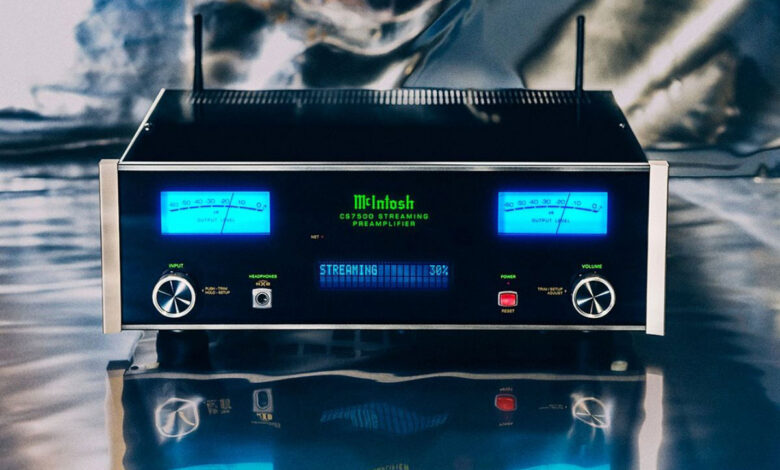
The McIntosh CS7500 AC remains immediately identifiable as a product from McIntosh Laboratory Inc. Its black front panel, blue-illuminated meters and green company illumination retain the visual language closely associated with the brand.
The chassis, however, gives that familiar appearance a somewhat more architectural treatment. McIntosh specifies polished stainless steel and hairline-brushed black titanium stainless steel, materials intended to support both the constructional and visual expectations attached to the product’s position in the upper High-end market.
At 44,45 cm wide, 15,2 cm high and 43,2 cm deep, the CS7500 AC is a substantial full-width component rather than a discreet network accessory. Its 11,3 kg weight further reflects the fact that McIntosh regards it as a complete preamplifier, not merely a streamer housed in a traditional-looking enclosure.
The Most Important Advantages at a Glance
- Streaming without a closed ecosystem: Apple AirPlay, Google Cast and the Connect functions of Qobuz, Spotify and TIDAL provide several familiar routes to music.
- Comprehensive Roon integration: Roon Ready and Roon Tested status suits systems combining local libraries with streaming services.
- Substantial digital conversion: The Quad Balanced 8-channel DAC architecture processes digital sources at resolutions up to 32 Bit 384 kHz via USB Audio.
- Broad source compatibility: Twelve analogue and digital inputs accommodate network playback, conventional source components, computers, vinyl and television sound.
- Flexible cartridge matching: The phono stage supports both MM and MC cartridges with five selectable gain settings.
- Direct TV connection: HDMI ARC routes television audio through the main stereo amplifier and loudspeakers.
- Freedom to select the power amplifier: The dedicated preamplifier format leaves the owner free to choose or later replace the power stage.
- Subwoofer-ready outputs: The second output pair can be used to integrate additional low-frequency support.
Price & Availability
According to Audio Components Vertriebs GmbH, the McIntosh CS7500 AC is available to order now. The recommended retail price is € 16.000,-.
Getting to the Point
The McIntosh CS7500 AC addresses a specific question with unusual clarity: if streaming has become a primary source, why should it remain an external addition to the preamplifier? McIntosh Laboratory Inc. places network playback, D/A conversion and platform connectivity directly inside the component that already manages volume, source selection and communication with the power amplifier.
This integration does not require the owner to surrender the flexibility of a separates-based system. Power amplification remains independently selectable, analogue sources retain a meaningful role, and the configurable phono stage prevents vinyl from becoming an afterthought. HDMI ARC also acknowledges that the television has joined the list of everyday audio sources in many stereo systems.
At € 16.000,-, the McIntosh CS7500 AC competes with formidable combinations of separate streamers, DACs and preamplifiers. Its case therefore rests on more than the number of functions it offers. The decisive attraction is the prospect of bringing those functions together in one carefully constructed, centrally operated McIntosh component while retaining freedom over the rest of the amplification chain.
| Product | McIntosh MX124 AC A/V Processor |
|---|---|
| Price | € 16.000,- |
Technical Specifications
| Product | McIntosh CS7500 AC 2-Channel Streaming Preamplifier |
|---|---|
| Characterisation | Two-channel streaming preamplifier with D/A converter and phono stage |
| Circuit design | Solid state |
| Total harmonic distortion | 0,005 % |
| Frequency response | 20 Hz to 20 kHz: +0 / −0,5 dB; 15 Hz to 100 kHz: +0 / −3 dB |
| Maximum output voltage | 16 V RMS balanced; 8 V RMS unbalanced |
| Signal-to-noise ratio | Line level: 100 dB; Phono MC: 80 dB; Phono MM: 82 dB |
| Phono | MM and MC; selectable gain of 40 dB, 46 dB, 52 dB, 58 dB or 64 dB |
| Analogue inputs | 2 × XLR, 3 × RCA, 1 × Phono MM/MC |
| Digital inputs | 2 × coaxial S/PDIF, 2 × TOSLINK, 1 × MCT, 1 × USB Audio, 1 × HDMI ARC |
| D/A converter | Quad Balanced 8-channel DAC, 32 Bit 384 kHz |
| USB Audio | PCM up to 32 Bit 384 kHz, DSD256, DXD 384 kHz |
| S/PDIF and TOSLINK | Up to 24 Bit 192 kHz |
| Network streaming | Up to 24 Bit 192 kHz |
| Streaming | Apple AirPlay, Google Cast, Qobuz Connect, Spotify Connect, TIDAL Connect |
| Roon | Roon Ready, Roon Tested |
| Bluetooth | AAC, Qualcomm aptX HD, Qualcomm aptX Adaptive |
| Outputs | 2 pairs of variable XLR outputs, 2 pairs of variable RCA outputs, 1 × fixed RCA output; second output pair can be used for subwoofers |
| Headphones | 6,3 mm headphone output with McIntosh Headphone Crossfeed Director HXD |
| Control | Bass and treble controls, Home Theater PassThru, RS232, IR, Power Control, Trigger |
| Power consumption | 30 W |
| Dimensions | 44,45 × 15,2 × 43,2 cm |
| Weight | 11,3 kg |
| Brand | McIntosh Laboratory Inc. |
|---|---|
| Manufacturer | McIntosh Laboratory Inc. |
| Distribution | Audio Components GmbH |
| More about this manufacturer at HiFi BLOG |