

Accuphase DG-78 Digital Voicing Equalizer – Smooth Voicing, 40-Bit DSP and 80-Band Equaliser for Targeted Sound Field Correction
The Accuphase DG-78 Digital Voicing Equalizer combines automatic room measurement, a 67-band voicing section, an 80-band graphic equaliser and a real-time spectrum analyser in a single component. A 40-bit floating-point DSP, parallel A/D and D/A converter arrays and a capacitive touchscreen with stylus form the technical core. We look at how the new Smooth Voicing method, the digital and analogue connectivity and the 30 memory slots fit together in practice.

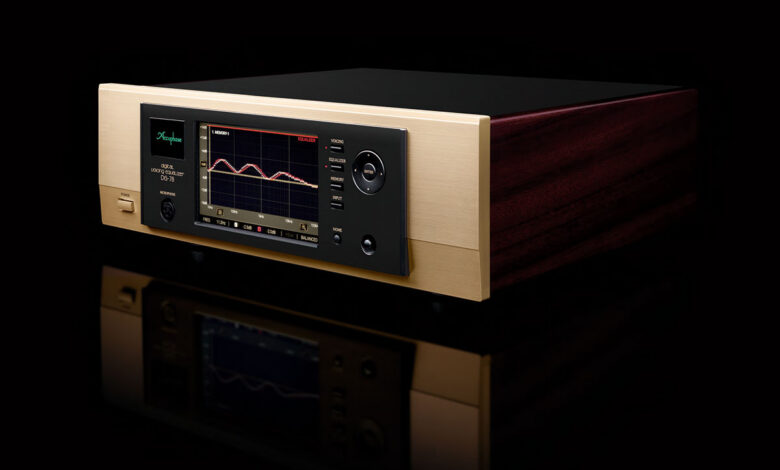
- The Accuphase DG-78 Digital Voicing Equalizer brings automatic room correction with the new Smooth Voicing method, an 80-band graphic equaliser and a 35-band real-time analyser together in one 15 kg component, driven by a 40-bit floating-point DSP and operated via a capacitive touchscreen with stylus. It can be inserted fully in the analogue domain via XLR or RCA/Cinch, or into an all-digital chain via HS-LINK Ver. 2, coaxial S/PDIF and TOSLINK, stores up to 30 named settings, and is available from specialist dealers at a recommended price of € 14.600,-.
Most room correction systems ask the listener to trust a black box. The Accuphase DG-78 Digital Voicing Equalizer takes the opposite view: it measures the room automatically, calculates a correction, and then hands the result back for inspection and adjustment. Accuphase Laboratory Inc. has followed this philosophy since the DG-28 of 1997, and the DG-78 is the sixth generation of the line. According to the company, the measurement routine has been revised, and so have the digital signal processing, the analogue-to-digital conversion, the user interface and the way settings are stored.

Key Facts Accuphase DG-78 Digital Voicing Equalizer
- Sixth-generation Digital Voicing Equalizer
- Smooth Voicing with automatic measurement and correction
- Voicing section with 67 frequency bands at 1/6-octave resolution
- Graphic equaliser with 80 bands, extending to 100 kHz
- Spectrum analyser with 35 bands, up to 50 kHz
- 40-bit floating-point DSP from Analog Devices
- 4MDS A/D converter with four AKM AK5578EN chips per channel
- 8MDS++ D/A converter with eight ESS ES9028PRO chips per channel
- ANCC in both the A/D and D/A stages
- Analogue inputs and outputs via RCA/Cinch and XLR
- Digital inputs and outputs via HS-LINK, coaxial S/PDIF and TOSLINK
- HS-LINK Ver. 2 with PCM up to 32 bit and 384 kHz, and DSD up to 5.6 MHz
- Capacitive IPS touch display, operated by finger or stylus
- 30 freely nameable memory slots
- USB-A port for backups and screenshots
- AM-68 measurement microphone and RC-340 remote control included
- Dimensions: 465 × 161 × 397 mm
- Weight: 15 kg
Where the DG-78 sits in the signal chain
Before any measurement, there is the question of where a device like this belongs in a system. Accuphase offers several answers. The DG-78 can be wired in fully analogue between preamplifier and power amplifier, using balanced XLR or unbalanced RCA/Cinch connections at both input and output. A tape or recorder loop works as well, as does the gap between the separately accessible preamplifier and power amplifier sections of an integrated amplifier.



For a purely digital chain, the unit offers HS-LINK Ver. 2, coaxial S/PDIF and TOSLINK, each as an input and an output. Over HS-LINK Ver. 2 it handles linear PCM up to 32 bit and 384 kHz as well as DSD up to 5.6 MHz. HS-LINK Ver. 1 remains available for backward compatibility. The newer version transmits audio data and master clock separately, which, according to Accuphase, removes the need for PLL-based clock recovery on the receiving side. The same HS-LINK cables work with both versions.
Multi-amplifier setups are also catered for. An analogue source can be digitised and corrected in the DG-78, then passed from a digital output to an electronic crossover, which divides the spectrum between separate power amplifiers.


How the measurement works
Accuphase defines a Digital Voicing Equalizer as a combination of sound field compensation and graphic equaliser. The voicing function establishes how loudspeakers and listening room respond together to a test signal, picked up by a measurement microphone. The equaliser then lets the user refine the result or deliberately shape a personal balance.
Two modes serve those purposes. Auto Voicing performs measurement and compensation largely on its own, in a guided sequence. Manual Voicing opens direct access to the individual correction points and shows the effect of each change on the display straight away. The test signal itself consists of four simultaneous sweep tones at different frequencies. They travel through the amplifier and loudspeakers into the room, where the supplied Accuphase AM-68 measurement microphone captures them. The manufacturer cites both a shorter measuring time and a more precise method for this generation.
Smooth Voicing and the problem of bass
The most significant functional addition is Smooth Voicing. It takes into account the characteristics of the loudspeakers and their behaviour in the particular room. The aim, as Accuphase describes it, is to narrow differences between the frequency responses of the left and right channels and produce a more even response curve.
The company places particular weight on low frequencies. Smooth Voicing is meant to make better use of the loudspeakers’ usable bass range without abandoning the channel-by-channel view of playback conditions. The routine runs in four steps: the user sets the measurement signal level, chooses a memory slot, starts the automatic analysis, and finally sees the corrected result on screen.
The voicing section works with 67 frequency bands in 1/6-octave steps, and the adjustment range is ±12 dB.
Voicing, equaliser and analyser as separate tools
The home screen gives immediate access to the three main functional areas. Voicing and equaliser each have a dedicated button on the front panel that switches the respective processing on and off independently. This makes it possible at any moment to compare the unprocessed signal, the room compensation alone, and room compensation plus additional equaliser correction.
The graphic equaliser offers 80 bands at 1/6-octave resolution and reaches up to 100 kHz, again with a range of ±12 dB. A target curve can be drawn directly on the display with the stylus or built up step by step with the cursor keys. Both approaches work during music playback, so changes can be judged and refined as they happen.
The analyser divides the spectrum into 35 bands at 1/3-octave resolution and analyses signals up to 50 kHz in real time. Its display can run alongside the equaliser or the voicing results. It shows which frequencies are actually present in the music, and also where an adjustment might be worthwhile.
Processing and conversion
Filter calculations are handled by an Analog Devices ADSP-21565 with native 40-bit floating-point processing. Digital inputs and previously digitised analogue sources are therefore processed entirely in the digital domain.
On the input side, Accuphase uses a 4MDS concept for A/D conversion: four AKM AK5578EN chips work in parallel for each channel, intended to lower noise and raise the precision of digitisation. According to the manufacturer, A-weighted residual noise at the analogue RCA/Cinch input has fallen from 5.6 µV in the Accuphase DG-68 to 4.6 µV.
The output stage uses an 8MDS++ architecture with eight ESS ES9028PRO chips per channel. Accuphase states that total harmonic distortion including noise is half that of its predecessor. Both the A/D and D/A circuits employ ANCC, short for Accuphase Noise and Distortion Canceling Circuit, which combines negative feedback with feed-forward compensation so that noise and distortion components generated by the amplifier stages cancel one another. The analogue output stage also uses a fifth-order Butterworth Direct Balanced Filter.
Display, stylus and memory
The large IPS LCD is a capacitive touch panel. Big buttons, a clearly organised menu structure and an on-screen keyboard are intended to make operation easy with a finger or with the supplied stylus. For precise input, additional cursor and Enter keys sit to the right of the display.
Up to 30 combinations of voicing data, equaliser curves and system settings can be stored, and each slot can be named individually. That allows different listening positions, loudspeaker placements or musical genres to be kept apart, as well as a strictly neutral setup alongside a deliberately tailored one.
Further system settings cover the sampling rate and gain of the analogue input, automatic or manual output-level matching, left-right balance, the HS-LINK version at the output and a switchable subsonic filter. Display brightness and the remote control can also be configured.
The USB-A port is explicitly not a USB audio interface. It accepts USB storage of up to 128 GB, onto which settings, memory contents and screenshots can be saved and from which they can be reloaded.
Build and design
The DG-78 follows Accuphase’s familiar front-panel design: champagne-coloured finish, black display area and clearly grouped controls. A solid top plate of brushed aluminium and side panels of naturally grained wood complete the construction.
The unit measures 465 mm wide, 161 mm high and 397 mm deep, and weighs 15 kg. Those figures suggest Accuphase regards the DG-78 as a full system component rather than a compact accessory.
The package includes the stylus, the Accuphase AM-68 measurement microphone with a five-metre cable and a microphone stand, the Accuphase RC-340 remote control, an Accuphase ASL-10B audio cable, a power cable and a cleaning cloth.
All benefits at a glance
- Guided room correction: Auto Voicing takes care of measurement and compensation in a single, step-by-step procedure.
- Hands-on tuning: Manual Voicing and the 80-band equaliser give broad access to the frequency response.
- Better bass handling: Smooth Voicing takes loudspeakers and room into account and is intended to even out the lower frequencies in particular.
- Drawing instead of dialling: Response curves can be sketched with the stylus straight onto the touch display.
- Instant comparison: Separate buttons switch voicing and equaliser on and off independently of each other.
- Fits analogue and digital systems: RCA/Cinch, XLR, coaxial S/PDIF, TOSLINK and HS-LINK allow a variety of integration options.
- Room for several setups: 30 nameable memory slots hold different measurements and equaliser settings.
- Backups without a computer: Settings and screenshots can be saved directly to a USB stick.
Price and availability
Accuphase Laboratory Inc. states that the new Accuphase DG-78 Digital Voicing Equalizer is arriving at specialist dealers now. The recommended retail price is € 14.600,-.
Conclusion
The Accuphase DG-78 Digital Voicing Equalizer remains an unusual proposition: it returns control over the tuning of an audio system to the owner in every respect. Automatic measurement, a freely drawable frequency response and real-time analysis sit side by side as equals, while the elaborate converter stages are meant, according to Accuphase, to allow analogue integration without pragmatic shortcuts. For demanding systems in which loudspeakers, room and personal taste are treated as one connected whole, the DG-78 from Accuphase Laboratory Inc. offers a notably comprehensive toolset.
| Product | Accuphase DG-78 Digital Voicing Equalizer |
|---|---|
| Price | € 14.600,- |
Technical Specifications
| Product | Accuphase DG-78 Digital Voicing Equalizer |
|---|---|
| Characterisation | Digital voicing equaliser combining room correction, graphic equaliser and spectrum analyser |
| Voicing | 67 frequency bands, 1/6 octave, IIR filters |
| Voicing adjustment range | ±12 dB |
| Equaliser | 80 frequency bands, 1/6 octave, IIR filters |
| Equaliser adjustment range | ±12 dB |
| Measurement signal | Sweep tones |
| Entering the frequency response curve | Directly via stylus or cursor keys |
| Spectrum analyser | 35 frequency bands, 1/3 octave, real-time analysis |
| Analyser level display | +18 dB to −90 dB, six ranges |
| Frequency response | 0.5 Hz to 50 kHz, +0 dB/−3 dB |
| Total harmonic distortion and noise | 0.0007 %, analogue input to analogue output, 20 Hz to 20 kHz |
| Gain | +12 dB to −90 dB, variable |
| DSP | Analog Devices ADSP-21565, 40-bit floating point |
| A/D converter | 4MDS, four AKM AK5578EN per channel |
| A/D resolution | 32 bit |
| A/D sampling rates | 44.1 kHz, 88.2 kHz, 176.4 kHz, 352.8 kHz |
| D/A converter | 8MDS++, eight ESS ES9028PRO per channel |
| D/A resolution | 32 bit |
| D/A sampling rates | 32 kHz to 384 kHz |
| Analogue inputs | 1 × stereo XLR, 1 × stereo RCA/Cinch |
| Analogue outputs | 1 × stereo XLR, 1 × stereo RCA/Cinch |
| Maximum analogue input levels | 0.89 V at +6 dB; 1.78 V at 0 dB; 3.55 V at −6 dB |
| Analogue input impedance | XLR 40 kOhm; RCA/Cinch 20 kOhm |
| Analogue output voltage | 5 V |
| Analogue output impedance | 50 Ohm |
| Digital inputs and outputs | HS-LINK, coaxial S/PDIF, TOSLINK |
| HS-LINK Ver. 1 | DSD 2.8 MHz; linear PCM up to 24 bit and 192 kHz |
| HS-LINK Ver. 2 | DSD up to 5.6 MHz; linear PCM up to 32 bit and 384 kHz |
| Coaxial S/PDIF | Linear PCM up to 24 bit and 192 kHz |
| TOSLINK | Linear PCM up to 24 bit and 96 kHz |
| USB | USB-A 2.0/3.0 for USB storage up to 128 GB |
| Memory slots | 30, freely nameable |
| Power consumption | 29 W |
| Dimensions | 465 × 161 × 397 mm |
| Weight | 15 kg |
| Accessories | Accuphase AM-68 measurement microphone, microphone cable, microphone stand, stylus, Accuphase RC-340 remote control, Accuphase ASL-10B audio cable, power cable, cleaning cloth |
| Brand | Accuphase Laboratory Inc. |
|---|---|
| Manufacturer | Accuphase Laboratory Inc. |
| Distribution Austria | R.M.S. State of the Art Audiovisual Products |
| Distribution Germany | P.I.A. Hi-Fi Vertriebs GmbH |
| Distribution Switzerland | cebrands.ch AG |
| More about this manufacturer at HiFi BLOG |