

Accuphase E-6000 – The Fine Art of Combining Power and Musical Finesse
The Accuphase E-6000 Precision Integrated Stereo Amplifier delivers 2 × 260 watts into 8 ohms and 2 × 350 watts into 4 ohms from a six-fold parallel push-pull output stage. Balanced AAVA volume control with ANCC, a fully balanced signal path and a toroidal transformer with two 47.000 µF reservoir capacitors form the technical core. Our report looks at how Accuphase has engineered an amplifier meant to drive demanding loudspeakers while preserving fine detail.

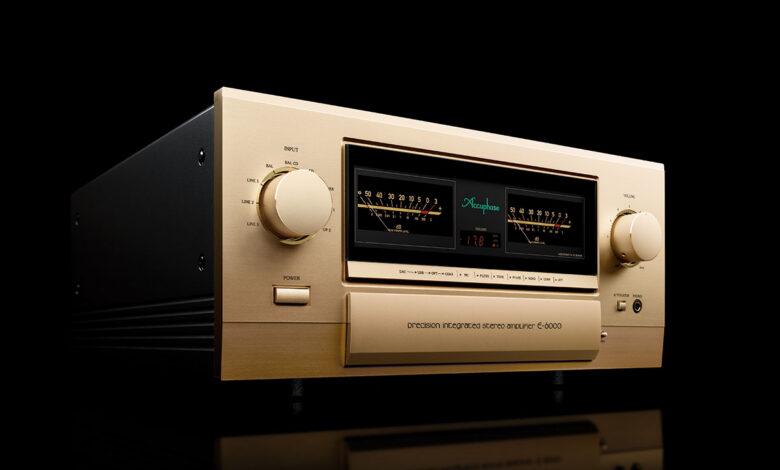
- The Accuphase E-6000 Precision Integrated Stereo Amplifier is a Class AB design with 2 × 260 watts into 8 ohms, a damping factor of 1.000 and a fully balanced circuit, with Balanced AAVA volume control and ANCC aimed at keeping noise and distortion low at everyday listening levels. It offers five line inputs, two balanced inputs, separate preamplifier outputs and power amplifier inputs, a discrete headphone amplifier and two slots for optional DAC and phono boards, and it is available from specialist dealers at a recommended retail price of € 14.300,-.
Driving power-hungry loudspeakers with authority takes serious engineering reserves, and that is the starting point for the new Accuphase E-6000 Precision Integrated Stereo Amplifier from Accuphase Laboratory Inc. The Japanese high-end HiFi specialist describes it as the most powerful integrated amplifier it has yet built, and sets equally exacting targets for low noise, precision and signal fidelity. It succeeds the Accuphase E-5000. Three areas receive the most attention: a fully balanced signal path, an elaborate volume control and a power supply sized to match the output stage.

Key Facts – Accuphase E-6000
- High-end stereo integrated amplifier with fully balanced circuit topology
- Class AB design delivering 2 × 260 watts into 8 ohms and 2 × 350 watts into 4 ohms
- Six-fold parallel push-pull output stage with power transistors
- Balanced AAVA volume control with ANCC to reduce noise and distortion
- Output stage configured as an instrumentation amplifier
- Damping factor of 1.000
- Toroidal transformer and two reservoir capacitors of 47.000 µF each
- Five line inputs, two balanced inputs, and separate preamplifier outputs and power amplifier inputs
- Two expansion slots for optional DAC and phono boards
- Separate headphone amplifier with discrete circuitry
- Dimensions of 465 × 221 × 502 mm and a weight of 38,6 kg
A Volume Control Without a Potentiometer
The most distinctive feature of the Accuphase E-6000 is how it sets the listening level. Most amplifiers pass the music signal through a variable resistor of some kind. Accuphase’s Balanced AAVA, short for Accuphase Analog Vari-gain Amplifier, takes a different route. The circuit derives several current signals of differing weight from the input and blends them according to the chosen volume, so the level changes without the signal ever passing through a conventional potentiometer.



In the E-6000 this principle is implemented in a balanced configuration. According to the manufacturer, it lowers the noise level at typical listening volumes by around ten per cent compared with conventional implementations.
Working alongside it is ANCC, the Accuphase Noise and distortion Canceling Circuit. Within the current-to-voltage conversion stage, it adds a second, particularly quiet amplifier branch next to the main amplifier. Its job, as Accuphase describes it, is to trim residual noise and distortion further, above all at low and moderate volume settings. The thinking is clear enough: the company is concerned not only with what the amplifier can do flat out, but with how precisely it performs at the levels people actually listen at.


Output Stage and Rated Power
With a guaranteed 260 watts per channel into 8 ohms and 350 watts into 4 ohms, Accuphase places the E-6000 at the top of its integrated amplifier range. The company presents this output as a means to an end: it is what allows demanding loudspeakers to be kept firmly under control, with plenty in reserve.
The heart of the amplifier is a six-fold parallel push-pull circuit using power transistors operating in Class AB. Each channel has generously sized heat sinks to carry away the heat generated at high output. The design is intended to run stably under heavy load while retaining the precision Accuphase is known for.
One detail deserves a mention: the manufacturer specifies these power figures across the full range from 20 Hz to 20 kHz with both channels driven at the same time. For an amplifier in this class, that is a useful indicator of what it can actually deliver.
The Power Supply and the Damping Factor
A powerful amplifier is only as good as the supply behind it, particularly when the load changes quickly. Accuphase has equipped the E-6000 with a large toroidal transformer and two high-voltage reservoir capacitors, each rated at 47.000 µF and 100 V. Together they are meant to keep the amplifier stages well fed and leave sufficient reserves when high output is demanded.
The stated damping factor of 1.000 is closely related. It expresses the ratio between the loudspeaker’s impedance and the amplifier’s output impedance, and is regarded as a key parameter for an amplifier’s ability to control the movement of the drivers electrically. To help here, Accuphase uses its Balanced Remote Sensing technology, which is intended to lower the output impedance further and so tighten electrical control over the connected loudspeakers. A low-impedance output stage can be of particular benefit with demanding bass passages and with speakers whose impedance curve is awkward.
A Balanced Signal Path From Input to Output
The fully balanced topology runs from the inputs right through to the outputs. The purpose, in Accuphase’s words, is to suppress interference as effectively as possible and to keep the audio signal intact through every amplification stage.
The output stage is built as an instrumentation amplifier. Because the signal is processed in balanced form, with matched impedances on both signal branches, external interference should be rejected particularly effectively. Accuphase adds its established current-feedback technology, which is intended to give a favourable phase response even at high frequencies. According to the manufacturer, the combination forms the basis for faithful reproduction whether the music is complex or the recording highly dynamic.
Controls, Mechanics and Front Panel
Accuphase pays as much attention to the mechanical side of the E-6000 as to the circuitry. The volume level sensor is a good example, its mechanism machined from a solid block of aluminium. The construction is intended to register the volume setting accurately and to give the amplifier its characteristically refined feel. Even when the level is changed with the supplied RC-260 remote control, mechanical noise is said to be kept to a minimum.
The front panel follows the Japanese company’s traditional design language. Two large analogue power meters dominate the fascia, while the controls for the additional functions sit behind a cover. They include bass and treble tone controls, loudness correction for low listening levels, a very finely graded balance control and a 20 dB attenuator. The phase can also be set individually for each input.
Connections and System Integration
The E-6000 is flexible when it comes to fitting into an existing system. Alongside five unbalanced line inputs there are two balanced inputs, so that conventional HiFi components and suitably equipped high-end sources can both be connected.
Of particular interest are the separate preamplifier outputs and power amplifier inputs, each available in balanced and unbalanced form. These allow the E-6000 to be used on its own as either a preamplifier or a power amplifier. The same provisions open the door to more elaborate setups with additional power amplifiers, and Accuphase explicitly envisages configurations for bi-amping.
Two pairs of large loudspeaker terminals allow two sets of speakers to be connected, with switching handled from the front panel. The integrated headphone amplifier is a separate, discretely built circuit, so good headphones can be driven directly from the amplifier without an external solution.
Optional DAC and Phono Boards
Accuphase has long followed a modular approach, letting selected integrated amplifiers grow in function as needs change. The E-6000 provides two slots for optional expansion boards.
For digital sources there is the Accuphase DAC-60 Digital Input Board. It uses two ESS ES9016K2M DAC chips operating in parallel and offers USB, optical S/PDIF and coaxial S/PDIF connections. Over USB it handles PCM signals up to 32 Bit and 384 kHz as well as DSD up to 11.2 MHz; the other digital inputs are limited by their respective interface standards.
Vinyl enthusiasts can add the Accuphase AD-60 Analog Disc Input Board, which supports both MM and MC cartridges, offers adjustable input impedance for MC pick-ups and includes a switchable subsonic filter. Fitted with both boards, the E-6000 can grow into a comprehensively equipped analogue and digital hub without separate components being needed for every added task.
All Benefits at a Glance
- Power in reserve: the Class AB output stage has enough output to drive demanding loudspeakers with composure.
- Balanced throughout: the elaborate circuit architecture is meant to reduce interference and support precise reproduction.
- Quiet level control: Balanced AAVA with ANCC is aimed at optimising signal handling at everyday listening volumes.
- Bass control: the high damping factor and low-impedance output stage create favourable conditions for controlled speaker drive.
- Generous supply: the toroidal transformer and large reservoir capacity provide reserves for dynamic passages.
- Flexible integration: separate preamplifier and power amplifier connections allow different system configurations, bi-amping included.
- Modular growth: optional DAC and phono boards adapt the amplifier to digital sources and vinyl.
- Considered operation: precise mechanics, analogue power meters and a wide range of functions combine classic HiFi culture with modern convenience.
Price and Availability
The Accuphase E-6000 Precision Integrated Stereo Amplifier is available from specialist dealers at a recommended retail price of € 14.300,-. The optional expansion boards for digital sources and phono cartridges are not part of the standard specification and must be purchased separately.
Getting to the Point
With the E-6000, Accuphase Laboratory Inc. offers a concept that can fairly be regarded as an alternative to a high-quality separate preamplifier and power amplifier. The substantial output figures are only part of the story. What stands out is the engineering effort invested in signal processing, volume control and power supply. The combination of Balanced AAVA, ANCC and a fully balanced amplifier architecture shows that this is not simply a question of the number of watts. The Accuphase E-6000 is meant to meet even demanding loudspeakers with maximum composure while retaining the fine detail expected of a high-end amplifier in this class. It is a technically ambitious concept, and its modular expandability makes it pleasingly versatile.
| Product | Accuphase E-6000 Precision Integrated Stereo Amplifier |
|---|---|
| Price | € 14.600,- |
Technical Specifications
| Product | Accuphase E-6000 |
|---|---|
| Characterisation | High-end stereo integrated amplifier |
| Amplifier technology | Class AB |
| Circuit topology | Fully balanced |
| Output stage | Six-fold parallel push-pull circuit |
| Output power into 8 ohms | 2 × 260 watts |
| Output power into 4 ohms | 2 × 350 watts |
| Frequency range of power ratings | 20 Hz to 20 kHz, both channels driven |
| Total harmonic distortion | 0,05 % at rated output |
| Intermodulation distortion | 0,01 % |
| Frequency response, line inputs | 20 Hz to 20 kHz (+0/−0.5 dB) |
| Frequency response, Main In | 20 Hz to 20 kHz (+0/−0.2 dB) |
| Extended frequency response | 3 Hz to 150 kHz (+0/−3 dB), Main In at 1 watt |
| Damping factor | 1.000 |
| Volume control | Balanced AAVA with ANCC |
| Signal-to-noise ratio, line inputs | 112 dB, A-weighted |
| Signal-to-noise ratio, Main In | 126 dB, A-weighted |
| Input sensitivity, line | 229 mV at rated output |
| Input sensitivity, Main In | 1,82 V at rated output |
| Input impedance, balanced | 40 kOhm |
| Input impedance, unbalanced | 20 kOhm |
| Analogue line inputs | 5 pairs RCA |
| Balanced inputs | 2 pairs XLR |
| Preamplifier outputs | RCA and XLR |
| Power amplifier inputs | RCA and XLR |
| Loudspeaker outputs | 2 pairs |
| Headphone output | Separate discrete headphone amplifier |
| Tone controls | Bass and treble, ±10 dB each |
| Loudness correction | +6 dB at 100 Hz |
| Attenuator | −20 dB |
| Digital inputs | Optional via Accuphase DAC-60 |
| Phono input | Optional via Accuphase AD-60, MM/MC |
| Power supply | Toroidal transformer |
| Reservoir capacitors | 2 × 47.000 µF/100 V |
| Loudspeaker protection | MOS-FET switch |
| Power consumption, no signal | 90 watts |
| Power consumption to IEC 62368-1 | 380 watts |
| Power consumption at rated output into 8 ohms | 887 watts |
| Standby power consumption | 0,4 watts |
| Dimensions (W × H × D) | 465 × 221 × 502 mm |
| Weight | 38,6 kg |
| Accessories | RC-260 remote control, mains cable |
| Brand | Accuphase Laboratory Inc. |
|---|---|
| Manufacturer | Accuphase Laboratory Inc. |
| Distribution Austria | R.M.S. State of the Art Audiovisual Products |
| Distribution Germany | P.I.A. Hi-Fi Vertriebs GmbH |
| Distribution Switzerland | cebrands.ch AG |
| More about this manufacturer at HiFi BLOG |