


JBL QuantumENGINE Grows into a Gaming Control Centre
The latest JBL QuantumENGINE rollout reaches far beyond additional audio presets. JBL is gradually turning the software into a control platform that recognises supported games, coordinates multiple Quantum devices and makes essential settings available from a smartphone or the Base Station supplied with the JBL Quantum 950.

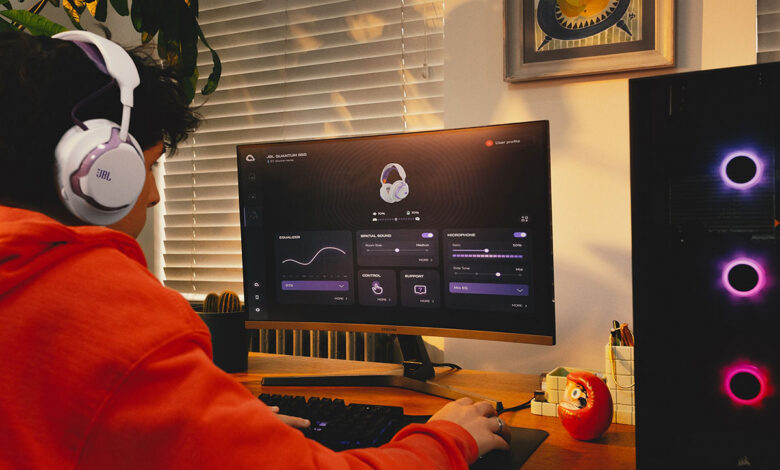
- Seven additions are being introduced in stages through the end of 2026, including an AI-powered Footstep Booster, automatic game detection, cross-platform profile synchronisation, Base Station macros and support for selected Nanoleaf lighting products. Taken together, they show JBL moving QuantumENGINE away from the familiar role of headset configuration software and towards a connected operating layer for a complete gaming setup.
When JBL fundamentally revised JBL QuantumENGINE last year, Harman International Industries described the software as the central audio-control platform for the JBL Quantum Series. The latest expansion now gives that ambition considerably more substance.

Game-centric user profiles and smartphone remote control are already available. Automatic game detection, broader Base Station control and macro programming are assigned to the third quarter of 2026, while the AI-powered Footstep Booster and Nanoleaf integration are scheduled for the fourth quarter.




The more revealing development, however, lies in the relationship between these additions. QuantumENGINE is being taught to understand which game is running, select an appropriate configuration, connect several components and offer access through whichever control surface is most convenient at the time. It is this increasing awareness of context that separates the new rollout from a conventional collection of software features.
Key Facts JBL QuantumENGINE
- Gradual expansion of JBL QuantumENGINE through the end of 2026
- Game-centric user profiles available now
- Profile synchronisation across Microsoft Windows, Apple macOS, Apple iOS and Google Android
- Automatic detection of supported games from the third quarter of 2026
- AI-powered Footstep Booster scheduled for the fourth quarter of 2026
- Cross-device control using the Base Station supplied with the JBL Quantum 950
- Base Station macro programming from the third quarter of 2026
- Smartphone remote control for central QuantumENGINE functions available now
- Integration with selected compatible Nanoleaf products from the fourth quarter of 2026
From Headset Utility to Gaming Platform
Gaming applications supplied with headsets have traditionally served a fairly predictable purpose. They expose the equaliser, microphone level, virtual surround processing and lighting controls that belong to the connected hardware. Once those settings are stored, many users have little reason to open the software again.
JBL is attempting to make QuantumENGINE more persistent without demanding more attention from the player. Rather than waiting for every change to be made manually, the platform is intended to react to the current game, retrieve a suitable profile and maintain that configuration across several devices.
This changes the underlying logic of the software. The important question is no longer simply what can be adjusted, but when those adjustments are selected, where they can be controlled and how many components can participate in the same configuration.
Profiles Provide the Common Language
Game-centric user profiles sit at the heart of the new structure. A profile can combine settings for the equaliser, JBL Quantum Spatial Sound, microphone and controls instead of representing a single tonal adjustment.
JBL has also extended these profiles beyond one computer. When users sign in with the same account, their configurations are synchronised between Microsoft Windows, Apple macOS, Apple iOS and Google Android.
The conflict handling is particularly relevant here. JBL states that settings already stored locally on a device will be retained rather than overwritten when they clash with a synchronised profile. Cloud synchronisation is useful only when it does not destroy carefully prepared local configurations, and this safeguard should make the system less intrusive in everyday use.
Automatic Detection Removes a Repetitive Step
A profile library becomes much more valuable when the player no longer has to browse it before launching every title. QuantumENGINE is therefore gaining automatic game detection, allowing supported games to be recognised as they start and the corresponding preconfigured sound profile to be loaded.
The practical benefit is straightforward. Players should no longer need to leave the game, open the dashboard and search for the required configuration whenever they change titles.
This may ultimately matter more than a conspicuous new audio effect. Good automation removes friction that users have learnt to tolerate, and profile selection is precisely the sort of repetitive task that software ought to handle. Its success will naturally depend on reliable detection and the range of games supported by JBL.
The development is already reflected in JBL’s software rollout. The official release notes for QuantumENGINE 2.8.6, dated 21 August 2026, refer to User Profile Auto Switch, which detects the active game and changes to the associated user profile automatically.
The AI Footstep Booster Listens for More Than Footsteps
The AI-powered Footstep Booster, due in the fourth quarter of 2026, is the feature most explicitly aimed at competitive play. Its name might suggest a simple emphasis of the frequency range in which footsteps tend to occur, but JBL describes a more dynamic system.
QuantumENGINE is intended to analyse the game soundtrack continuously and identify relevant acoustic events. Footsteps are part of that analysis, but JBL also names voices, gunfire and explosions. The processing is designed to sharpen clarity and improve the directional perception of opposing players’ footsteps in popular first-person shooters.
In principle, that makes the Footstep Booster distinct from a static EQ preset. A fixed curve treats all material in the same way, whereas continuous analysis could respond differently according to the current scene and the sounds present at that moment.
Whether the final implementation remains subtle enough to preserve the wider soundtrack while making tactical information easier to locate cannot yet be judged. JBL’s claim that the enhancement will not compromise audio quality will need to be assessed once the finished feature is available.
A Broader Role for the JBL Quantum 950 Base Station
The Base Station supplied with the JBL Quantum 950 is also being moved closer to the centre of the ecosystem. Instead of acting solely as an accessory for one headset, it is intended to control several compatible JBL Quantum devices.
JBL cites a combination of the JBL Quantum 950 and JBL Quantum Stream Studio as an example. Users will be able to adjust functions such as JBL Quantum Spatial Sound and microphone EQ presets directly from the Base Station, avoiding the need to open the QuantumENGINE dashboard on the computer.
This is more significant than saving a few mouse clicks. It gives software-defined functions a permanent physical interface on the desk and allows that interface to serve a group of products rather than only the device with which it was originally supplied.
The approach also suits gaming and streaming particularly well. Moving between the two activities often requires different microphone, monitoring and spatial-audio settings. A dedicated control surface can make that transition faster and more deliberate than navigating through several software panels.
Macros Take the Base Station Beyond Audio
Macro programming extends the Base Station’s remit again. Custom macros can be assigned to its control knob, allowing recurring in-game action sequences to be triggered with a single command.
At that point, the Base Station ceases to be merely an audio controller. It becomes a programmable part of the gaming workspace, with a role that can extend into general interaction with the game.
This function has also been developing ahead of the wider announcement. JBL’s release notes for QuantumENGINE 2.7.8, dated 30 June 2026, already mention macro configuration and cross-device control for the Base Stations associated with the JBL Quantum 950 and JBL Quantum 950X.
The Smartphone Becomes a Second Control Screen
Not every improvement depends on owning the JBL Quantum 950. Smartphone remote control is already available and gives players access to several important QuantumENGINE functions without requiring them to leave a full-screen game.
EQ presets, JBL Quantum Spatial Sound, microphone volume, microphone EQ and Game & Chat balance can all be adjusted from the phone. Devices using the same account can be connected with one click, while QR-code pairing provides an alternative. The interface supports both portrait and landscape orientation.
The advantage is immediate: the game remains uninterrupted while the audio controls move onto a separate display. This is particularly useful for settings such as Game & Chat balance or microphone level, which may need to be corrected during a session rather than prepared in advance.
It also demonstrates that JBL is not restricting QuantumENGINE to one primary desktop interface. The computer remains the central platform, but control can migrate to the device best suited to the moment.
Nanoleaf Takes the Configuration into the Room
The most visible sign of JBL’s platform strategy arrives from outside the audio system. From the fourth quarter of 2026, game-themed lighting configurations created in QuantumENGINE are intended to extend to selected compatible Nanoleaf products.
JBL specifically mentions Nanoleaf Shapes and Nanoleaf Blocks. Their lighting can become part of the same game-related environment that governs the audio profile and other Quantum settings.
Ambient lighting is hardly new to gaming, but the method of integration is the relevant point. JBL is not presenting it as an isolated lighting feature. Nanoleaf products are being brought into software that also manages headsets, microphones, profiles and control hardware.
The result could be a more coherent setup in which one recognised title activates the intended audio behaviour and the matching room lighting. That is a more convincing platform proposition than placing independent controls for each product behind separate applications.
One Rollout Rather Than One Update
Calling this a major update could imply that all seven functions will arrive in a single QuantumENGINE release. JBL’s timetable describes a more gradual process.
Game-centric profiles and smartphone remote control are available now. Automatic game detection, the Base Station’s expanded control role and macro programming are scheduled for the third quarter of 2026, while the Footstep Booster and Nanoleaf support are due in the fourth quarter.
The release history shows that parts of this programme are already entering the software. QuantumENGINE 2.7.8 introduced the foundations for Base Station macros, cross-device control and smartphone operation, while version 2.8.6 added automatic user-profile switching based on the active game.
It therefore makes more sense to view the announcement as an ongoing platform rollout rather than one isolated version change. Software releases, device firmware, supported hardware and potentially server-side services will all contribute to the final feature set.
The Connections Matter More Than the Feature Count
Individual gaming headsets are readily compared by their drivers, wireless standards, battery life or microphone design. A functioning ecosystem is harder to reduce to a specification table, particularly when its value emerges from the way several products and interfaces cooperate.
That is where the expanded QuantumENGINE could become strategically important for JBL. A supported game launches, the appropriate profile activates, the headset and microphone adopt their prepared settings, adjustments remain accessible from the phone or Base Station and the room lighting follows the same context.
Each component may appear modest in isolation. Together, they outline software that is meant to disappear into the background while keeping the entire setup in the correct state.
The Most Important Advantages at a Glance
- Automatic game adaptation: Supported titles can trigger their assigned user profiles without a manual selection.
- Unified game profiles: EQ, JBL Quantum Spatial Sound, microphone and control settings can be managed as one configuration.
- Cross-platform synchronisation: Profiles follow the user across Microsoft Windows, Apple macOS, Apple iOS and Google Android.
- Context-sensitive audio processing: The forthcoming Footstep Booster is designed to analyse relevant game sounds continuously instead of relying solely on a fixed EQ curve.
- Cross-device operation: The JBL Quantum 950 Base Station can assume control of several compatible products within the Quantum ecosystem.
- Smartphone remote access: Essential sound and microphone settings remain available without interrupting the current game.
- Programmable controls: Base Station macros can condense repeated actions into a single command.
- Nanoleaf integration: Selected lighting products can become part of the same game-related QuantumENGINE environment.
Price & Availability
JBL is introducing the new QuantumENGINE functions in stages. Game-centric user profiles and smartphone remote control are already available. Automatic game detection, the Base Station’s expanded control functions and macro programming are scheduled for the third quarter of 2026 or are already entering the corresponding software rollout.
The AI-powered Footstep Booster and integration with selected Nanoleaf products are expected in the fourth quarter of 2026. The required Base Station is supplied with the JBL Quantum 950. JBL has not announced a separate price for the new QuantumENGINE functions.
Getting to the Point
The latest rollout clarifies what JBL wants QuantumENGINE to become. It is no longer intended to be an application opened once to configure a new headset and then largely forgotten. Instead, JBL is building a layer that connects game recognition, stored profiles, audio devices, microphones, physical controls, smartphones and, eventually, room lighting.
The strongest part of that idea is not the AI label attached to the Footstep Booster. It is the effort to remove manual intervention. If QuantumENGINE can select profiles reliably, preserve configurations across devices and expose the right controls in the most convenient place, its value will lie in how little attention it requires.
The Footstep Booster will determine whether JBL can bring the same intelligence to the audio processing itself. Until it arrives in the fourth quarter of 2026, that aspect remains a manufacturer promise. The broader direction, however, is already apparent: QuantumENGINE is developing into the connective tissue of the JBL Quantum ecosystem.
| Theme | JBL QuantumENGINE is evolving into a gaming control center |
|---|---|
| Harman International Industries |
| Brand | JBL |
|---|---|
| Manufacturer | Harman International |
| Distribution | Harman Deutschland GmbH |
| More about this manufacturer at HiFi BLOG |