

Hegel A200 – The Resolutely Analogue Integrated Amplifier
Hegel Music Systems AS has created two closely related integrated amplifiers for listeners who want very different things from the centre of their HiFi system. The Hegel A200 shares its output stage and core amplifier technology with the H200, but dispenses with streaming, digital inputs and D/A conversion altogether. In their place, it offers a second balanced input and leaves every digital decision to external source components.


- The Hegel A200 is aimed at listeners who already own the DAC, streamer or CD player they want to use and do not wish to pay for another digital platform inside their amplifier. Its 2 × 150 W output stage, stability down to 2 Ohm and damping factor of more than 4.000 provide the basis for driving demanding loudspeakers, while two XLR inputs, two RCA inputs and an integrated MM phono stage accommodate a substantial analogue system. It is not the stripped-down version of the H200, but the alternative for users who want to retain full control over their source components.
Choosing between the Hegel A200 and Hegel H200 is not primarily a question of amplifier performance. Hegel Music Systems AS gives both models the same 2 × 150 W power-amplifier platform, the same fundamental approach to loudspeaker control and many of the same everyday functions. What changes is the role assigned to the integrated amplifier. The H200 is designed to accept digital signals, stream music and perform D/A conversion itself; the A200 remains analogue from input to output and deliberately leaves those tasks elsewhere in the system. That single decision defines who this amplifier is for, how it connects and why the absence of digital circuitry should not be confused with a lower position in the range.

Key Facts Hegel A200
- Fully analogue Class A/B integrated amplifier
- 2 × 150 W into 8 Ohm
- Stable with loudspeaker loads down to 2 Ohm
- Hegel SoundEngine2 amplifier technology
- Damping factor greater than 4.000
- Two balanced XLR and two unbalanced RCA line inputs
- MM phono input based on the MM section of the Hegel V10
- Fixed and variable RCA line outputs
- Headphone output
- Home Cinema integration via configurable fixed input level
- TV remote learning, adjustable start-up and maximum volume
- Automatic standby and configurable display dimming
- Black finish
The Choice Comes Before the Specification Sheet
Two amplifiers can share a chassis, an output stage and much of their operating logic while serving quite different systems. That is precisely the distinction Hegel is drawing with the A200 and H200. The connected H200 brings the digital source chain into the amplifier. The A200 does the opposite: it stops at the analogue inputs and allows an external DAC, network player, CD player or phono source to determine everything that happens before amplification.
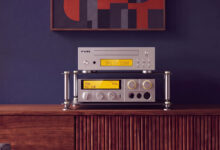
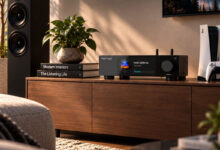

This separation has an obvious practical consequence. Owners who already have a digital front end they intend to keep are not tied to an additional converter or streaming platform. Future changes to those components can also be made without replacing the amplifier. Hegel is therefore not presenting analogue minimalism as an end in itself; the A200 is a way of dividing responsibilities within a HiFi system.
The analogue model also gains a second pair of balanced XLR inputs where the digital section would otherwise sit. Together with two unbalanced RCA line inputs, this gives the A200 four conventional line-level connections for external sources. There are no digital inputs, no integrated network player and no internal DAC.
The Same Power Platform as the H200
Once the signal reaches the amplifier, the difference between the two new models largely disappears. The Hegel A200 uses a Class A/B output stage rated at 2 × 150 W into 8 Ohm and is specified for loudspeaker impedances down to 2 Ohm. This is important because nominal power alone says little about how an amplifier will behave when a loudspeaker presents a difficult electrical load.
Hegel quotes a damping factor of more than 4.000 for the main output stage. In engineering terms, that figure describes a very low output impedance and the amplifier’s ability to exert firm electrical control over the connected drive units. It is one of the defining measurements in Hegel’s approach, although the audible result in any particular system will still depend on the loudspeaker, room and installation.
The specified frequency response extends from 5 Hz to 100 kHz. Signal-to-noise ratio is stated at more than 100 dB, crosstalk at less than -100 dB, and distortion at less than 0,01 per cent at 50 W into 8 Ohm at 1 kHz. These figures place the emphasis on wide bandwidth, low noise and controlled behaviour rather than on headline output power alone.


SoundEngine2 Intervenes Where Distortion Begins
Hegel SoundEngine2 is central to the A200’s amplifier architecture. Rather than applying a large amount of conventional global negative feedback after errors have travelled through the complete amplifier circuit, the system is intended to detect and counteract distortion close to the point at which it arises.
According to Hegel Music Systems AS, this approach combines the low distortion associated with feedback-based amplifier designs with the dynamic behaviour the company seeks from a lower-feedback topology. The A200 therefore uses the same core technology as the H200 even though the two models receive their music from different types of source chain.
For the buyer, this common platform is more relevant than the different feature lists. Choosing the A200 does not mean accepting a less capable output stage in exchange for fewer functions. It means selecting the analogue version of the same underlying amplifier proposition.
A Phono Input with a Clear Lineage
A fully analogue integrated amplifier would look incomplete if vinyl playback were treated as an incidental extra. Hegel therefore derives the A200’s Moving Magnet phono stage from the MM section of its separate Hegel V10 Phono Preamplifier.
The circuit uses hand-matched FET transistors in its gain stages together with selected operational amplifiers. Hegel states that the design was developed for low noise and accurate signal handling. The input is intended exclusively for Moving Magnet cartridges; users of Moving Coil designs will still require an appropriate external phono preamplifier or step-up solution.
This is also where the A200’s system logic becomes particularly clear. A turntable can connect directly, while owners of more specialised analogue front ends remain free to use an external phono stage through one of the line inputs. The integrated MM circuit broadens the amplifier’s usefulness without changing its role as an analogue control centre.

Four Line Inputs, Two Useful Outputs
The two balanced XLR pairs will be particularly relevant in systems built around higher-grade external source components. They are joined by two unbalanced RCA line inputs and the separate RCA connection for the MM phono stage.
Hegel also provides two unbalanced line outputs with different purposes. The fixed RCA output can supply a recorder or another system at line level. The variable RCA output follows the A200’s volume control and can therefore feed a subwoofer or an external power amplifier. A headphone output allows private listening without introducing another component into the system.
The connection set is consequently broader than the phrase “analogue integrated amplifier” might suggest. What the A200 excludes is precisely defined, but the analogue functions that remain cover source selection, vinyl replay, headphones, system expansion and subwoofer integration.
Designed to Fit Around the Rest of the System
Hegel has also carried across several functions that concern daily operation rather than signal format. Individual inputs can be assigned a fixed volume level, allowing the A200 to serve as the power-amplifier section within a Home Cinema installation whose AV receiver or processor controls volume.
The amplifier can learn volume commands from a television remote control. This may be useful when a TV, external DAC or another source is already the everyday control point of the system. Configurable start-up and maximum volume settings help prevent unwanted level jumps, while automatic standby reduces power consumption when the amplifier is not being used.
Display behaviour can be adjusted as well. The front-panel display may remain clearly visible, dim automatically or be switched off for listening in a darkened room. None of these functions alters the analogue concept, but together they prevent that concept from becoming an excuse for inconvenient operation.
Familiar Hegel Form, Deliberately Restrained Finish
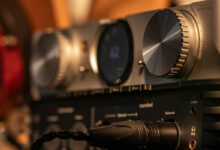
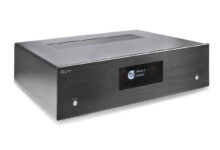
The Hegel A200 measures 43 × 41 × 12 cm and weighs 13,5 kg. Its front follows the company’s established visual language, with a central display positioned between two large rotary controls. One selects the source and the other adjusts volume.
Unlike the H200, which is offered in black or white, the A200 is available only in black. The restrained appearance suits the product’s intended role: this is an amplifier designed to remain at the centre of a system while allowing the selected source components to define its digital capabilities.
The Most Important Advantages at a Glance
- Freedom to choose the digital front end: DACs and streaming components remain external and can be selected or upgraded independently.
- No reduction in core amplifier performance: The A200 uses the same 2 × 150 W power-amplifier platform as the H200.
- Suitable for demanding loudspeakers: Stability down to 2 Ohm and a damping factor above 4,000 provide substantial electrical control.
- Strong balanced connectivity: Two XLR input pairs accommodate more than one balanced source component.
- Direct vinyl connection: The integrated MM phono stage is derived from the corresponding section of the Hegel V10.
- Flexible system expansion: Fixed and variable line outputs support recorders, additional systems, subwoofers or external power amplifiers.
- Straightforward Home Cinema integration: A fixed-level input allows an AV processor or receiver to take over volume control.
- Practical everyday operation: TV remote learning, volume limits, automatic standby and adjustable display dimming simplify regular use.
Price & Availability
The Hegel A200 is scheduled to become available through authorised specialist retailers in October 2026. The recommended retail price is € 3.295,-. It is offered exclusively in a black finish.
Conclusion
The Hegel A200 makes most sense when viewed as a decision about system architecture rather than as an H200 with features removed. Its buyer is expected to have clear ideas about digital playback and to prefer an external DAC, streamer or CD source over an integrated platform. In return, the amplifier provides two balanced input pairs, a serious MM phono stage and the same 2 × 150 W output platform as its network-capable sibling.
That distinction is unusually clean. Hegel is not asking one product to satisfy two opposing ideas of a modern integrated amplifier. The H200 concentrates functions; the A200 preserves separation. For a listener with a carefully chosen digital front end or a predominantly analogue system, the latter may be the more coherent solution precisely because it does less before the signal reaches the amplifier stage.
| Product | Hegel A200 Analog Integrated Amplifier |
|---|---|
| Price | € 3.295,- |
Technical Specifications
| Product | Hegel A200 |
|---|---|
| Product type | Fully analogue Class A/B integrated amplifier |
| Power output | 2 × 150 W into 8 Ohm at 1 kHz, 1% THD |
| Minimum loudspeaker load | 2 Ohm |
| Amplifier technology | Hegel SoundEngine2 |
| Balanced analogue inputs | 2 × XLR |
| Unbalanced analogue inputs | 2 × RCA |
| Phono input | 1 × RCA, Moving Magnet |
| Line outputs | 1 × fixed RCA, 1 × variable RCA |
| Additional output | Headphone output |
| Frequency response | 5 Hz to 100 kHz |
| Signal-to-noise ratio | More than 100 dB |
| Crosstalk | Less than -100 dB |
| Distortion | Less than 0.01% at 50 W into 8 Ohm, 1 kHz |
| Intermodulation distortion | Less than 0.01% at 19 kHz + 20 kHz |
| Damping factor | More than 4,000, main power output stage |
| Dimensions | 43 × 41 × 12 cm |
| Weight | 13,5 kg |
| Finish | Black |
| Brand | Hegel Music Systems |
|---|---|
| Manufacturer | Hegel Music Systems |
| Distribution | GP Acoustics GmbH |
| More about this manufacturer at HiFi BLOG |