

EAT E-Glo SB Phono Stage – Discrete Circuit Design and Balanced Signal Routing for MM and MC
The new EAT E-Glo SB Phono Stage brings one of the defining principles of the flagship EAT E-Glo F B to a more accessible price point: balanced processing of the exceptionally low-level signal generated by a phono cartridge. Its first gain stage is fully balanced, while two ECC83S and two E88CC valves form the complete second stage. Extensive adjustment, two independently configurable inputs and optional linear power supply upgrading add a welcome degree of everyday flexibility to the ambitious circuit design.


- A fully balanced input stage, four-valve second gain stage and entirely discrete audio circuitry place the EAT E-Glo SB well beyond the conventional MM/MC phono preamplifier.
E.A.T. – European Audio Team introduces the new EAT E-Glo SB Phono Stage, an ambitious phono preamplifier for both MM and MC cartridges. Positioned below the EAT E-Glo F B, it nevertheless adopts one of the flagship model’s central design principles: balanced processing of the minute signal produced by a phono cartridge. Compared with the new EAT E-Glo CB, the SB version employs more closely selected polypropylene film capacitors and a more elaborate valve topology. Two ECC83S and two E88CC valves form its complete second gain stage, while integrated operational amplifiers have been excluded from the entire audio signal path.

Key Facts EAT E-Glo SB Phono Stage
- MM/MC phono preamplifier with RCA and balanced XLR inputs
- Fully balanced first gain stage
- Second gain stage employing two ECC83S and two E88CC valves
- Completely discrete audio circuitry without integrated operational amplifiers
- Split passive and active RIAA equalisation
- Gain settings from 40 to 70 dB, with an additional 6 dB via XLR
- Wide-ranging impedance and capacitance adjustment
- Two turntables or tonearms can remain connected, with settings stored separately
- Simultaneously available RCA and balanced XLR outputs
- Switchable 20 Hz subsonic filter
- Dual-mono construction and external power supply
- Black or silver aluminium enclosure
- Optional magnetic side panels in Macassar or Piano Black
- Hand-built in Europe
- Price: €4.490,-
Derived from the EAT E-Glo F B
European Audio Team introduced the EAT E-Glo F B almost a year ago as the first model in a new generation of balanced phono preamplifiers. Its “F B” designation stands for “Fully Balanced”. With the EAT E-Glo CB and the EAT E-Glo SB presented here, the company is now applying some of the flagship model’s underlying concepts at lower price points.




The E-Glo SB is not simply a stripped-down E-Glo F B. Its architecture combines solid-state devices and valves with very specific roles. In the first gain stage, the two opposing signal phases from a cartridge connected via XLR are processed by three operational-amplifier circuits assembled entirely from discrete components. The two signal phases are only combined afterwards, before entering the first part of the RIAA equalisation network.
This arrangement is particularly relevant when exceptionally low signal voltages have to be amplified. Noise affecting both conductors equally can largely be rejected by the balanced circuit. That is a worthwhile advantage with low-output MC cartridges, especially when high gain settings are required.


Four Valves in the Second Gain Stage
The most significant distinction between the EAT E-Glo SB and the EAT E-Glo CB lies in the second gain stage. Whereas the CB combines valves and transistors in this section, the E-Glo SB uses two ECC83S and two E88CC valves throughout the complete second stage. This section also incorporates the second part of the RIAA equalisation and the switchable subsonic filter.
A further discrete solid-state circuit is employed at the output. It generates the balanced signal for the XLR outputs and provides a low output impedance of 100 Ohms through RCA or twice 100 Ohms through XLR. Separate DC servo circuits are used to minimise residual DC voltage at the outputs.
Strictly speaking, the EAT E-Glo SB is therefore a hybrid valve phono preamplifier. The decisive point, however, is that E.A.T. avoids integrated operational amplifiers throughout the audio path and builds every functional section from discrete components.
Selected Capacitors for Gain and Equalisation
The EAT E-Glo SB uses a more closely selected grade of semi-crystalline polypropylene film capacitors than the E-Glo CB. These components are employed in both the gain stages and the RIAA equalisation network.
E.A.T. highlights their low dissipation factor and stability across changes in temperature and frequency. The manufacturer specifies an RIAA accuracy within 0.5 dB from 20 Hz to 20 kHz. Equalisation is divided between a passive section and an active stage rather than being entrusted to a single network.


Extensive Adjustment for MM and MC Cartridges
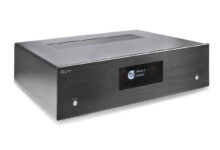
All controls for gain, input impedance, capacitance and the subsonic filter are located on the upper panel of the EAT E-Glo SB. The enclosure therefore need not be opened, nor must the phono stage be removed from the equipment rack whenever a different cartridge is installed.
MC loading can be set between 10 Ohms and 1.2 kOhms. In the high-impedance range, values from 30 to 75 kOhms are available. This makes it possible to fine-tune not only MC cartridges but also MM designs beyond the conventional fixed value of 47 kOhms. MM input capacitance can additionally be adjusted between 50 and 620 pF.
Gain settings of 40, 45, 50, 55, 65 and 70 dB are provided. Using the balanced XLR outputs adds a further 6 dB to each setting, allowing the phono playback level to be matched more precisely with the other sources in a HiFi system.
Two Turntables Can Remain Connected
RCA and XLR inputs allow two turntables or tonearms to remain connected to the EAT E-Glo SB simultaneously. The phono stage stores the selected settings for each input, avoiding the need to reconfigure loading, capacitance and gain whenever the user changes between sources.
There is one important qualification concerning the balanced XLR input. MC cartridges are generally suited to balanced operation by virtue of their construction. This is not automatically true of MM cartridges. Conventional MM designs should therefore be connected via RCA, with the XLR input reserved for MM cartridges specifically designed to support balanced operation.
According to E.A.T., the RCA and XLR outputs can be used at the same time. The phono signal could consequently be sent to an integrated amplifier and a recording device or second audio system in parallel.


External Power Supply and Optional EAT LPS 2
The power supply is housed separately to keep electromagnetic interference as far as possible from the sensitive gain stages. An external 18 V switch-mode power supply is included as standard.
For users wishing to upgrade the power supply, E.A.T. offers the optional EAT LPS 2 Linear Power Supply. This employs a shielded, vacuum-impregnated transformer, a DC blocker and more elaborate filtering. Its second output can power a compatible EAT turntable at the same time as the phono stage.
Aluminium Enclosure with Adjustable Valve Illumination
The circuit is housed in a 395 mm-wide aluminium enclosure offered in black or silver. All four valves remain visible above the upper panel and are illuminated by LEDs that can be dimmed and adjusted in colour.
Optional side panels are available in high-gloss genuine Macassar wood or Piano Black. Their magnetic attachment allows them to be fitted, exchanged or removed without modifying the enclosure.
The Most Important Benefits at a Glance
- Low-noise balanced signal processing: The XLR input can reject common-mode interference, which is particularly useful with low-output MC cartridges.
- Broad cartridge compatibility: Wide-ranging gain, impedance and capacitance settings accommodate a diverse selection of MM and MC designs.
- Direct access to every setting: All cartridge adjustments are readily accessible from the upper panel.
- Two turntables in one system: RCA and XLR inputs can remain connected, with individual configurations stored for each source.
- Discrete audio signal path: Integrated operational amplifiers are excluded from the audio circuitry.
- Elaborate valve stage: Four valves handle the entire second gain stage and part of the RIAA equalisation.
- Flexible output options: RCA and balanced XLR outputs can operate simultaneously.
- Upgradeable power supply: The optional EAT LPS 2 provides a straightforward route to a linear power supply.
Price and Availability
European Audio Team will offer the new EAT E-Glo SB Phono Stage in black and silver. The recommended retail price is €4,490.
The magnetic EAT Sidepanels in Piano Black or high-gloss Macassar are available separately for €199. The optional EAT LPS 2 Linear Power Supply is priced at €1,495.
Conclusion
The new EAT E-Glo SB from E.A.T. – European Audio Team should not be regarded as a diluted version of the E-Glo F B. It is a distinct answer to the question of how balanced phono amplification and a substantial valve architecture can be delivered at a more approachable price.
The combination of a fully balanced first gain stage, an entirely valve-based second stage and unusually comprehensive cartridge adjustment is particularly compelling. The ability to connect two turntables, store their respective settings and use both output formats simultaneously also makes this elaborate circuit rather more practical than its purist engineering might initially suggest.
| Product | EAT E-Glo SB Phono Stage |
|---|---|
| Price | EAT E-Glo SB Phono Stage € 4.490,- EAT Magnetic Sidepanels € 199,- EAT LPS 2 Linear Power Supply € 1.495,- |
Technical Specifications
| Product | EAT E-Glo SB Phono Stage |
|---|---|
| Description | Discrete MM/MC valve phono preamplifier with balanced connections |
| Circuit topology | Dual mono, completely discrete audio circuitry |
| Valve complement | 2 × ECC83S, 2 × E88CC |
| RIAA equalisation | Split passive and active |
| MM/high input impedance | 30, 36, 42, 47, 53, 59, 65 or 75 kOhms |
| MC/low input impedance | 10, 18, 43, 75, 150, 300 or 600 Ohms; 1.2 kOhms |
| MM input capacitance | 50, 150, 270, 370, 520 or 620 pF |
| Gain | 40, 45, 50, 55, 65 or 70 dB |
| Gain via XLR output | Additional 6 dB at each setting |
| Output impedance | 100 Ohms via RCA; 2 × 100 Ohms via XLR |
| Signal-to-noise ratio | MM: over 90 dBV, 100 dBV IEC-A; MC: over 80 dBV, 90 dBV IEC-A |
| MM total harmonic distortion | Below 0.004 per cent at 1 V RMS and 40 to 55 dB |
| MC total harmonic distortion | Below 0.04 per cent at 1 V RMS and 65 to 70 dB |
| RIAA accuracy | Within 0.5 dB from 20 Hz to 20 kHz |
| Subsonic filter | 20 Hz, 18 dB per octave |
| Inputs | RCA, XLR |
| Outputs | RCA, XLR; simultaneously available |
| Power supply | External, 18 V/1,000 mA; 110 to 250 V, 50/60 Hz |
| Power consumption | Maximum 24 W; below 0.5 W in standby |
| Finishes | Black or silver |
| Optional side panels | Piano Black or high-gloss genuine Macassar wood |
| Dimensions | 395 × 86 × 262 mm |
| Weight | 5.1 kg excluding power supply |
| Manufacturing | Hand-built in Europe |
| Brand | E.A.T. – European Audio Team |
|---|---|
| Manufacturer | E.A.T. – European Audio Team |
| Distribution Austria | Audio Tuning Vertriebs GmbH |
| Distribution Germany | IAD GmbH |
| Distribution Switzerland | E.A.T. – European Audio Team |
| More about this manufacturer at HiFi BLOG |