

EAT E-GLO CB Phono Stage – Balanced Input Architecture, ECC83S Valves and Extensive Cartridge Matching
The new EAT E-GLO CB Phono Stage takes a carefully judged route between a conventional solid-state design and an entirely valve-based phono preamplifier. Its three-stage hybrid circuit begins with a fully balanced, discrete and notably low-noise input section before handing the signal to a single-ended gain stage built around two ECC83S valves. Two independently configurable inputs, six gain settings and extensive impedance and capacitance choices make it an unusually adaptable proposition for serious vinyl systems.


- With two separately configurable inputs, balanced connection for suitable cartridges and one of the more extensive loading ranges in its class, the EAT E-GLO CB is designed for analogue systems that involve more than a single fixed cartridge.
E.A.T. – European Audio Team introduces the EAT E-GLO CB Phono Stage as a technically distinct hybrid design for moving-magnet and moving-coil cartridges. Rather than treating valves as decorative punctuation, the company places them within a three-stage architecture that addresses the peculiar demands of signals measured in fractions of a millivolt. The first gain stage is fully balanced and assembled from discrete semiconductors, the second combines two ECC83S valves with a transistor, while the final stage provides balanced and unbalanced outputs with a low output impedance. Add two inputs with separately stored settings, front-panel access to every important cartridge parameter and simultaneous RCA and XLR output, and the E-GLO CB begins to look less like a purist curiosity and more like a genuinely useful analogue control centre.

Key Facts: EAT E-GLO CB Phono Stage
- MM and MC phono preamplifier
- Fully balanced discrete input stage
- Three-stage hybrid topology with two ECC83S valves
- No integrated operational amplifiers in the audio path
- RCA and balanced XLR inputs with separate stored settings
- RCA and balanced XLR outputs available simultaneously
- Six gain settings from 40 to 70 dB; additional 6 dB via XLR
- MM loading from 30 to 75 kOhm and 50 to 620 pF
- MC loading from 10 Ohm to 1.2 kOhm
- Split passive and active RIAA equalisation
- Dual-mono construction with external power supply
- Black or silver finish; handmade in Europe
- Recommended retail price: € 3,490.-
A Different Route Between Solid-state and Valve Design
The EAT E-GLO CB arrives alongside the EAT E-GLO SB, but the two phono stages are not merely different trim levels of the same basic circuit. The CB follows its own hybrid philosophy, combining a balanced discrete input section with a subsequent single-ended valve and transistor stage.


That choice is particularly relevant at the input. A phono cartridge generates an extremely small signal, leaving it especially vulnerable to hum and interference before meaningful gain has been applied. Differential processing allows noise appearing equally on both signal conductors to be rejected, helping to preserve the useful information delivered by the cartridge.
The first stage comprises three discrete semiconductor amplifier circuits. Two process the positive and negative phases independently, while the third combines them for the next section. EAT avoids integrated operational amplifiers throughout the audio signal path.


Two ECC83S Valves in the Second Gain Stage
Once the signal has passed through the balanced input section, it reaches a single-ended hybrid stage built around two ECC83S triodes and a transistor. This section also contains the second portion of the RIAA equalisation circuit and the switchable subsonic filter.
EAT divides the RIAA correction between passive and active sections rather than assigning the entire task to one network. Semi-crystalline hydrocarbon polypropylene film capacitors are used throughout the gain and equalisation stages, selected for their low dissipation factor and stable behaviour across changes in frequency and temperature.
A final discrete semiconductor stage provides both balanced and unbalanced output. It also lowers the output impedance, making the phono stage less dependent on short interconnects or unusually benign downstream loads. Separate DC servo circuits keep unwanted direct-current components at the outputs under control.
Two Turntables, Two Stored Configurations
The ability to connect two turntables or tonearms at the same time is one of the E-GLO CB’s more persuasive practical features. One RCA input and one balanced XLR input are provided, with the chosen loading, capacitance and gain parameters stored separately for each.
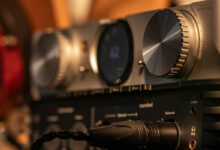
All principal adjustments are accessible from the top panel. There is no need to open the enclosure, move internal jumpers or peer at rows of miniature DIP switches. That matters if the phono stage is shared by two substantially different cartridges, or if cartridge changes form a regular part of the system rather than an occasional workshop exercise.
Available gain settings are 40, 45, 50, 55, 65 and 70 dB. The balanced XLR output adds a further 6 dB, providing sufficient scope for conventional MM designs, high-output MC cartridges and considerably quieter low-output moving-coil models.


Extensive MM and MC Loading
Moving-coil cartridges can be terminated at 10, 18, 43, 75, 150, 300 or 600 Ohm, with 1.2 kOhm completing the range. That is sufficiently broad to accommodate cartridges that prefer a relatively heavy electrical load as well as designs that sound more open when presented with a higher impedance.
The MM settings are just as noteworthy. Rather than stopping at the conventional 47 kOhm value, the E-GLO CB offers 30, 36, 42, 47, 53, 59, 65 and 75 kOhm. Capacitance can be set to 50, 150, 270, 370, 520 or 620 pF, allowing the user to account for both the cartridge specification and the capacitance introduced by the tonearm cable.
The balanced XLR input does require a degree of care. Moving-coil cartridges are naturally well suited to balanced connection because their generators are electrically floating. Some MM cartridges, however, connect one side of the generator to ground internally. These should be used through the RCA input unless their manufacturer explicitly approves balanced operation.
RCA and XLR Outputs Can Operate Together
The RCA and balanced XLR outputs remain active simultaneously. The phono signal can therefore be routed to two destinations – for example, a main integrated amplifier and a secondary system, headphone amplifier or recording device – without adding an external distribution stage.
Output impedance is specified at 100 Ohm via RCA and 2 × 100 Ohm through XLR. EAT quotes RIAA accuracy within 0.5 dB between 20 Hz and 20 kHz. A switchable subsonic filter operates at 20 Hz with a slope of 18 dB per octave, providing a useful means of suppressing record warps and very-low-frequency energy before it reaches the amplifier and loudspeakers.
External Power Supply and Optional EAT LPS 2
A separate switch-mode power supply is supplied as standard. Moving the mains conversion circuitry away from the sensitive audio electronics reduces the risk of electromagnetic interference entering the gain stages.
The optional EAT LPS 2 offers a linear upgrade path. According to the manufacturer, it employs a low-stray-field, vacuum-impregnated transformer, shielding between the primary and secondary windings and a DC blocker. A second output can power a compatible EAT turntable alongside the phono stage.
Careful placement remains advisable regardless of the chosen power supply. EAT recommends keeping the E-GLO CB away from the substantial mains transformers found in power amplifiers and larger integrated amplifiers. At phono-level gain, physical separation can still achieve more than an imposing metal enclosure alone.
Aluminium Casework and Visible Valves
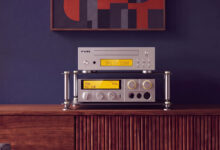
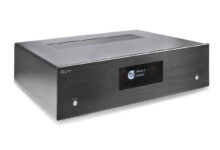
The circuitry is housed in a 395 mm-wide all-aluminium enclosure, offered in black or silver. Both ECC83S valves remain visible through apertures in the top panel and can be illuminated by adjustable LEDs. The colour and brightness of the lighting may be altered, allowing the visual treatment to remain restrained or rather more conspicuous.
Magnetically attached side panels are available as an option, finished in Piano Black or high-gloss Macassar wood. They soften the otherwise technical appearance and provide a closer visual match to EAT’s turntables and more traditional High-end components.
The Most Important Benefits at a Glance
- Broad cartridge compatibility: Fine adjustment of gain, resistance and capacitance supports a wide selection of MM and MC cartridges.
- Balanced MC connection: The XLR input can exploit the inherently balanced generator of a compatible cartridge and reject common-mode interference.
- Two analogue sources: Two turntables or tonearms can remain connected and be selected without repatching cables.
- Independent memories: Loading, capacitance and gain settings are stored separately for both inputs.
- Accessible adjustment: The main parameters can be changed from the top panel without opening the enclosure.
- Discrete signal path: Integrated operational amplifiers are absent from the complete audio circuit.
- Flexible integration: RCA and XLR outputs may be used at the same time.
- Upgrade potential: The optional EAT LPS 2 provides linear power for the phono stage and a compatible EAT turntable.
Price and Availability
The EAT E-GLO CB Phono Stage is available through authorised retailers in black or silver, with a recommended retail price of € 3.490,-. Optional magnetic side panels in Piano Black or high-gloss Macassar wood cost € 199,- per pair. The EAT LPS 2 linear power supply is offered separately for € 1.495,-.
Conclusion
The EAT E-GLO CB should not be mistaken for a simplified version of a more ambitious model. Its appeal lies precisely in the way its hybrid architecture has been arranged: the minuscule cartridge signal receives balanced treatment at the most critical point, while two ECC83S valves contribute to the second gain stage without dictating the entire circuit.
For many owners, however, the decisive qualities will be more practical. Two inputs with separate memories, unusually fine MM and MC loading and direct access to all essential settings make this a phono stage built for systems that may evolve over time. E.A.T. – European Audio Team has produced a sophisticated and highly adaptable design that treats cartridge matching as a central part of analogue replay, rather than a handful of settings to be buried beneath the chassis.
| Product | EAT E-Glo CB Phono Stage |
|---|---|
| Price | EAT E-Glo CB Phono Stage € 3.490,- EAT Magnetic Sidepanels € 199,- EAT LPS 2 Linear Power Supply € 1.495,- |
Technical Specifications
| Product | EAT E-GLO CB Phono Stage |
|---|---|
| Product type | MM and MC phono preamplifier |
| Circuit | Fully discrete hybrid topology |
| Valve complement | 2 × ECC83S |
| Construction | Dual mono |
| Inputs | RCA, balanced XLR |
| Outputs | RCA, balanced XLR |
| Gain | 40, 45, 50, 55, 65 or 70 dB |
| Gain via XLR output | Additional 6 dB |
| MM input impedance | 30, 36, 42, 47, 53, 59, 65 or 75 kOhm |
| MC input impedance | 10, 18, 43, 75, 150, 300 or 600 Ohm; 1.2 kOhm |
| MM input capacitance | 50, 150, 270, 370, 520 or 620 pF |
| RCA output impedance | 100 Ohm |
| XLR output impedance | 2 × 100 Ohm |
| Signal-to-noise ratio, MM | More than 92 dBV; 102 dBV IEC-A |
| Signal-to-noise ratio, MC | More than 80 dBV; 90 dBV IEC-A |
| THD, MM | Less than 0.005 per cent at 1 V RMS and 40 to 55 dB |
| THD, MC | 0.04 per cent at 1 V RMS and 65 to 70 dB |
| RIAA accuracy | Within 0.5 dB from 20 Hz to 20 kHz |
| Subsonic filter | 20 Hz, 18 dB per octave |
| Power supply | External, 18 V and 1,000 mA |
| Mains voltage | 110 to 250 V, 50/60 Hz |
| Power consumption | Maximum 17 W; less than 0.5 W in standby |
| Finishes | Black or silver |
| Optional side panels | Piano Black or high-gloss Macassar |
| Dimensions | 395 × 86 × 262 mm |
| Weight | 5 kg without power supply |
| Manufacture | Handmade in Europe |
| Brand | E.A.T. – European Audio Team |
|---|---|
| Manufacturer | E.A.T. – European Audio Team |
| Distribution Austria | Audio Tuning Vertriebs GmbH |
| Distribution Germany | IAD GmbH |
| Distribution Switzerland | E.A.T. – European Audio Team |
| More about this manufacturer at HiFi BLOG |