

Sonos 27 – The Audio Operating System Becomes an Open AI Platform
Sonos Inc. presents Sonos 27 as the next generation of the audio operating system it has spent more than two decades developing. External AI assistants, adaptable roles for compatible speakers and closer integration between headphones and the home system form the core of the new platform. The first functions begin rolling out on 8 September 2026, although several will initially remain in Early Access or require specific hardware.

- Sonos 27 represents a strategic shift in emphasis: Sonos Inc. no longer wants its software to be seen merely as the infrastructure behind a collection of networked speakers, soundbars and headphones. Sonos Fabric is intended to let compatible products recognise their surroundings and change their roles, while Sonos 27mcp opens system control to external AI assistants. The result is an ambitious platform strategy whose most important elements will arrive gradually rather than as one comprehensive update.
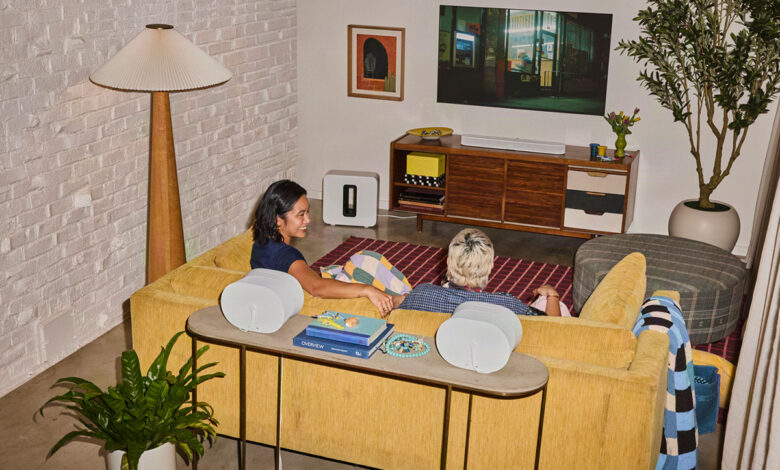
A Sonos Move 2 could provide music wherever it happens to be needed during the day. Place it behind the listening position in the evening, and Sonos 27 is intended to recognise its new location and turn it into a rear channel for the Home Cinema system. Move it again, and the speaker returns to its previous purpose.

This ability to change roles offers the clearest route into Sonos 27. Sonos Inc. is not presenting another collection of app functions under a new version number. The company wants the system itself to understand more about the products connected to it, where they are located and how they should work together at a particular moment.


Headphones, voice control, web access and external AI assistants extend this principle beyond the speakers. Sonos 27 is consequently less about one spectacular feature than about changing the relationship between all parts of the Sonos ecosystem.
Key Facts Sonos 27
- New generation of the audio operating system from Sonos Inc.
- Software update for all products based on the Sonos S2 platform
- Sonos Fabric as the foundation for Portable Surrounds and Headphone Linking
- Sonos Positioning Technology detects speaker location using high-frequency sound signals
- Sonos Move 2 and Sonos Play can be used as temporary rear surround speakers
- Headphone Linking initially available exclusively for Sonos Ace Ultra
- Sonos 27mcp connects external AI assistants and agents, including ChatGPT
- Sonos 27voice developed for music and mood-based curation
- Sonos Custom Agents with individual models, personas and voices announced
- Revised navigation for Sonos 27app
- Additional control through Sonos 27voice and Sonos 27web
- Staged rollout begins on 8 September 2026
- Several functions initially launch in Early Access
- Available features depend on the Sonos hardware used
From Portable Speaker to Rear Surround
Products in a networked audio system have traditionally been assigned a room and a function during setup. A speaker installed in the living room remains a living-room speaker; rear channels belong permanently to the Home Cinema configuration. Portable products may be moved physically, but their role within the system does not necessarily follow them.
Portable Surrounds is designed to loosen this rigid allocation. According to Sonos Inc., Sonos Positioning Technology employs high-frequency sound signals to establish the location of a compatible speaker. Once the system recognises that a Sonos Move 2 or Sonos Play has been positioned behind the listener, it can assign the product to a rear surround channel.
The same speaker can be removed again and used independently elsewhere. This creates a plausible everyday use for hardware that would otherwise spend much of its time committed to just one task.
The idea is compelling precisely because it addresses the way people actually use portable speakers. Whether it proves equally convincing in practice will depend on the reliability of the position detection and on how little intervention is required when moving between the two operating modes.
Headphones Become Part of the Home System
Sonos Ace Ultra approaches the same question from a different direction. Headphone Linking connects the headphones directly to a nearby Sonos system and allows playback to move between the products in the room and the listener’s ears.
This gives Sonos Ace Ultra a role that extends beyond conventional Personal Audio. The headphones become another destination within the domestic system, rather than an independent device that happens to share its brand and app environment with the speakers.
Headphone Linking is due to enter Early Access on 29 September 2026 and will initially be reserved for Sonos Ace Ultra. The restriction makes clear that the broader reach of Sonos 27 does not translate into identical functionality across every generation of hardware.
One Foundation for Two Very Different Features
Portable Surrounds and Headphone Linking address different listening situations, but Sonos Inc. places both under the same technical umbrella. That foundation is Sonos Fabric.
Sonos Fabric is intended to enable compatible products to recognise one another and adjust their behaviour to the current situation. The system does not merely establish that a component is available on the network. It uses information about proximity or position to determine how that component should participate in playback.
This is where Sonos 27 begins to differ from a conventional software update. Individual features matter, but the underlying architecture is meant to support a system in which the relationship between products can change without requiring a completely new configuration each time.
Control Is No Longer Confined to the App
The Sonos app remains part of the experience, but Sonos Inc. no longer describes it as the sole centre of operation. Sonos 27app is instead one of several interfaces that can access the same underlying system.
Its navigation has been revised with input from the Sonos community. The company says the changes are intended to make the app clearer and more intuitive, although the announcement does not yet provide a detailed list of every modification.
Alongside the app, Sonos 27web and Sonos 27voice offer additional means of control. Sonos 27voice is the company’s own assistant, developed specifically for music playback and the selection of content to suit a requested mood.
Sonos 27mcp extends this choice beyond services developed by Sonos itself. It provides an interface through which external AI assistants and agents can connect to the Sonos system. ChatGPT is one of the examples explicitly named by Sonos Inc.
“With this Sonos integration, people can ask ChatGPT from their smartphone or computer to play music anywhere in their home without leaving the conversation they are having. It is a simple way to stay in the moment, and we are looking forward to making it available to Sonos listeners around the world.”
Atty Eleti, Product Lead for ChatGPT Voice at OpenAI
Custom Agents Point Beyond Voice Control
Sonos Custom Agents indicate how much further the company wants to take this approach. Users are expected to be able to create individual agents, each based on its own model, personality and voice.
Such agents would turn AI control into something more personal than choosing between a handful of predefined assistants. They also fit Sonos Inc.’s decision not to commit its platform to one universal AI solution.
For the moment, Custom Agents remain an announcement rather than an available component of Sonos 27. Sonos Inc. has not provided a launch date, and the practical scope of the function has yet to be defined.
Why Call It an Audio Operating System?
Sonos was conceived as a distributed audio system long before wireless multiroom speakers became commonplace. Its products were built to operate individually in different rooms or to work together as one installation. Sonos 27 now gives the software responsible for that coordination a much more prominent identity.
Calling it an audio operating system shifts attention away from the individual control application. The app becomes an interface, while the operating system manages the wider relationship between hardware, software and the available forms of control.
That distinction also explains why Sonos Inc. is presenting functions as different as position-aware speakers, headphone integration and access for external AI agents as parts of one release. Their common feature is not a shared operating screen, but their dependence on the same system architecture.
“Twenty years ago, we made a bet on something that the rest of the industry is only now arriving at – a home deserves its own audio operating system. We built our system around a shared love of music and the belief that nothing shapes a mood quite like great sound. Sonos 27 takes this idea further, combining acoustic engineering, adaptable software, intelligence and design in a way that only Sonos can. This is only the beginning of what our audio operating system can do.”
Tom Conrad, CEO of Sonos Inc.
New Hardware Shows Where the Platform Is Heading
Sonos Beam Ultra and Sonos Ace Ultra are being introduced alongside Sonos 27. In this context, their importance lies in the way they represent two sides of the expanded system rather than simply adding another soundbar and another pair of headphones to the portfolio.
Sonos Beam Ultra is described by the manufacturer as a mid-size soundbar capable of genuine 7.1.2 Dolby Atmos reproduction. It provides the Home Cinema environment in which the concept of adaptable rear surround speakers becomes relevant.
Sonos Ace Ultra has been designed at hardware level for closer integration with the Sonos system. Headphone Linking is the first function to demonstrate that connection, although it will initially remain an Early Access feature.
The two products therefore serve as the first hardware representatives of the Sonos 27 strategy. They also illustrate why a software update for the entire S2 platform does not automatically place every Sonos product on the same functional level.
A Platform Arriving Function by Function
The Sonos 27 rollout begins in September 2026, but there will be no single date on which every announced capability becomes available. Different elements are being introduced separately, and several will start in Early Access.
| Function | Planned Launch | Requirement or Limitation |
|---|---|---|
| Sonos 27 | Staged rollout from September 2026 | Software update for Sonos S2 products; available features depend on the hardware |
| Revised Sonos 27app navigation | 8 September 2026 | Updated Sonos app |
| Sonos 27mcp | 8 September 2026 | Initially available in Early Access |
| Portable Surrounds | 8 September 2026 | Sonos Move 2 or Sonos Play |
| Headphone Linking | 29 September 2026 | Early Access and initially exclusive to Sonos Ace Ultra |
| Sonos Custom Agents | Not yet announced | No confirmed launch date |
The revised navigation for Sonos 27app, Sonos 27mcp and Portable Surrounds are scheduled to begin rolling out on 8 September 2026. Headphone Linking follows on 29 September 2026 together with the general availability of Sonos Ace Ultra.
Custom Agents belong to a later stage whose timing is still unknown. The Sonos 27 available at launch will therefore establish the direction of the platform without immediately delivering every part of the announced concept.
Openness Has a Specific Meaning Here
Sonos Inc. speaks of an open platform, but that description must be read in the correct context. Its openness concerns the choice of AI assistants and agents that may be used to control the system. Sonos 27 itself remains the operating system of a proprietary hardware ecosystem.
Even within that ecosystem, compatibility is graduated. All products based on Sonos S2 are due to receive Sonos 27, yet functions such as Portable Surrounds and Headphone Linking require particular models. Some capabilities are also launching in Early Access rather than as finished features available without qualification.
For owners of existing systems, the relevant question is consequently not only whether Sonos 27 will be installed. They will also need to establish which functions their hardware supports and whether those functions are already fully available.
This does not undermine the platform concept, but it defines its starting point. Sonos 27 presents a broad view of how the system could develop while initially providing only the first practical examples.
The Most Important Advantages at a Glance
- Flexible product roles: Compatible speakers can change their function according to their position and the current listening situation.
- Portable rear channels: Sonos Move 2 and Sonos Play can temporarily become rear surround speakers.
- Closer headphone integration: Headphone Linking connects Sonos Ace Ultra directly to the home system.
- A choice of AI assistants: Sonos 27mcp supports connections to external assistants and agents, including ChatGPT.
- Dedicated music assistance: Sonos 27voice focuses on playback and mood-based music selection.
- Several control interfaces: Sonos 27app, Sonos 27voice and Sonos 27web provide different routes into the same system.
- Wide software availability: Sonos 27 is intended as an update for all products based on the Sonos S2 platform.
- Scope for personalisation: Sonos Custom Agents are designed to support individual models, personalities and voices.
Price & Availability
Sonos Inc. does not charge a separate price for Sonos 27. The audio operating system will be distributed as a software update for existing products based on the Sonos S2 platform. The functions available on each system will depend on the hardware in use.
The revised navigation for Sonos 27app, Sonos 27mcp in Early Access and Portable Surrounds for Sonos Move 2 and Sonos Play are scheduled to become available from 8 September 2026.
Sonos Beam Ultra and Sonos Ace Ultra have been available to pre-order since 1 September 2026 and are due to go on general sale on 29 September 2026. Headphone Linking will enter Early Access on the same day and will initially be exclusive to Sonos Ace Ultra. Prices and full details of the two new products are addressed in their respective reports.
Getting to the Point
The most revealing aspect of Sonos 27 is not artificial intelligence on its own. It is the attempt to make the entire system less dependent on fixed assignments: one speaker for one room, one pair of headphones outside the home system and one app as the central means of control.
Portable Surrounds provides the strongest illustration because its benefit is immediately understandable. A portable speaker can retain the freedom for which it was designed and still take on a defined role in a Home Cinema system when required. Headphone Linking applies a similar logic to Sonos Ace Ultra, while the different control options extend flexibility to the way users interact with the system.
Sonos Inc. is nevertheless describing a platform in advance of its complete implementation. Early Access restrictions, model-specific compatibility and the absence of a launch date for Custom Agents require a clear distinction between what Sonos 27 delivers at launch and what it promises for the future.
Even with those qualifications, the direction is coherent. Sonos 27 treats software not merely as the means of controlling a collection of products, but as the layer that decides how those products can work together. That is the real change behind the new name.
| Product | Sonos 27 |
|---|---|
| Price | Free for existing systems |
| Brand | Sonos Inc. |
|---|---|
| Manufacturer | Sonos Inc. |
| Distribution | Sonos Inc. |
| More about this manufacturer at HiFi BLOG |