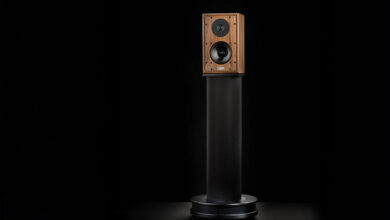


Wharfedale Denton 1S – Compact two-way coaxial loudspeaker for the Wharfedale Heritage Series
The Wharfedale Denton 1S is not another rose-tinted exercise in loudspeaker nostalgia. Inspired by the 1974 Wharfedale Denton 1, it takes the idea of a compact, flexible, coaxial two-way speaker and rethinks it with current acoustic engineering. The result is a Heritage Series model that looks less like a museum piece and more like a loudspeaker designed for real rooms, real furniture and real listening habits.


- Wharfedale has chosen one of its more distinctive Denton designs as the starting point for the new Denton 1S, rather than simply repeating the familiar wood-veneered retro formula. Its coaxial driver, rear brilliance adjustment and flexible placement options give this compact speaker a notably practical edge.
Wharfedale is extending the Wharfedale Heritage Series with a loudspeaker that deliberately steps away from the classic wood-veneer aesthetic associated with many retro-inspired models. The new Wharfedale Denton 1S looks back to the Wharfedale Denton 1 of 1974, a compact loudspeaker with which Wharfedale pursued a more modern, flexible and function-led design language at the time.

Key Facts
- Compact passive two-way loudspeaker from the Wharfedale Heritage Series
- Inspired by the 1974 Wharfedale Denton 1
- Newly developed coaxial driver with a shared acoustic centre
- 25 mm silk dome tweeter and 165 mm polypropylene mid/bass driver
- Designed for coherent imaging, stable spatial reproduction and a wide listening area
- Bass reflex cabinet with 11,5 litre internal volume and bass extension down to 45 Hz at -6 dB
- Rear-mounted Brilliance switch for adaptation to different placement situations
- Suitable for stands, shelves, sideboards, desktop use or wall mounting
- Available in Matt Black, Matt White and Matt Blue
- Available from the end of May 2026 at £ 649,- per pair
The new Denton 1S is not a straightforward revival. Wharfedale describes it instead as a ground-up reinterpretation of the original concept: compact dimensions, a cabinet with softly rounded edges, flexible placement options and a newly engineered coaxial driver that allows both ways to radiate from a common acoustic centre. In doing so, the Denton 1S is intended to connect with familiar Wharfedale virtues while presenting itself quite deliberately as a loudspeaker for contemporary living spaces.




A classic as the starting point, not a retro copy
The original Wharfedale Denton was first introduced in 1967 and stood for compact HiFi sound at an attractive price. In 1974, the Wharfedale Denton 1 followed and occupied a special place within the Denton story. It moved away from the conventional wood-cabinet appearance of the period and instead adopted a moulded plastic enclosure with rounded edges. Acoustically, too, it was unusual, since its driver layout was based on a coaxial arrangement.
That is precisely the idea Wharfedale is now revisiting. The Wharfedale Denton 1S takes the conceptual cornerstones of the earlier model – compact form, rounded enclosure, coaxial radiation and flexible positioning – but implements them with current loudspeaker technology. That distinction matters. The Denton 1S is not intended merely to look nostalgic; it is intended to work as a modern compact loudspeaker.


Coaxial driver as the central technical feature
At the heart of the Wharfedale Denton 1S is a newly developed two-way coaxial driver. A 25 mm silk dome tweeter sits concentrically in the centre of a 165 mm polypropylene mid/bass driver. Both ways therefore radiate from a shared acoustic centre.
The appeal of this principle lies in particularly coherent imaging. Timing and phase behaviour can be controlled with great precision in such a configuration, which should translate into stable stereo focus, convincing spatial definition and a more even tonal balance across a broader listening area. In rooms where loudspeakers cannot be positioned perfectly symmetrically or well away from boundaries, this is more than an academic point; it is a practical advantage.
For the mid/bass driver, Wharfedale uses a further-developed polypropylene cone. This is intended to combine stiffness, low mass and controlled self-damping in a favourable balance. The aim is a clean midrange with reduced colouration and good transient behaviour. The tweeter uses a damped rear chamber and a powerful magnet system, designed to deliver treble that is smooth, but still sufficiently open and detailed.
Crossover with Brilliance switch
The crossover of the Wharfedale Denton 1S was developed under the direction of Peter Comeau, Director of Acoustic Design at Wharfedale. It uses fourth-order Linkwitz-Riley filters at 2,6 kHz. Wharfedale emphasises that the tuning was not determined by calculation alone, but also by extensive listening tests.
A particularly practical detail is the rear-mounted Brilliance switch. It offers two positions, “norm” and “max”. In the max position, the range between 2 and 4 kHz is raised by 1,5 dB. This is intended to help the Denton 1S adapt more readily to different placement conditions, for example when used close to a wall, on a shelf or on a sideboard.
For a compact loudspeaker that is explicitly not designed solely for conventional stand-mount use, this type of adjustment makes sense. It adds flexibility and acknowledges the reality of domestic listening, where loudspeakers often have to sit where the room permits rather than where the acoustics would ideally dictate.


Compact cabinet with bass reflex tuning
The Wharfedale Denton 1S measures 330 x 236 x 229 mm, making it a genuinely compact loudspeaker. The cabinet has an internal volume of 11,5 litres and uses a rear-facing bass reflex port. The port is flared at both ends, with the inner flare executed in a soft rubber material to reduce airflow noise.
Wharfedale specifies bass extension down to 45 Hz at -6 dB. For a loudspeaker of this size, that is a notable figure, particularly as the Denton 1S is not being positioned merely as a nearfield monitor, but as a fully fledged compact HiFi loudspeaker.
The cabinet construction differs significantly from the historical model that inspired it. Instead of a moulded plastic enclosure, Wharfedale uses a multi-layer wood-based construction with fibreboards of different thicknesses, internal bracing and targeted damping. This is intended to control cabinet resonances and improve mechanical stability. The fact that the front baffle requires only one large driver cut-out also contributes to its rigidity.
Flexible placement: stands, shelves or wall mounting
The Wharfedale Denton 1S is primarily conceived as a compact HiFi loudspeaker for use on stands, but it can also be placed on shelves, lowboards, desks or close to a wall. A 3/8 inch mounting point on the rear also allows wall mounting.
Wharfedale is therefore positioning the Denton 1S as a loudspeaker for different domestic scenarios. It is designed not only for a conventional stereo system, but also for situations where larger loudspeakers are simply not practical. With a sensitivity of 88 dB and a nominal impedance of 8 Ohm, with a minimum of 4,5 Ohm, it should also be comparatively straightforward to partner with a broad range of amplifiers.
Modern design rather than classic wood finish
While many models in the Wharfedale Heritage Series lean strongly into classic wood finishes, mid-century cues and traditional proportions, the Wharfedale Denton 1S takes a different route. Its inspiration lies in the more progressive design language of the 1970s.
The cabinet features gentle curves, a matt lacquer finish and a classic cloth grille. The Denton 1S is available in Matt Black, Matt White and Matt Blue. The blue finish in particular introduces a deliberately contemporary accent, setting the Denton 1S apart from the more traditionally styled Heritage models. The Heritage badge on the removable, magnetically attached grille nevertheless maintains a clear link to Wharfedale history.
Price and availability
The Wharfedale Denton 1S is scheduled to be available from the end of May 2026. It will be offered in Matt Black, Matt White and Matt Blue. The recommended retail price is £ 649,- per pair.
Conclusion
With the Wharfedale Denton 1S, Wharfedale is adding a loudspeaker to the Heritage Series that does not simply rely on the familiar signals of retro design. Instead, the Denton 1S picks up an unusual chapter from the company’s own history and translates it into a modern, compact loudspeaker concept.
Its new coaxial driver, flexible placement options, Brilliance switch and deliberately contemporary styling make the Denton 1S an interesting counterpoint to many classically drawn compact loudspeakers. It feels less like a nostalgic keepsake and more like a compact HiFi loudspeaker that uses Wharfedale’s past as material for a very present-day product.
| Product | Wharfedale Denton 1S |
|---|---|
| Price | £ 649,- |
Technical specifications
| Product | Wharfedale Denton 1S |
|---|---|
| Characterisation | Compact passive two-way loudspeaker |
| Series | Wharfedale Heritage Series |
| Design principle | Two-way coaxial system |
| Tweeter | 25 mm silk dome |
| Mid/bass driver | 165 mm polypropylene cone |
| Cabinet principle | Bass reflex |
| Bass reflex port | Rear-facing, double-flared |
| Internal volume | 11,5 litres |
| Bass reproduction | Down to 45 Hz at -6 dB |
| Crossover | Fourth-order Linkwitz-Riley |
| Crossover frequency | 2,6 kHz |
| Sound tuning | Brilliance switch with “norm” and “max” |
| Brilliance switch | 1,5 dB lift between 2 and 4 kHz in “max” position |
| Sensitivity | 88 dB |
| Impedance | 8 Ohm, minimum 4,5 Ohm |
| Power handling | Up to 100 Watt |
| Placement | Stands, shelf, sideboard, desktop, wall mounting |
| Wall mounting | 3/8 inch mounting point |
| Dimensions | 330 x 236 x 229 mm |
| Finishes | Matt Black, Matt White, Matt Blue |
| Brand | Wharfedale |
|---|---|
| Manufacturer | IAG Group Ltd. |
| Distribution | IAD GmbH |
| More about this manufacturer at HiFi BLOG |