

Shanling M3 Plus Master – A better judged portable player
Some product updates are made to create noise. Others are made to make a good device feel properly finished. The Shanling M3 Plus Master belongs in the latter category, refining Shanling’s established platform with more memory, a revised audio stage and a stronger sense of ease in daily use.

- The Shanling M3 Plus Master is not trying to reinvent the portable player. Its appeal lies in something more convincing: a proven design, revisited with better judgement, better balance and a clearer sense of what experienced listeners actually value.
There is a particular kind of product update that deserves more attention than it usually gets. Not the dramatic relaunch, not the spec-sheet explosion, not the performative redesign meant to signal change at a glance. Something quieter than that. Something more deliberate. The Shanling M3 Plus Master appears to be exactly that kind of machine.

Rather than scrapping the Shanling M3 Plus and replacing it with an all-new concept, Shanling has chosen the more disciplined route. It has kept the platform, kept the broad architecture and kept the core proposition intact, then gone back into the details that define whether a portable player merely looks competitive or actually feels right once it becomes part of everyday listening. That makes the Shanling M3 Plus Master more interesting than a superficial model refresh might suggest.




Portable HiFi is full of products that look persuasive in bullet points and feel less convincing in the hand. In this category, isolated headline features only tell part of the story. The real measure is how well the whole device behaves once the music starts and the listening routine settles in. Does the operating system move with confidence? Does the player remain calm when multiple apps and wireless functions are in play? Does the audio stage sound composed, unforced and properly sorted, or does it lean on brightness and edge to create a false impression of precision? These are the questions that separate a merely competent DAP from one that earns long-term respect. Shanling seems to understand that, and the Shanling M3 Plus Master is framed accordingly.
Key Facts
- Shanling M3 Plus Master as the new Master Edition of the previous Shanling M3 Plus
- 6 GB RAM for smoother system performance under heavier app load
- Revised audio section with optimised power supply and adjusted capacitors
- According to the manufacturer, slightly revised sound tuning with a somewhat fuller, gentler character and a more open soundstage
- Android 13 as an open platform
- Four Cirrus Logic CS43198 DACs and two SGM8262 amplifier stages
- 4,7 inch display, 64 GB internal storage and microSD card slot
- 3,5 mm connection and 4,4 mm Pentaconn
- Bluetooth 5.0 with LDAC and aptX HD in transmission mode
- Price: € 599,-, market launch at the end of March 2026
Not a reinvention, and better for it
The original Shanling M3 Plus was already more serious than many compact digital audio players in its class. It offered an open Android 13 platform, a Qualcomm Snapdragon 665 processor, a 4,7 inch display, four Cirrus Logic CS43198 DAC chips and a balanced output stage with enough substance to make the player feel like more than a casual portable gadget. It had the bones of a proper enthusiast machine.
What Shanling now appears to be doing with the Shanling M3 Plus Master is less dramatic but arguably more useful. The focus shifts away from novelty and towards the way a device settles into real ownership. That matters because a modern Android-based player is expected to do far more than decode files correctly. It has to handle streaming services, local playback, library management, wireless headphones, app switching and background tasks with a degree of calm that makes the device feel trustworthy rather than merely powerful on paper.
That is why the move to 6 GB RAM matters. More memory does not alter the basic sonic identity of the player, nor should it be sold as if it does. Its value lies elsewhere. It should allow the Shanling M3 Plus Master to feel less pressed, less brittle and more fluid under heavier day-to-day demands. That kind of ease is often more valuable than any single spectacular specification, because it shapes the experience every time the device is used.

A more considered audio stage
The more revealing part of the update is the work done around the audio section. Shanling says the power supply has been revised and that different capacitors have been introduced. Those are not the sort of changes that lend themselves to easy marketing theatre, but they are often exactly the kind of changes that matter in serious audio design, especially in compact portable hardware where circuit density, thermal limitations and shared internal space can all work against sonic composure.
According to the manufacturer, the Shanling M3 Plus Master has been tuned for a slightly fuller, smoother and more open presentation, with a modest uplift in clarity. What makes that description interesting is that it points away from the usual trick of dressing up a sound with extra edge and calling it detail. Shanling seems to be aiming for something more mature than that: more space around instruments, a more relaxed sense of projection and a tonal balance that favours flow over glare.
If that is indeed how the player behaves in practice, then the Shanling M3 Plus Master could prove more rewarding than products that chase instant impact at the expense of long-term listenability. Portable players are often judged too quickly. The ones that last are not always the most obviously spectacular in the first ten minutes. They are the ones that continue to sound civilised, articulate and musically coherent after far longer sessions. That appears to be the direction Shanling is pursuing here.
Four DACs, proper drive capability
Crucially, Shanling has not tampered with the broader hardware structure that made the original design compelling in the first place. The Shanling M3 Plus Master still relies on four Cirrus Logic CS43198 DACs and two SGM8262 amplifier stages. Even before one gets into the numbers, that tells you something useful about the product’s intent. This is not a lifestyle object dressed up in enthusiast language. It is a portable source designed for people who will actually care how the analogue stage is executed.
The practical significance becomes clearer at the output stage. The 4,4 mm Pentaconn connection provides enough power to make the player relevant not just for efficient in-ear monitors but also for more demanding portable headphones that benefit from firmer grip and greater dynamic headroom. That broadens the Shanling M3 Plus Master considerably. A DAP becomes much more persuasive when it is not tied to one narrow listening scenario. The 3,5 mm connection remains available for conventional use, while the balanced output gives the device room to behave with more authority where it counts.
Android 13 remains central to the appeal
Equally important is Shanling’s decision to retain Android 13 as the platform. A current-generation DAP that limits how people access music risks feeling outdated, however strong its audio hardware may be. Listening habits are now too varied for that. Some users stream almost everything. Others rely on local libraries. Many move between both, often within the same day. An open Android platform remains one of the most effective ways to accommodate those realities without forcing the user into a rigid ecosystem.
That flexibility is part of what gives the Shanling M3 Plus Master broader relevance. It is not locked into the narrow identity of a file player for specialists. It can serve as a more complete portable source device, open to streaming services, local playback and a range of system roles beyond standalone listening. Shanling also confirms USB DAC Mode and USB Transport functionality, both of which increase the player’s practical value. Used one way, it is a self-contained personal player. Used another, it becomes part of a larger portable or desktop setup. That kind of range matters.
Hi-res Audio support with ample headroom
Format support remains extensive. The Shanling M3 Plus Master handles Linear PCM up to 32 Bit and 768 kHz as well as DSD512. Of course, figures of that kind can easily turn into shorthand for technical ambition rather than everyday necessity. Still, there is real value in not having to think about limitations. Anyone with a varied library, a mixture of download sources or a tendency to move between formats will appreciate the fact that the player appears to have enough decoding headroom to remain untroubled by almost any sensible music collection.
Wireless use taken seriously
Bluetooth is integrated with a level of seriousness that makes the Shanling M3 Plus Master more flexible than a traditional DAP stereotype would suggest. Bluetooth 5.0 is supported, including SBC, AAC, aptX, aptX HD and LDAC for transmission, plus SBC and LDAC in reception mode. That gives the player a broader role in daily use. It can feed compatible wireless headphones at a higher standard than the baseline codecs allow, while also working as a Bluetooth receiver when needed.
That matters because it expands the device beyond the old image of a portable player as a self-contained niche object. The Shanling M3 Plus Master starts to look more like a compact mobile audio hub, able to adapt to different listening habits rather than insisting on one purist use case.
Externally familiar, intentionally so
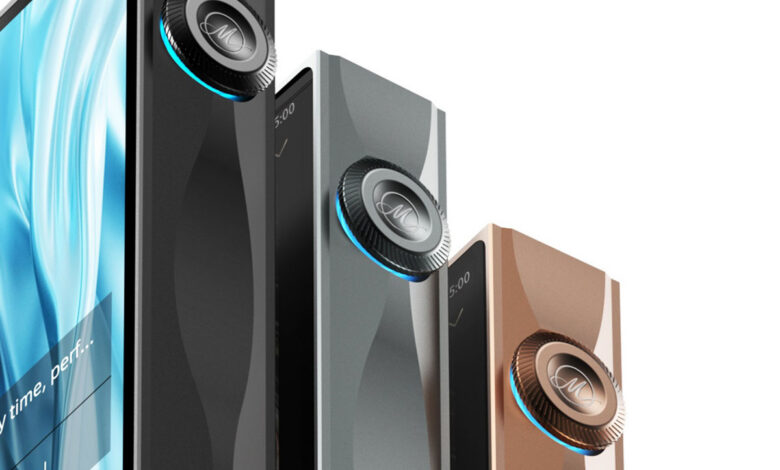
On the outside, Shanling has resisted the urge to redesign the player simply to make the update more visible. The Shanling M3 Plus Master keeps the established chassis, the same broad industrial design language and the same colour variants as the earlier Shanling M3 Plus. That is a sensible decision. The existing form factor was already compact, practical and visually coherent.
The differences are more restrained. An engraved M logo on the volume wheel and a new start-up animation distinguish the Master Edition, but the restraint is telling. Shanling does not seem interested in presenting this as a loud generational break. The Shanling M3 Plus Master is positioned instead as a more resolved, more carefully finished interpretation of a platform that already had a strong foundation.
Price and availability
According to the manufacturer, the Shanling M3 Plus Master is expected to reach the market at the end of March 2026 at a price of € 599,-. That places it clearly above the standard Shanling M3 Plus. Shanling points to increased memory component costs as part of the explanation, but the more relevant point is that the higher price is tied to recognisable improvements. The additional RAM and the revised audio section suggest that this is not a decorative special edition, but a version shaped by deliberate technical and practical refinement.
Conclusion
The Shanling M3 Plus Master does not try to win attention by pretending to be something radically new. Its case is more measured than that, and more credible. Shanling appears to have taken a capable portable player and worked on the parts that determine whether it feels genuinely accomplished: smoother behaviour under real-world use, broader composure in system operation and an audio stage that, according to the manufacturer, aims for greater ease, openness and tonal maturity. In a market where too many updates are designed to be noticed first and understood later, the Shanling M3 Plus Master makes a more convincing argument. It looks like a player refined not for effect, but for better listening.
| Product | Shanling M3 Plus Master Android Portable Player |
|---|---|
| Price | € 599,- |
Technical Specifications
| Product | Shanling M3 Plus Master Android Portable Player |
|---|---|
| Characterisation | Portable Hi-res Audio player with Android operating system, designed for demanding mobile listening via headphones and in-ear monitors, as well as a flexible digital and analogue control centre |
| Platform | Android 13, relevant for broad app compatibility and flexible use with streaming services, local library and additional functions |
| Processor | Qualcomm Snapdragon 665, important for smooth navigation, app management and stable multitasking |
| Memory | 6 GB RAM, for higher app load and a calmer, smoother user experience in everyday use |
| Internal Storage | 64 GB |
| Storage Expansion | microSD card slot, practical for extensive local music libraries |
| Display | 4,7 inch display with 1.280 x 720 pixels, relevant for a clear overview of library, streaming apps and system settings |
| DAC | Four Cirrus Logic CS43198, designed for high-resolution, clean signal processing with fine detail rendering and good transparency |
| Amplifier | Two SGM8262, relevant for powerful output stages and assured control even with more demanding portable headphones |
| Audio Tuning | Revised power supply and adjusted capacitors, according to the manufacturer with a somewhat fuller, gentler sound character, a more open soundstage and slightly increased clarity |
| Headphone Outputs | 3,5 mm connection and 4,4 mm Pentaconn |
| Output Power 3,5 mm | Up to 200 mW at 32 Ohm, suitable for many portable headphones and in-ear models |
| Output Power 4,4 mm Pentaconn | Up to 800 mW at 32 Ohm, relevant for greater dynamic reserves, better control and more authority with more power-hungry headphones |
| Dynamic Range | Up to 130 dB via 4,4 mm Pentaconn, indicating high fine detail rendering and good layering of quiet details |
| Signal-to-Noise Ratio | Up to 130 dB via 4,4 mm Pentaconn, important for a calm, clean background |
| Distortion | THD+N according to the manufacturer 0,0007 percent, indicating clean and precise reproduction |
| Bluetooth Transmission Mode | Bluetooth 5.0 with LDAC, aptX HD, aptX and SBC |
| Bluetooth Reception Mode | Bluetooth 5.0 with LDAC and SBC |
| USB Functions | USB DAC Mode and USB Transport, practical for use as an external DAC or as a digital source for additional devices |
| Supported Formats | Linear PCM up to 32 Bit and 768 kHz as well as DSD512, therefore designed for very broad Hi-res Audio support |
| Battery | 3.500 mAh |
| Battery Life | Up to 14 hours via 3,5 mm connection and up to 11 hours via 4,4 mm Pentaconn, decisive for genuine mobile use without constant recharging |
| Dimensions | 115 x 70 x 18 mm |
| Weight | 205 g |
| Special Features | M logo on the volume wheel and new start-up animation as distinguishing features of the Master Edition |
| Colours | Available in the same colour variants as the previous Shanling M3 Plus |
| Brand | Shenzhen Shanling Digital Techno |
|---|---|
| Manufacturer | Shanling Audio |
| Distribution | NT Global Distribution GmbH |
| More about this manufacturer at HiFi BLOG |