

ORIGIN by PIEGA 4.0 Review – How Much High-end HiFi Can You Have at a Small Price?
The ORIGIN by PIEGA 4.0 is a 33 cm two-way bass-reflex bookshelf speaker with an MDF cabinet, a 140 mm mid/woofer and an AMT-1 air motion transformer tweeter. Swiss manufacturer PIEGA SA has stepped away from its signature aluminium enclosures to bring its sound philosophy to a wider audience on a modest budget. We auditioned it at Audio Exclusive in Wels with Technics electronics and Qobuz, and came away impressed by its refinement, its coherence and its sheer musical enjoyment.

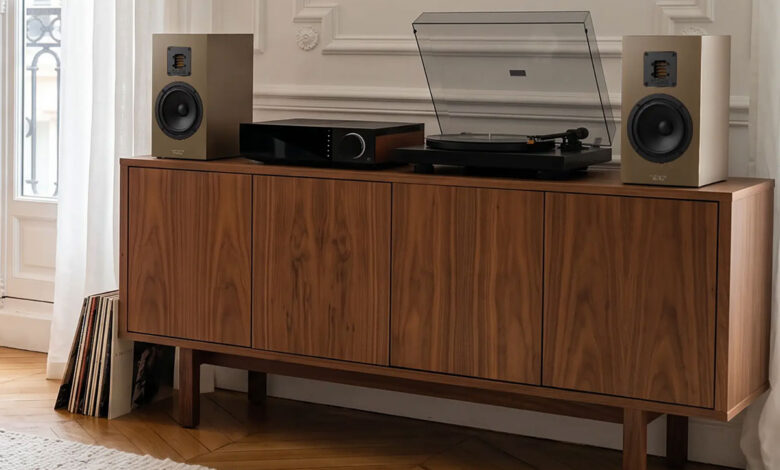
- The ORIGIN by PIEGA 4.0 from Swiss manufacturer PIEGA SA is a compact two-way bass-reflex speaker with an MDF cabinet, a 140 mm mid/woofer and a specially adapted AMT-1 air motion transformer tweeter, offered in Gunmetal Grey or Sand Matt through selected specialist dealers only. In our listening tests it combined finely resolved treble, a natural midrange and well-controlled bass with real versatility across genres, which makes it a sound foundation for a first serious system that can grow with better electronics, and an attractive option for smaller listening rooms.
Few things are as rewarding in this hobby as being made to rethink expectations built up over many years. The ORIGIN by PIEGA 4.0 did exactly that. It is the smallest stereo loudspeaker in the new ORIGIN by PIEGA Series from Swiss manufacturer PIEGA SA, it stands just 33 cm tall, and yet its musical expressiveness, refinement and distinct character make it, in our view, one of the most interesting new arrivals at its price.

Key Facts – ORIGIN by PIEGA 4.0
- Compact passive two-way bass-reflex loudspeaker
- Part of the separately positioned ORIGIN by PIEGA Series
- High-quality MDF cabinet
- Specially adapted AMT-1 tweeter based on the air motion transformer principle
- 140 mm mid/woofer
- Elaborately developed and carefully voiced crossover
- Frequency response: 42 Hz to 40 kHz
- Sensitivity: 88 dB/W/m
- Nominal impedance: 4 ohms
- Recommended amplifier power: 20 to 200 watts
- Swiss product design by Hürlemann
- Two finishes: Gunmetal Grey and Sand Matt
- Magnetically attached front grilles
- Sold through selected specialist dealers
Table of Contents
A separate line, not simply a cheaper PIEGA
This is not just another affordable model slotted into the regular PIEGA catalogue. The company positions ORIGIN by PIEGA as a standalone line outside its standard range, sold exclusively through selected specialist dealers. It is an understandable decision, since it keeps the new speakers clearly apart from the established loudspeakers of the Swiss manufacturer.

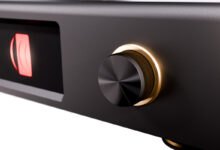
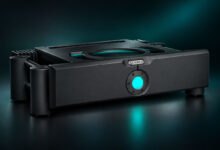


The series has three members, which we list here for completeness. Alongside our test sample, the ORIGIN by PIEGA 4.0 compact bookshelf speaker, there is the ORIGIN by PIEGA 8.0, an elegant floorstanding model. There is also, as the name suggests, the ORIGIN by PIEGA Center, a centre speaker that makes the line suitable for home cinema as well as classic two-channel HiFi.
Back to the roots, with today’s know-how
Ask anyone with a serious interest in loudspeakers what they associate with PIEGA SA and two things will probably come up: the painstaking manufacture of aluminium cabinets, and the development of exceptionally sophisticated ribbon tweeters, up to and including the company’s unique coaxial ribbon systems. Founded in 1986 in Horgen on Lake Zurich, the firm has built a remarkable position on the international market over the years. Its speakers sit in the premium segment and reach well into genuine high-end HiFi territory, which means extensive development, the finest materials and demanding production, all of which naturally carry a price.
The ORIGIN by PIEGA Series sets out to open that sound philosophy to a much wider audience, above all to music lovers taking their first steps into quality HiFi on a limited budget. PIEGA’s usual constructional approach could hardly have achieved that, because the effort that goes into those aluminium enclosures alone puts a firm ceiling on how attractively a speaker can be priced. So why not go back to the beginning?
Although today’s range would hardly suggest it, the early PIEGA speakers made in Horgen had conventional wooden cabinets. The ORIGIN by PIEGA Series deliberately picks up that thread, but with the experience and technical means of today.


The art of saving in the right place
Perhaps the hardest task in developing quality HiFi is not to explore what is technically possible regardless of cost, but to achieve the most convincing result within a fixed financial frame. That, in our view, is where the ORIGIN by PIEGA 4.0 earns its credit. The designers have evidently thought hard about where a different construction could deliver substantial savings without losing sight of what matters, which is the quality of the music.
The cabinet is the most obvious starting point. In place of elaborately produced aluminium profiles, PIEGA uses MDF (medium-density fibreboard), a material that has proved itself in loudspeaker building for decades. It has favourable acoustic properties, machines superbly and, with a sensible internal design, provides excellent conditions for a low-resonance enclosure. The real difference lies in production cost: an MDF cabinet is far cheaper to make than a comparable aluminium one, particularly when you consider the effort PIEGA puts into its metal enclosures.
The budget freed up in this way can be spent elsewhere, on the development and selection of the drive units and, not least, on getting them to work together as perfectly as possible. That the ORIGIN by PIEGA 4.0 is anything but a product dominated by the red pencil is evident from its build and finish, which meet the high standards of the Swiss manufacturer.
The AMT-1: fine detail by a different route
The treble is where the ORIGIN by PIEGA 4.0 departs most noticeably from what PIEGA owners might expect. Although the tweeter also relies on a very light diaphragm, it is not one of the classic ribbon tweeters the company has been known for over several decades. Instead PIEGA fits an air motion transformer (AMT), adapted specifically to the Swiss developers’ requirements and called the AMT-1.
The technology has historical links to the company’s own story. In PIEGA’s early years its co-founder Kurt Scheuch worked intensively on a range of tweeter technologies, among them the air motion transformer principle.
In a conventional ribbon tweeter the diaphragm moves essentially in the direction in which the sound travels. In an air motion transformer a pleated diaphragm is driven in such a way that air is alternately squeezed out of and drawn into the folds. This makes it possible to fit a comparatively large effective diaphragm area into a very small space, and the low moving mass and the particular operating principle favour an agile, finely resolved treble. These are exactly the qualities that fit the sound philosophy we have associated with PIEGA loudspeakers for many years.


Mid/woofer, port and crossover
Alongside the AMT-1 sits a mid/woofer measuring 140 mm in diameter. Its electroacoustic properties were tailored to the available cabinet volume, and the engineers opted for a bass-reflex design in order to achieve as substantial a low-frequency foundation as possible despite the compact dimensions. The port is on the rear of the cabinet, which is worth bearing in mind if the speakers will stand close to a wall.
PIEGA quotes a frequency response of 42 Hz up to 40 kHz for the compact two-way speaker, without stating a tolerance. How low such a small speaker reaches matters less to us than how well it reproduces the range it does cover. What counts is a bass foundation that gives music its substance, precise rhythmic structure and, above all, a midrange that lets voices and acoustic instruments keep their individual character. In a two-way design the mid/woofer has an especially demanding job: it must provide authority in the lower registers and also render the frequencies to which our ears are most sensitive with finesse and naturalness.
The crossover is an aspect of loudspeaker design that tends to get far too little attention, yet it largely decides whether two excellent drive units become an excellent speaker. Pairing an air motion transformer with a conventional cone mid/woofer is a tricky assignment. Differing dispersion patterns, electroacoustic behaviour and the interplay around the crossover frequency all have to be reconciled so that a single, coherent sound emerges.
PIEGA stresses that it paid special attention to the crossover of the ORIGIN by PIEGA Series. A great deal of work went not only into the basic concept and the choice of high-quality components but, above all, into the acoustic fine-tuning. This is probably where the developers’ vast experience pays off most. The quality of a loudspeaker cannot be calculated from the sum of the purchase prices of its parts. Knowing which components suit a particular job, how to match them and which measures bring the greatest gain in sound is something that takes years to learn, and the ORIGIN by PIEGA 4.0 shows what nearly four decades of experience in loudspeaker development can be worth.
Small in size, assured in style
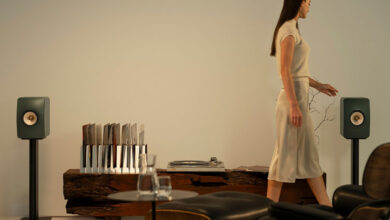
The ORIGIN by PIEGA 4.0 measures 33 cm in height, a mere 17 cm in width and 28 cm in depth. At 7 kg per speaker it weighs enough to give an impression of solid construction.
The Swiss product designer Hürlemann is responsible for the look of the entire ORIGIN by PIEGA Series, and has managed to give the speakers an individual and appealing design language despite the departure from PIEGA’s characteristic aluminium cabinets. It is a pleasingly understated approach, neither striving for an overtly luxurious appearance nor pushing the technical character of the speaker to the fore. Clean lines and well-judged proportions take centre stage, and the two finishes, Gunmetal Grey and Sand Matt, set rather different accents. Gunmetal Grey comes across as technical and elegant, whilst Sand Matt has a warmer, more homely feel.
The front grilles are held magnetically, so they can hide the drive units discreetly without any fixings spoiling the baffle. For a speaker aimed partly at people not yet familiar with traditional HiFi as a hobby, that matters. The ORIGIN by PIEGA 4.0 slots naturally into a modern home, without the room having to be turned into a dedicated listening space.
Choosing the right amplifier
With a nominal impedance of 4 ohms and a sensitivity of 88 dB/W/m, the ORIGIN by PIEGA 4.0 looks on paper like a speaker that many amplifiers could drive. PIEGA recommends an amplifier output between 20 and 200 watts, though nominal power should not be the only guide. A stable power supply, the ability to handle a 4 ohm load with confidence and the quality of the signal processing often count for far more.
We think it is worth taking particular care over the amplifier here. That is not because the speaker is unusually hard to drive, but because its sonic potential rewards high-quality electronics. It is also what makes the ORIGIN by PIEGA 4.0 an interesting long-term investment: you can start with a good, reasonably priced stereo integrated amplifier and move up to better electronics over time, without necessarily having to replace the speakers as well.
Connection is via what PIEGA calls Multi-Connectors. They accept bare cable ends as well as cables terminated with plugs such as bananas, and hold either securely for a dependable long-term connection.


Listening session at Audio Exclusive in Wels
For our test of the ORIGIN by PIEGA 4.0 we travelled to Wels in Upper Austria, to Audio Exclusive – the higher end, run by Kurt Wögerer. At a meeting with Martin Bühler of PIEGA SA, we were joined by our esteemed colleague Carsten Rampacher of AREA DVD, and had the chance to spend time with the speakers of the new ORIGIN by PIEGA Series.
Kurt Wögerer’s well-equipped listening studios offer almost ideal conditions for forming a well-founded impression of very different HiFi systems. We particularly value the faultless room acoustics, and his experience in assembling a coherent HiFi chain is a further asset. For a speaker as compact as the ORIGIN by PIEGA 4.0 it was especially tempting to explore its potential under good conditions, because poor placement, unfavourable room acoustics or the choice of other components are often what stops a speaker from showing what it can do.
The amplifier could hardly have suited us better. The Technics SU-R1000 Stereo Integrated Amplifier has been familiar to us for years, since it is also the centrepiece of the HiFi chain in our own listening room. As source we used the Technics SL-G700M2 Network/Super Audio CD Player, a partner that matches it not only visually but also in its standards. Kurt Wögerer relied on cables from the German specialist Audioplan, whose products have long played an important part in the systems assembled at Audio Exclusive.
Our only music source was the streaming service Qobuz, whose extensive catalogue of hi-res audio recordings gave us an ideal basis for a varied listening programme. Operation was particularly convenient: using Qobuz Connect in the app on our Apple iPhone 18 Pro, we controlled playback directly on the Technics SL-G700M2.
It is fair to ask whether such an ambitious chain is appropriate for a speaker whose price also targets newcomers. Yet anyone who wants to find a speaker’s real limits should avoid letting the other components become the limiting factor. That the ORIGIN by PIEGA 4.0 impressed us so much in this setting is, looking back, one of the nicest findings of the test.
What it sounds like: size is not the measure
It is remarkable how much expectation the mere sight of a loudspeaker creates. You sit down in front of a towering floorstander with a very different mindset than you do in front of a compact speaker only 33 cm tall. With the latter, many listeners are prepared to accept certain limitations in advance and almost unconsciously judge the sound against the dimensions of the box.
With the ORIGIN by PIEGA 4.0 that way of thinking proved misplaced very quickly. What impressed us was not a sound that was respectable for its size. It was a sound of notable quality, regardless of how big the speaker is.
Above all it is the finesse of the reproduction that we liked. The AMT-1 conveys a wealth of musical information without constantly drawing attention to itself. Resolution is not staged as a prominent treble; it is simply part of the music. The midrange is at least as noteworthy. With voices and acoustic instruments in particular, the value of a carefully balanced tonal character becomes obvious, and timbre, texture and expressiveness determine the character of the sound. That the developers managed to pair the AMT-1 with a mid/woofer that blends so convincingly into the overall picture deserves particular recognition.
This also explains why PIEGA’s people stressed the importance of the crossover when we spoke. The aim is not to combine an especially fine tweeter with the most capable mid/woofer possible, but to forge the two into one acoustic unit, and that is one of the speaker’s main strengths. No single aspect is staged spectacularly. The appeal lies in the sum of its qualities and the way they add up to a convincing musical whole.
We do not take that for granted in this price class. Speakers here often suggest detail through a prominent treble, or try to create an impression of a voluminous sound with an exaggerated upper bass. In our view the ORIGIN by PIEGA 4.0 has no need to compete for the listener’s favour with such effects.
The compact build also brings some appealing advantages for imaging. At this size it is fascinating how little the physical dimensions of the drivers need to have to do with the perceived scale of the music.
In the bass, one should not harbour illusions. A single 140 mm mid/woofer in a comparatively small cabinet cannot move the volumes of air that a generously sized floorstander can. But the musical quality of the bass cannot be measured by depth and maximum sound pressure alone. Contour, precision and the ability to convey the rhythmic structure of a recording convincingly are often worth far more. This makes the speaker an appealing choice even away from supposedly ideal genres.
There is musical versatility as well. You never feel you are dealing with a speaker best suited to small acoustic ensembles, whose merits only show on carefully chosen audiophile productions. On the contrary, it is the switch between very different styles that makes the ORIGIN by PIEGA 4.0 so enjoyable. The subtle shading of a jazz recording is as much part of its repertoire as the energy of rock, the timbres of a classical ensemble or the rhythmic punch of electronic music.
When all the differentiation is done, one thing stands out above everything else: it is enormous fun to listen to music with these speakers. In this price class that is far more than a pleasant aside. It is arguably the most important thing one can say about a loudspeaker meant to win people over to high-quality HiFi.
The music we played
We deliberately made our listening programme very varied. Alongside recordings that are ideal for testing a speaker’s fine detail and naturalness, we included productions that put dynamics, rhythmic expression and bass quality first. We wanted to know how much musical freedom the ORIGIN by PIEGA 4.0 really allows, because it would be a shame if the size of the speaker always had to be kept in mind when choosing what to play.
Chantal Chamberland – Love Never Felt So Good
Chantal Chamberland’s individual reading of this song is well suited to judging how a speaker handles voices. The challenge is to keep the warmth and unmistakable character of the voice without losing transparency. Subtle phrasing, vocal texture and small dynamic gradations give such an interpretation its charm.
The blend of fine detail and musical substance that we liked so much about the ORIGIN by PIEGA 4.0 is exactly what is needed here. The point is not to put details up front, but to let them settle naturally into the performance. With voices, one of the speaker’s essential qualities emerges: it gives musical expression the weight it deserves.
Henry Mancini – The Pink Panther Theme
Henry Mancini’s best-known piece lives on its irresistible rhythm, the colours of its instruments and a special lightness of delivery. The distinctive saxophone needs proper body without losing its fine textures, and the individual instruments must be cleanly separated whilst the musical connection is kept.
For the ORIGIN by PIEGA 4.0 it is a lovely demonstration of why a compact, carefully tuned two-way speaker can be so appealing. The homogeneity of the sound, and the ability to make music something you experience independently of the cabinet dimensions, are especially valuable here. It is precisely this mix of precision and lightness that we value in the speaker.
Yello – The Expert
A test of a compact speaker’s potential would be incomplete without Yello. With its electronically generated textures, pronounced rhythmic elements and the distinctive voice of Dieter Meier, “The Expert” is a first-rate challenge. It calls for contour and precision in the bass, the ability to separate very different sound elements in space and a quick response to abrupt dynamic shifts.
Tracks like this show that bass quality is by no means just a question of how low the speaker can go. A bass that is cleanly structured, gives the rhythmic elements their punch and does not push itself forward can be musically far more convincing than a seemingly spectacular but poorly differentiated foundation. It matters here that the ORIGIN by PIEGA 4.0 does not draw its appeal from the AMT-1 alone, but comes across as a very coherent overall concept.
The Cranberries – Zombie
“Zombie” asks something quite different of a speaker. The increasingly dense guitars, the drums and the highly expressive voice of Dolores O’Riordan must be reproduced convincingly as a whole, even in the intense passages. It shows how important a balanced voicing is in the transition between midrange and treble. A speaker that is too forward makes the music tiring very quickly, whilst one that is too restrained loses much of the energy inherent in the recording.
The task is to leave the music its rough expressive power and still deliver a differentiated, easy-to-follow sound. It is a discipline that suits the musically balanced character of the ORIGIN by PIEGA 4.0 well, because an outstanding speaker should be able to convey not only pleasant sound but also the full intensity of a performance.
Holly Cole – Come Fly with Me
With Holly Cole we return to a recording that is above all about the fine shading of the performance. “Come Fly with Me” depends on its particular interpretation, the presence of the voice, the interplay of the musicians and often very subtle dynamic accents.
Here you can hear that resolution and musicality are not mutually exclusive. Only a speaker that can show even the smallest changes in articulation and dynamics lets you grasp such an interpretation in full. We regard the ORIGIN by PIEGA 4.0 as an especially attractive speaker for lovers of this kind of music. Its strength lies not in pushing every detail forward on its own, but in presenting the subtleties as part of a musically convincing whole.
Giuliano Carmignola, Sonatori de la Gioiosa Marca – Antonio Vivaldi: Le Quattro Stagioni, Violin Concerto in E major, RV 269 “La Primavera”, I. Allegro
Few musical disciplines demand as much of a speaker’s treble as stringed instruments, and this performance of Vivaldi’s “Le Quattro Stagioni” by Giuliano Carmignola and the Sonatori de la Gioiosa Marca is a particularly good example. The violin must be reproduced with all its brilliance and rich overtone structure, yet its sound must never turn shrill. Add the agility of the ensemble, the many small dynamic changes and the interplay of soloist and accompaniment, and you need a high degree of transient accuracy as well as a natural rendering of timbre.
Given the Swiss designers’ decision to use an air motion transformer in the ORIGIN by PIEGA 4.0 and to match it carefully with the mid/woofer, this is a discipline of special interest. It comes down to the blend of delicacy, agility and naturalness that characterises the speaker’s sound, and gives it a notable maturity with classical music too.
Falco – Vienna Calling
“Vienna Calling” has to convey one thing above all: sheer joy of playing. Rhythmic punch, the mix of electronic and instrumental elements and the special character of Falco’s voice are the key points, and the energy and dynamics so typical of this production must come across.
For all the justified preoccupation with detail, spatial imaging and tonal balance, one thing should never be forgotten: a great HiFi system should above all tempt us to listen to music, whatever the genre and whatever the audiophile credentials of the recording. That you do not need specially selected audiophile productions to enjoy the ORIGIN by PIEGA 4.0 is, for us, among its essential virtues.
Melissa Aldana – Echoes of the Inner Prophet
In Melissa Aldana’s “Echoes of the Inner Prophet”, the differentiated portrayal of complex musical structures matters as much as the natural reproduction of each instrument. A tenor saxophone has a remarkably layered sound. Beyond the note itself, the fine breath noises, the different kinds of articulation and the dynamic gradations convey the player’s individual expression.
The interaction between the musicians is another attraction of a jazz recording like this. A speaker has to let the listener concentrate on individual instruments without losing the musical flow. For the ORIGIN by PIEGA 4.0 these are precisely the disciplines in which a finely resolving treble, combined with as homogeneous a midrange as possible, proves its worth. Music this layered rewards you for turning your attention to different aspects each time you listen. Detail is not an end in itself here, but opens a fresh route into the music again and again.
Willie Nelson – Come On Up to the House
How much of a recording’s true character a speaker can convey is often easiest to judge from very simple musical settings. Willie Nelson’s version of “Come On Up to the House” is a beautiful example. His unmistakable, life-worn voice gives the recording its expressive power.
A speaker should avoid giving the performance a different character through a tonal signature of its own. The task is to preserve the fine nuances as well as the substance and natural body of the voice. Recordings like this remind us that the real worth of an outstanding speaker cannot be measured by spectacular effects or complex performances alone. Often it is the ability to create an extremely intense atmosphere with very few musical means. For this kind of listening, which is above all about an emotional connection to the recording, the ORIGIN by PIEGA 4.0 offers excellent conditions with its natural, finely differentiated manner of playing.
S.M.V. – Thunder
Stanley Clarke, Marcus Miller and Victor Wooten, who appear together as S.M.V., are three of the most outstanding bass players of their generation. “Thunder” is naturally a special challenge for any speaker, and above all for one as compact as the ORIGIN by PIEGA 4.0.
It is not simply a matter of putting a mighty bass foundation into the room. The more interesting question is how far a speaker can keep the different playing techniques, the individual tonal colours of the instruments and the often lightning-fast note sequences cleanly apart. Precision, speed and a clear picture of the rhythmic structures are indispensable on a recording like this.
This is also where a good compact speaker has its appeal. The laws of physics cannot be suspended, but it is remarkable how much musical substance a comparatively small cabinet and a single 140 mm mid/woofer can convey. A speaker’s quality in this discipline is also judged by how much of the musicians’ virtuosity reaches the listener, and not only by how forcefully its bass can be felt in your own four walls.
Character without colouring the music
It may seem a little contradictory to credit a speaker with a strong character and, at the same time, praise its ability not to impose a character of its own on the music. Yet that is, for us, one of the greatest qualities of the ORIGIN by PIEGA 4.0. What fascinated us about this compact speaker was not a pronounced sonic quirk, but how it conveys music of different styles with all their individual traits. It brings the intimate atmosphere of a small jazz group, the subtleties of classical music, the energy of a rock production or the often spectacular soundscapes of electronic music equally to life, and does so with a finesse and musical maturity that we do not take for granted at this price.
Limits, and who it is for
Of course, a compact two-way speaker like the ORIGIN by PIEGA 4.0 cannot offer the physical authority in the deepest registers, or the dynamic reserves, of large floorstanders. Anyone who regularly wants to enjoy music at high levels in a very large room will have to look at other solutions for that reason alone. Within the application range set by its design, however, the ORIGIN by PIEGA 4.0 delivers an outstanding performance.
We must also admit that it was this compact model of the new ORIGIN by PIEGA Series that fascinated us most personally. However used we are to working with speakers that cost many times what the Swiss ask for the ORIGIN by PIEGA 4.0, it is always exciting to be reminded what sonic level can be reached with a comparatively modest outlay. The most fascinating speakers are those you quickly stop thinking about in terms of size and price, devoting yourself to the music instead. For us the ORIGIN by PIEGA 4.0 is exactly such a speaker.
The term entry-level system often suggests a mere stopover on the way to a much more ambitious HiFi chain. We would not see the ORIGIN by PIEGA 4.0 that way. It is quite capable of serving for many years as the basis of a high-quality system. That it held its own so well in our test with the Technics SU-R1000 and the Technics SL-G700M2 underlines the point. Nobody needs electronics in that class to build a very convincing chain around the ORIGIN by PIEGA 4.0, but the combination shows what potential the speaker has, and what reserves it holds for upgrading the other components later.
Nor should it be reduced to a speaker for beginners. Experienced HiFi enthusiasts looking for a particularly high-quality compact solution for a smaller listening room should definitely consider this model. It is also a fine example of how the HiFi industry can win new audiences for high-quality audio. Anyone who gathers their first experience of demanding music reproduction with a speaker like this will soon discover what an immense gain in quality of life a really good HiFi chain can bring. That the buyer is never made to feel they have settled for a compromise forced by a tight budget, a mere foretaste of the real thing, is what makes the Swiss approach so convincing. It is hard to imagine a bigger compliment for a speaker positioned in this way.
All benefits at a glance
- Refinement: A musical maturity that goes well beyond what is usually expected in this price class.
- Detail without exaggeration: The AMT-1 tweeter delivers plenty of information, but never turns resolution into a show.
- A coherent whole: Careful matching of the drive units gives the sound a convincingly unified character.
- Versatility: Equally at home with jazz, classical, rock and electronic music, and far from reliant on audiophile showcase recordings.
- Room to grow: It holds its own even with genuine high-end HiFi electronics, so later upgrades are possible.
- At home in the living room: Compact dimensions and a timeless, individual design allow it to blend into the home.
- Staying power: More than a stepping stone, it is a dependable basis for increasingly ambitious systems.
- Value for money: Nearly four decades of loudspeaker experience, delivered in an attractive price class.
FAQ – Frequently Asked Questions about the ORIGIN by PIEGA 4.0
What distinguishes the ORIGIN by PIEGA 4.0 from other loudspeaker systems by PIEGA?
While the Swiss loudspeaker manufacturer PIEGA SA primarily uses elaborately crafted aluminum enclosures for its standard loudspeaker series, the ORIGIN by PIEGA 4.0 features a high-quality MDF enclosure. Furthermore, instead of the classic PIEGA ribbon tweeter, it utilizes a specially adapted Air Motion Transformer (AMT). This design approach allows for a significantly more attractive price point.
Is the ORIGIN by PIEGA 4.0 a typical entry-level loudspeaker?
Although the ORIGIN by PIEGA 4.0 is priced in a range accessible to entry-level buyers, its sonic potential extends far beyond this segment. It is therefore equally well-suited for experienced hi-fi enthusiasts looking for a high-end compact loudspeaker system.
What are the features of the AMT-1 tweeter?
The AMT-1 is an Air Motion Transformer specifically adapted to meet PIEGA’s requirements. By using a very lightweight, folded diaphragm, it creates the ideal conditions for fast, precise, and highly detailed high-frequency reproduction. During the development of the ORIGIN by PIEGA 4.0, special attention was paid to ensuring a harmonious interaction between the AMT-1 and the 140 mm mid/bass driver.
What kind of amplifier is required for the ORIGIN by PIEGA 4.0?
The manufacturer recommends an amplifier output between 20 and 200 watts. Given the nominal impedance of 4 ohms, an amplifier with good load stability should be used. Given the high sonic potential of the ORIGIN by PIEGA 4.0, pairing it with high-end electronics is well worth considering.
Does the ORIGIN by PIEGA 4.0 require a subwoofer?
For enjoying music in small to medium-sized rooms, an additional subwoofer is by no means essential. However, those who place a premium on the reproduction of the deepest frequencies – or who intend to use the speaker system as part of a home cinema setup – can certainly supplement the ORIGIN by PIEGA 4.0 with a suitable subwoofer.
Can the ORIGIN by PIEGA 4.0 be placed on a shelf?
Thanks to its compact dimensions, this is certainly possible. To fully realize the speaker’s sonic potential, however, we recommend placing it in an open space on dedicated speaker stands, with the AMT-1 tweeter positioned roughly at ear level.
Can the ORIGIN by PIEGA 4.0 be used in a home cinema system?
The ORIGIN by PIEGA series includes additional models – the ORIGIN 8.0 and the ORIGIN Center—which are sonically matched to the ORIGIN 4.0. This allows the product line to be used to create a high-quality multi-channel system.
For which musical genres is the ORIGIN by PIEGA 4.0 particularly well-suited?
In our testing, the ORIGIN by PIEGA 4.0 proved to be an exceptionally versatile speaker system. While its outstanding detail and natural reproduction truly shine with vocals, jazz, and classical music, it is equally impressive when playing rock, pop, or electronic music. Their balanced tonal tuning and precise reproduction of rhythmic structures make them a musical all-rounder, equally well-suited to any genre.
What distinguishes the ORIGIN by PIEGA 4.0 from the ORIGIN 8.0?
While the ORIGIN by PIEGA 4.0 is designed as a compact two-way speaker system featuring a 140 mm mid/bass driver, the ORIGIN 8.0 is a 2.5-way floorstanding speaker equipped with two 170 mm woofers. Both models utilize the AMT-1 tweeter and share the same sonic philosophy. The ORIGIN 4.0 is particularly well-suited for small to medium-sized listening rooms, whereas the ORIGIN 8.0 – thanks to its larger cabinet volume and greater diaphragm surface area – offers deeper bass extension and higher dynamic reserves.
Price and availability
The ORIGIN by PIEGA 4.0 is offered through selected specialist dealers of Swiss loudspeaker manufacturer PIEGA SA. The compact speaker is available in two finishes, Gunmetal Grey and Sand Matt.
The recommended retail price is € 1.498,- per pair.
Getting to the point
The finesse, expressiveness and maturity of the ORIGIN by PIEGA 4.0 left a lasting impression on us. That a speaker this compact, and this affordably priced, achieves all of this is what makes the model so special in our eyes. It is a loudspeaker that can serve as a first step into quality HiFi, yet it is equally capable of keeping very ambitious music lovers satisfied in the long run.
To put it plainly: at € 1.498,- per pair we rate the ORIGIN by PIEGA 4.0 as outstanding value for money, and we name it a reference in its price class. It is a vivid reminder that excellent music reproduction does not call for an enormous budget, and that PIEGA SA has found its way back to its own roots with the ORIGIN by PIEGA Series without losing sight of the standards it has built up over nearly four decades.
| Product | ORIGIN by PIEGA 4.0 |
|---|---|
| Price | € 1.498,- per pair |
Technical Specifications
| Product | ORIGIN by PIEGA 4.0 |
|---|---|
| Characterisation | Passive compact loudspeaker, two-way bass-reflex design, ORIGIN by PIEGA Series |
| Enclosure material | MDF |
| Tweeter | 1 x AMT-1 air motion transformer |
| Mid/woofer | 1 x 140 mm |
| Crossover | Passive |
| Frequency response | 42 Hz to 40 kHz |
| Sensitivity | 88 dB/W/m |
| Nominal impedance | 4 ohms |
| Recommended amplifier power | 20 to 200 watts |
| Connections | Multi-Connectors |
| Front grille | Magnetically attached |
| Design | Hürlemann |
| Dimensions (H x W x D) | 330 x 170 x 280 mm |
| Weight | 7 kg per speaker |
| Finishes | Gunmetal Grey, Sand Matt |

With the ORIGIN by PIEGA 4.0, the Swiss loudspeaker manufacturer PIEGA SA has created a compact speaker system of remarkable musical maturity. The combination of a classic MDF cabinet, a high-resolution AMT-1 tweeter, and a meticulously engineered crossover results in an exceptionally coherent, natural, and expressive sound. While the ORIGIN by PIEGA 4.0 is positioned as an entry point into the world of high-end HiFi, its sonic performance is by no means that of an entry-level speaker; its potential extends well beyond its price category.
Positive
- Outstanding musical detail
- Natural, nuanced reproduction
- Exceptionally cohesive sound profile
- Remarkable musical versatility
- High sonic potential, even for sophisticated high-end HiFi systems
- Superior build quality
- Distinctive, living-room-friendly design
- Outstanding price-performance ratio
Negative
- Due to their design, they offer more limited deep-bass and output-level headroom compared to larger floorstanding speaker systems.
Test Environment
- Technics SU-R1000 Stereo Integrated Amplifier
- Technics SL-G700M2 Network/Super Audio CD Player
- Cable from Audioplan
- Apple iPhone 18 Pro
- Qobuz via Qobuz Connect
Conclusion
Sound
Design
Handling
Price/Performance
REFERENCE of the price range
The ORIGIN by PIEGA 4.0 truly impressed us with the sheer depth of sonic refinement, musical expression, and distinct character it manages to pack into such a compact and affordably priced loudspeaker system. It combines exquisite resolution with a natural quality and musical versatility; it is impeccably crafted and capable of holding its own even within a high-end hi-fi setup. Offering outstanding value for money, it is, in our view, a clear benchmark within its price category.