

Accuphase DP-470 MDS Compact Disc Player – New CD Player with 4MDS+ D/A Converter and ANCC Technology
The Accuphase DP-470 MDS Compact Disc Player is built around the CD alone, with no SACD, streaming or HDMI to distract from it. Its newly designed transport, 4MDS+ D/A converter and ANCC noise-cancelling circuit are all aimed at cleaner, quieter playback, while USB-B, coaxial S/PDIF and TOSLINK inputs let it serve as a standalone D/A converter too. Accuphase quotes 2.5 µV of output noise, down from 2.8 µV in the DP-450.

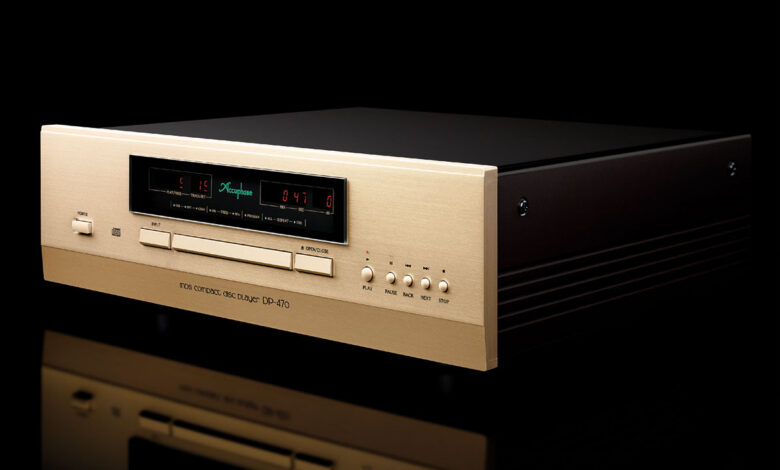
- The Accuphase DP-470 MDS Compact Disc Player is a dedicated CD player with a newly developed transport, a 4MDS+ D/A converter running four converter paths per channel and ANCC circuitry that brings guaranteed output noise down to 2.5 µV, while its USB-B (up to 32 Bit 384 kHz PCM and DSD 22.5 MHz), coaxial S/PDIF and TOSLINK inputs allow it to double as the central D/A converter of a classic HiFi system. It is due to reach specialist dealers in December 2026 at a recommended retail price of € 5.800,-.
There is no shortage of manufacturers who now treat the disc player as a sideline. Accuphase Laboratory, Inc. is not among them. With the DP-470 MDS Compact Disc Player, the Japanese specialist carries its classic CD player line forward and keeps the brief deliberately narrow: the Compact Disc is the point, not SACD, not streaming, not a long list of extra functions. Instead, the engineering effort goes into the areas that decide whether a CD player is any good – transport mechanics, vibration control, power supply, D/A conversion and the analogue output stages.

The DP-470 is nonetheless more than a disc spinner. Three digital inputs (USB-B, coaxial S/PDIF and TOSLINK) give computers, network players, televisions and other digital sources access to its converter. Against the DP-450 that it succeeds, Accuphase cites output noise reduced from 2.8 µV to 2.5 µV, while the case dimensions and the unmistakable Accuphase look remain unchanged.



Key Facts – Accuphase DP-470 MDS Compact Disc Player
- CD player with integrated D/A converter
- Newly developed CD transport mechanism
- 4MDS+ D/A converter based on the ESS ES9026PRO
- Four D/A converter paths operating in parallel per channel
- ANCC – Accuphase Noise and distortion Canceling Circuit
- Direct Balanced Filter with separate signal paths for XLR and RCA
- USB-B: PCM up to 32 Bit 384 kHz, DSD up to 22.5 MHz
- Coaxial S/PDIF: up to 24 Bit 192 kHz
- TOSLINK: up to 24 Bit 96 kHz
- Coaxial and TOSLINK transport outputs
- Balanced XLR and unbalanced RCA outputs
- Digitally adjustable output level
- Dimensions: 465 × 151 × 393 mm
- Weight: 13,7 kg
More Than a CD Player: The DP-470 as a D/A Converter
Although Accuphase positions the DP-470 MDS unmistakably as a CD player, its digital platform is not reserved for the built-in drive. The rear panel carries three digital inputs – USB-B, coaxial S/PDIF and TOSLINK – so the elaborate 4MDS+ conversion stage can be put to work for outside sources as well.
Via USB-B, the player accepts linear PCM up to 32 Bit 384 kHz. DSD is supported at 2.8 MHz, 5.6 MHz, 11.2 MHz and 22.5 MHz, although DoP is specified only up to 11.2 MHz, and Accuphase states that DSD at 22.5 MHz requires ASIO. The coaxial S/PDIF input handles linear PCM up to 24 Bit 192 kHz, while TOSLINK manages up to 24 Bit 96 kHz.
In practice, that means a computer or network audio player can be connected straight to the DP-470. A television can be linked as well, provided its optical digital output delivers a PCM signal. The DP-470 then takes over the D/A conversion and passes the result from its analogue outputs to a preamplifier or integrated amplifier.
The coaxial S/PDIF and TOSLINK sockets also work in the opposite direction, as pure transport outputs. The signal read from the disc can therefore be handed to an external D/A converter or to other digital components.


Four Converter Paths per Channel: 4MDS+
The heart of the digital signal processing is the conversion principle Accuphase calls MDS+, short for Multiple Delta Sigma Plus. In the DP-470, four D/A converter paths run in parallel for each channel, built on the ESS ES9026PRO, a 32 Bit Hyperstream II eight-channel DAC.
The idea has long been one of the Japanese company’s core technologies. Connecting several identical converters in parallel is intended to lower noise and distortion and to improve linearity and other relevant parameters. With four parallel paths, Accuphase speaks of a theoretical doubling of performance in terms of distortion, noise and linearity compared with a single converter path.
According to the manufacturer, this gain is not confined to particular frequencies or signal levels. That matters because low-level interference is a particular weak spot of delta-sigma converters, which is why Accuphase carries the same effort through into the I/V conversion stage that follows.
ANCC: Tackling Noise and Distortion at Source
One of the DP-470’s technical highlights is ANCC, which stands for Accuphase Noise and distortion Canceling Circuit. The circuit detects noise and distortion components at the input of the I/V converter and aims to cancel them with a matching correction signal.
Accuphase combines the technique with the 4MDS+ architecture and quotes a guaranteed output noise of just 2.5 µV for the new player. The DP-450 managed 2.8 µV, so the manufacturer reports a reduction of 11 per cent. The signal-to-noise ratio is given as 120 dB, the dynamic range as 117 dB and the channel separation as 114 dB. According to the guaranteed specifications, total harmonic distortion including noise is 0.0008 per cent from 20 Hz to 20 kHz.
Direct Balanced Filter: XLR and RCA Kept Apart
After conversion, Accuphase does not simply treat the two analogue outputs as branches of one output stage. The Direct Balanced Filter instead gives the unbalanced line output and the balanced output completely separate filter and signal paths.
RCA and XLR therefore each pass through their own low-pass filter. For both outputs, Accuphase specifies an output voltage of 2.5 V at an output impedance of 50 Ohm. The balanced XLR output also has a phase selector switch, which lets its pin assignment be matched to different components.
The output level can be adjusted digitally over a range of 60 dB in 1 dB steps. Accuphase intends this mainly for balancing the differing output levels of several source components within one HiFi system.


A Transport Designed for Calm
In a high-quality CD player, signal processing does not begin at the D/A converter. Reading the spinning disc as precisely as possible is a decisive part of the overall concept, and this is where Accuphase invests heavily in the DP-470.
The drive mechanism sits as close to the base plate as possible. This produces a low centre of gravity and is meant to limit the transmission of external vibration to the transport. High-grade elastic dampers decouple the traverse and the loading mechanism from one another and are also intended to reduce natural resonances of the positioning motor. An 8-pole neodymium composite magnet holds the disc and turntable evenly in place, to keep rotation as smooth and stable as possible.
A three-layer bridge cover surrounds the mechanism as well. It is designed to prevent vibration generated by the spinning disc from reaching the case, where it could be amplified as resonance. The disc tray is no afterthought either: it is machined from a solid block of aluminium, hard anodised and moved along high-quality steel guides.
This is a thoroughly classic high-end approach. Rather than leaning on error correction alone to deliver reliable data, Accuphase tries to create mechanically stable conditions for the scanning process in the first place.
Separate Supplies for the Digital and Analogue Sections
Accuphase takes the separation of digital and analogue circuitry seriously, and the power supply and board layout show it. The mains transformer provides independent supplies for the analogue and digital sections, and a discretely built, particularly low-noise supply is used in addition for the analogue circuits.
On the DAC board, the analogue section, DAC circuitry, transport control, power supply and digital section are likewise arranged clearly apart from one another. The aim is to keep mutual interference, and with it additional noise components, as low as possible. High-carbon cast-iron insulator feet complete the picture; they are meant to decouple the massive case from whatever it stands on.
At 465 mm wide, 151 mm high and 393 mm deep, the DP-470 keeps the dimensions of its predecessor. At 13,7 kg, the new CD player is still far from a lightweight.
Voicing Equalizer in the Digital Signal Path
Combining digital outputs and inputs creates an option of particular interest within an Accuphase system. A Accuphase Voicing Equalizer can be looped in between the transport output and a digital input, so that the data read from the disc first passes through the equalizer and then returns digitally to the DP-470’s own D/A converter.
Sound-field corrections can thus be made at the digital level without relegating the DP-470 to a mere transport and bypassing its own conversion stage. The manufacturer’s documentation explicitly provides for this kind of interplay between components in an Accuphase system.
Controls and Practical Extras
Operation stays classic. The front panel gives direct access to the essential transport functions, and the display can show the sampling frequency and quantisation bit depth of digital signals alongside track and time information.
The DP-470 also supports programmable playlists, so the tracks on a disc can be played in an order of your own choosing. The Accuphase RC-150 remote control is included in the package, as is the Accuphase AL-10 RCA audio cable.
All Benefits at a Glance
- Elaborate transport: a low centre of gravity, elastic dampers and a three-layer bridge cover are designed to suppress vibration where it arises.
- 4MDS+ conversion: four parallel D/A converter paths per channel reduce noise and distortion.
- ANCC technology: a compensation circuit acting directly on the I/V converter trims noise and distortion further.
- Independent analogue outputs: the Direct Balanced Filter routes RCA and XLR through their own signal and filter paths.
- Extensive DAC functionality: USB-B handles PCM up to 32 Bit 384 kHz and DSD up to 22.5 MHz.
- Flexible digital integration: coaxial S/PDIF and TOSLINK serve both as inputs for external sources and as transport outputs.
- Voicing Equalizer compatibility: the digital outputs and inputs allow an Accuphase sound-field corrector to be inserted into CD playback.
- Carefully separated power supplies: the digital and analogue sections have their own supplies, backed by a discrete low-noise supply for the analogue circuitry.
Price and Availability
Accuphase gives a recommended retail price of € 5.800,- for the new Accuphase DP-470 MDS Compact Disc Player. It is scheduled to reach specialist dealers in December 2026.
Getting to the Point
The Accuphase DP-470 MDS Compact Disc Player makes it plain how much the audio CD still matters to Accuphase Laboratory, Inc. While the disc player is drifting towards the margins elsewhere, the Japanese manufacturer commits serious engineering to the transport, vibration control, power supply and D/A conversion, and even improves on its predecessor’s measured figures such as output noise.
Nor is the DP-470 only for those who play nothing but CDs. With three digital inputs and a high-resolution USB interface, it can just as well act as the central D/A converter in a traditional HiFi system. SACD, streaming and HDMI are left out by design. That sharp focus should appeal most to music lovers with a large CD collection who want a player in which the physical disc is the main attraction rather than one function among many.
| Product | Accuphase DP-470 MDS Compact Disc Player |
|---|---|
| Price | € 5.800,- |
Technical Specifications
| Product | Accuphase DP-470 MDS Compact Disc Player |
|---|---|
| Characterisation | High-end CD player with integrated 4MDS+ D/A converter and digital inputs |
| Compatible disc format | CD |
| D/A converter | 4MDS+ principle, ESS ES9026PRO |
| D/A converter architecture | Four D/A converter paths operating in parallel per channel |
| ANCC | Accuphase Noise and distortion Canceling Circuit |
| USB-B | USB 2.0 High Speed |
| USB-B PCM | 44.1 / 48 / 88.2 / 96 / 176.4 / 192 / 352.8 / 384 kHz, 16 to 32 Bit |
| USB-B DSD | 2.8 / 5.6 / 11.2 / 22.5 MHz, 1 Bit; DoP up to 11.2 MHz |
| TOSLINK input | PCM 32 / 44.1 / 48 / 88.2 / 96 kHz, 16 to 24 Bit |
| Coaxial S/PDIF input | PCM 32 / 44.1 / 48 / 88.2 / 96 / 176.4 / 192 kHz, 16 to 24 Bit |
| Digital transport outputs | Coaxial S/PDIF, TOSLINK |
| Analogue outputs | 1 × balanced XLR, 1 × RCA |
| Output level control | 0 dB to -60 dB, 1 dB steps, digital |
| Signal-to-noise ratio | 120 dB |
| Dynamic range | 117 dB |
| Power consumption | 18 W |
| Dimensions | 465 × 151 × 393 mm |
| Weight | 13,7 kg |
| Included accessories | Power cable, Accuphase AL-10 RCA audio cable, Accuphase RC-150 remote control, USB driver and installation guide |
| Brand | Accuphase Laboratory Inc. |
|---|---|
| Manufacturer | Accuphase Laboratory Inc. |
| Distribution Austria | R.M.S. State of the Art Audiovisual Products |
| Distribution Germany | P.I.A. Hi-Fi Vertriebs GmbH |
| Distribution Switzerland | cebrands.ch AG |
| More about this manufacturer at HiFi BLOG |