

REL Carbon Special Black Label line array Review - How six subwoofers take an outstanding high-end hi-fi system to a new level
Six subwoofers, twelve 12-inch diaphragms and 5,400 watts RMS might suggest a display of brute force. In practice, the REL Carbon Special Black Label Six-Pack does something altogether more sophisticated: it disappears. Our review examines how two vertical stereo line arrays can make an already formidable High-end HiFi system sound larger, freer, clearer and far more complete.

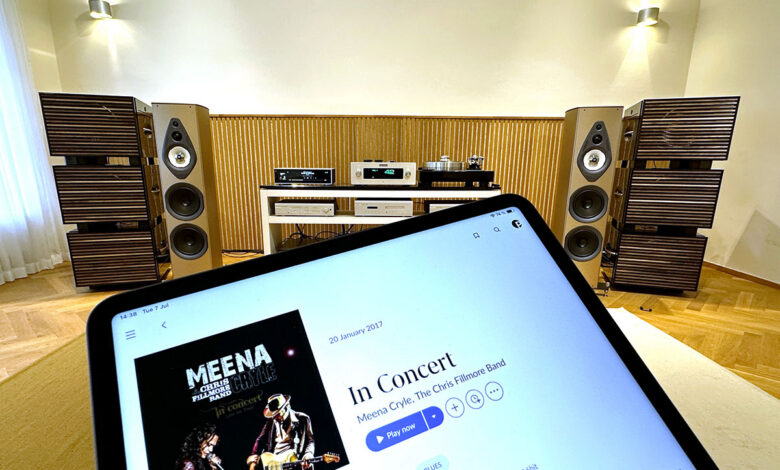
- The most remarkable aspect of the REL Carbon Special Black Label Six-Pack is not how much bass it produces, but how little attention it draws to itself. Its true contribution becomes unmistakable only when all six subwoofers are switched off and the previously expansive soundstage appears to contract before the listener.
At the outer reaches of High-end HiFi, progress rarely comes from correcting obvious mistakes. The more accomplished a system becomes, the less useful it is to think in terms of missing bass, insufficient resolution or a component that simply needs replacing. What remains is the more demanding pursuit of extracting further scale, ease, spatial truth and musical coherence from a chain that is already performing at an extraordinary level. It is precisely here that REL Acoustics Ltd. proposes one of the most uncompromising concepts in contemporary stereo reproduction: the Six-Pack, a pair of vertical line arrays comprising six subwoofers in total.

Key Facts REL Carbon Special Black Label Six-Pack
- Vertical stereo line array comprising six identical subwoofers
- Three REL Carbon Special Black Label subwoofers assigned to each channel
- Developed for high-quality stereo High-end HiFi systems
- One 12-inch carbon-fibre active driver per subwoofer
- Down-firing 12-inch carbon-fibre passive radiator
- 900 watts RMS amplifier power per subwoofer
- Total Six-Pack amplifier power of 5,400 watts RMS
- Lower frequency limit of 19 Hz at –6 dB
- High-level connection directly from the power amplifier’s loudspeaker outputs
- Daisy-chain wiring using REL Bassline Blue Line-Array Connectors
- Line-array-compatible cabinet from the current REL Serie S
- Premium Wood Grille supplied as standard
- Prepared for REL Airship Direct
Table of Contents
Three Subwoofers per Channel – An Arrangement Designed to Provoke
Each channel is supported by three identical subwoofers stacked vertically and positioned in direct relation to its corresponding main loudspeaker. It is an arresting arrangement. At first glance, it may even appear wilfully excessive, inviting assumptions of seismic output, theatrical low-frequency effects and enough acoustic pressure to test the structural integrity of the listening room. That assumption could hardly be further removed from the purpose of the system.




The Six-Pack is not an exercise in seeing how much bass can be forced into a room. Nor is it intended to turn refined stereo reproduction into a demonstration of physical impact. Its objective is considerably more ambitious: to integrate low-frequency energy with such speed, uniformity and restraint that the six subwoofers cease to register as separate sound sources.
Not More Bass, but More of Everything
REL Acoustics Ltd. regards deep bass as part of the structural fabric of reproduced sound rather than an isolated frequency range. Correctly integrated, the Six-Pack should affect far more than the lowest octave. Its influence ought to be heard in soundstage dimensions, dynamic expression, transparency, tonal density, image stability and the system’s ability to convey the physical volume and atmosphere captured in a recording.
This distinction is fundamental. A conventional view of a subwoofer begins with extension: how low it reaches, how loudly it plays and how much additional weight it gives to bass instruments. The REL Acoustics Ltd. approach begins with integration. Extension matters, but only if it contributes to a more complete and believable presentation.
The intention is therefore not to hear six subwoofers. It is to hear the main loudspeakers apparently exceeding what their dimensions, enclosure volume and conventional placement ought to permit.


Testing the REL Six-Pack in a Living-Room Environment
For this review, a complete REL Six-Pack was installed at the Audio Tuning Townhouse. Six REL Carbon Special Black Label subwoofers formed two vertical arrays flanking a pair of Sonus faber Amati Supreme loudspeakers, with three subwoofers stacked on each side.
The setting was important. This was not an acoustically austere laboratory, a studio control room or a purpose-built demonstration chamber stripped of domestic context. The listening space had been conceived as a sophisticated contemporary living room, with architecture, furnishings and materials playing an active part in the environment.
That made the installation especially relevant. A system of this scale is not designed solely for measurements or trade-show spectacle. Its intended owner is more likely to be a serious music listener seeking uncompromised reproduction within an equally ambitious residential setting.
The Audio Tuning Townhouse therefore provided a useful test of both performance and plausibility. Could two towers of three substantial subwoofers genuinely integrate into a refined domestic interior? More importantly, could they become acoustically invisible despite remaining physically impossible to overlook?
Making Something Excellent Decisively Better
Before placing six subwoofers beside an already outstanding system, one question has to be addressed. Is anything actually missing from a loudspeaker such as the Sonus faber Amati Supreme? Does a floorstanding design of this stature require assistance at low frequencies? The immediate answer is no.
The loudspeakers from Vicenza already deliver deep, controlled and authoritative bass. Driven by an Audio Research S 200 power amplifier and supported by carefully selected source components, they produced a presentation with formidable substance, scale, dynamic reach, resolution and tonal coherence before any of the REL Carbon Special Black Label subwoofers were activated.
There was no obvious deficiency to correct. The sound did not appear lightweight, dynamically constrained or lacking in extension. Nothing suggested that the main loudspeakers required rescuing. That was precisely why the system represented such a demanding and revealing platform for assessing the Six-Pack.
The line array could not rely on disguising the shortcomings of a small loudspeaker, compensating for an anaemic amplifier or smothering an awkward room with additional energy. It had to demonstrate that a genuinely accomplished High-end HiFi system could be improved in a substantial, immediately recognisable and musically meaningful way.
This is central to the Six-Pack philosophy of REL Acoustics Ltd. The concept does not imply that reference-class floorstanding loudspeakers are incomplete or poorly conceived. Rather, it follows one of the more persuasive principles of High-end HiFi: acknowledging that further performance is possible does not diminish what has already been achieved. On the contrary, only an excellent foundation reveals the full value of an equally accomplished low-frequency system.
From Wales to the World – The Distinctive Philosophy of REL Acoustics Ltd.
The story of REL Acoustics Ltd. began in Bridgend, Wales, in 1990. The company name is derived from the initials of its founder, Richard Edmund Lord, who had become dissatisfied with the subwoofer designs available at the time.
Many were conceived primarily for spectacular home cinema effects. They could produce generous output, but often sounded comparatively slow and proved difficult to integrate convincingly into serious stereo systems. Their contribution was readily apparent, yet rarely seamless.
Richard Edmund Lord pursued a different objective. A subwoofer should not behave as an independent effects generator positioned beneath the music. It should operate as an integral part of the loudspeaker system, completing its musical foundation while preserving timing, tonal balance, dynamic character and continuity. That thinking led to the philosophy that continues to define REL Acoustics Ltd. One of its most important elements is the high-level connection, in which the subwoofer signal is taken directly from the loudspeaker outputs of the power amplifier.
The subwoofer therefore receives fundamentally the same signal as the main loudspeakers, including the dynamic behaviour and sonic character imparted by the power amplifier itself. Rather than receiving a separate, generically processed bass feed, it is tied directly to the amplifier-loudspeaker relationship that defines the rest of the system.
Following the retirement of Richard Edmund Lord in 2005, REL Acoustics Ltd. was acquired by John Hunter and Donald Brody. John Hunter subsequently played a decisive role in shaping the present product philosophy, voicing and broader understanding of what a subwoofer can contribute to a stereo system. Within this framework, a subwoofer is not merely a device for reproducing frequencies that the main loudspeaker cannot reach. It becomes a tool for improving the spatial, tonal and dynamic behaviour of the entire installation.
The Six-Pack is arguably the purest expression of this philosophy. REL Acoustics Ltd. defines the arrangement as a vertical stack of three matching subwoofers positioned behind or close to each main loudspeaker. The result is a controlled column of low-frequency energy intended to support not only bass extension, but also the scale and dimensionality of the whole soundstage.
Why Six Subwoofers?
One capable subwoofer can provide greater extension, weight and dynamic security. Two identical subwoofers, assigned individually to the left and right channels, add more even room excitation and preserve stereo information at low frequencies.
Why, then, use three per side?
The answer is not merely more cone area or greater amplifier power, although the figures are undeniably formidable. A complete installation provides six 12-inch active drivers, six 12-inch passive radiators and a nominal combined amplifier output of 5,400 watts RMS. Those numbers describe the capacity of the system. They do not explain its behaviour.
The more important point is that the acoustic workload is distributed across six closely matched active systems. Each subwoofer is required to make only a modest contribution. A given sound-pressure level can therefore be achieved with considerably less excursion than would be demanded from a single driver attempting to perform the same task.
This allows the active drivers to remain within a particularly linear and controlled operating range. Mechanical stress, compression and distortion are reduced, while substantial headroom remains available for transient demands.
The audible result is not necessarily greater volume. It is speed, composure and the absence of strain. The apparent paradox of the REL Six-Pack is that its most extravagant physical characteristic enables every individual subwoofer to behave with extraordinary restraint.
The Line Array as a Vertically Extended Sound Source
In a conventional installation, a subwoofer usually sits close to the floor. This is practical, acoustically effective and entirely suitable for many systems. REL Acoustics Ltd., however, argues that a high-quality loudspeaker system can benefit when low-frequency energy is not introduced exclusively from a single horizontal plane.
Stacking three subwoofers creates a vertically extended sound source for each channel. The room is excited over a greater proportion of its height rather than primarily along the floor.
REL Acoustics Ltd. associates this geometry with improved room coupling, greater dynamic freedom and a soundstage that expands not only in width and depth, but also vertically. It is useful to consider the three positions as serving different acoustic functions, although they are not divided into rigidly separate frequency bands.
The lowest subwoofer benefits most strongly from proximity to the floor and adjacent room boundaries. It establishes the physical foundation and couples the deepest energy into the room with particular effectiveness. The middle subwoofer sits closer to the acoustic plane of the main loudspeaker and listener. It strengthens the connection between deep bass, upper bass and the lower midrange, allowing voices and instruments to appear more corporeal and spatially secure.
The upper subwoofer extends low-frequency excitation further into the vertical dimension. Its contribution is less readily perceived as localised bass and more as increased height, air and room-filling ease. All three systems continue to overlap. Their respective influence is determined by position, boundary interaction and the individual adjustment of level and crossover frequency.
A line array does not automatically eliminate room modes. It can, however, distribute acoustic energy more evenly and reduce the tendency for individual resonances to dominate the listening experience.
No Demonstration of Brute Force
Six subwoofers naturally evoke images that have little to do with delicacy: large cone movements, rattling furniture, vibrating glasses and bass waves experienced more as physical events than musical information. The REL Six-Pack works in the opposite manner. The six units are not adjusted so that each one demonstrates its full output capability. Every subwoofer operates at a remarkably low level. Even when watching the active drivers closely, visible cone movement may be difficult to detect.
This does not mean that the subwoofers are inactive. It illustrates how little excursion is required when the task is shared by such a large total radiating area.
The effect is created by the combined action of all six systems. They do not merely add loudness; they create reserve. No single driver needs to make dramatic excursions to reproduce a complex or impulsive low-frequency passage, and none of the amplifiers is required to operate close to its limit. The resulting ease is one of the defining qualities of the Six-Pack. It follows the music without drawing attention to the work being done.


REL Carbon Special Black Label – The Foundation of the Six-Pack
The REL Carbon Special Black Label occupies a distinctive position within the current REL Serie S. It is the flagship model in the company’s medium-sized enclosure format and incorporates a number of design principles derived from the Reference Series. REL Acoustics Ltd. highlights the close relationship between its 12-inch active driver and the driver developed for the REL No.31 Reference. The REL Carbon Special Black Label has been designed for use as a single subwoofer, as part of a stereo pair or within a complete vertical line array.
Its cabinet measures 488 mm wide, 410 mm high and 565 mm deep. It is not a small subwoofer, yet it remains relatively compact in view of its performance class and the use of two 12-inch diaphragms. The latest REL Serie S cabinet architecture is wider and lower than that of earlier generations. This gives the subwoofer a substantial yet carefully proportioned appearance.
The reduced height is particularly advantageous in a line-array installation. Three stacked enclosures form an imposing tower, but one that remains visually balanced rather than excessively tall and narrow.
A high-gloss Piano Black finish reinforces the premium positioning. In the review system, the six black cabinets formed a remarkably convincing visual relationship with the Sonus faber Amati Supreme loudspeakers finished in Sabbia Oro. Despite the sheer number of enclosures, the installation never appeared temporary, industrial or studio-like. The two arrays assumed the character of deliberate architectural elements within the room.
Premium Wood Grille as an Intentional Design Feature
A Premium Wood Grille is supplied as standard with the REL Carbon Special Black Label. This elaborately formed real-wood cover is far more than a decorative alternative to a conventional fabric grille. Its sculptural construction gives the subwoofer the presence of a finely made item of furniture or contemporary product design. As natural wood is used, every grille displays its own grain pattern and tonal variation.
This becomes especially significant in a Six-Pack installation. Six large, overtly technical cabinets could easily dominate a domestic interior. The wooden grilles soften the visual severity of the arrays and establish a natural relationship with fine furniture, timber surfaces and residentially oriented loudspeaker systems. REL Acoustics Ltd. supplies the Premium Wood Grille as standard with the REL Carbon Special Black Label. A conventional black fabric grille is available as an alternative.
12-inch Carbon-fibre Active Driver
At the centre of the REL Carbon Special Black Label is a front-firing 12-inch active driver using a diaphragm manufactured entirely from carbon fibre. For this application, carbon fibre offers a particularly valuable balance of high stiffness and low mass. A rigid diaphragm should move as closely as possible to a piston, resisting uncontrolled deformation even under substantial load. Low moving mass, meanwhile, supports rapid acceleration and deceleration.
Speed is fundamental to the philosophy of REL Acoustics Ltd. A subwoofer should not lag behind an impulse or produce a softened cloud of low-frequency energy. It must respond immediately to the signal, particularly when partnered with fast, highly resolving High-end loudspeakers.
The driver used in the REL Carbon Special Black Label is closely related to the construction developed for the REL No.31 Reference. REL Acoustics Ltd. describes it as an unusually agile, lightweight and rigid design intended to combine substantial output capability with precise articulation and tonal differentiation.
A 12-inch Passive Radiator Providing Controlled Support
The active driver is complemented by a down-firing 12-inch passive radiator, also manufactured from carbon fibre. A passive radiator performs part of the function normally assigned to the port in a bass-reflex enclosure. It uses the rearward energy generated by the active driver without forcing air at high velocity through a comparatively narrow opening. The air-flow noise that can occur in a reflex port is therefore avoided.
For the REL Carbon Special Black Label, REL Acoustics Ltd. developed a passive radiator intended to match the speed and control of the exceptionally light active driver. It extends usable low-frequency response and helps the subwoofer retain authority below the immediate operating range of the driven diaphragm. The quoted lower frequency limit is 19 Hz at –6 dB. The significance of that figure lies less in the isolated number than in the manner in which such extension is used.
A Six-Pack is not intended to produce continuous subsonic theatre. Its ability to descend into this region provides a foundation that remains effective even when the lowest frequencies are sensed as spatial and physical information rather than consciously identified as individual tones.
900 Watts RMS per Subwoofer
Each REL Carbon Special Black Label contains an amplifier rated at 900 watts RMS. REL Acoustics Ltd. describes the topology as Linear Class D, or as a hybrid arrangement combining a high-current analogue power supply with an efficient Class D output stage.
The design incorporates a mains transformer weighing approximately 15 pounds and provides peak output of up to 1,250 watts. This arrangement is intended to unite substantial current reserves with control and the rapid response associated with REL Acoustics Ltd. Across the complete Six-Pack, nominal continuous amplifier power totals 5,400 watts RMS.
Once again, the figure should not be interpreted as an invitation to pursue maximum output. It defines the extent of the available reserve. During normal music reproduction, only a fraction of this capacity is required. The line array can consequently reproduce demanding peaks without sounding forced. Its power is perceived not as sheer loudness, but as a striking absence of effort.
Analogue Filters and Individual Adjustment
Every REL Carbon Special Black Label incorporates its own amplifier and individual controls for output level and crossover frequency. This is essential to the operation of a Six-Pack. The six subwoofers are not passive drivers powered by a central amplifier. Each unit can be adjusted according to its position in the array and its interaction with the room. The contribution made by the lower, middle and upper subwoofer can therefore be finely balanced rather than dictated by a single global setting.
REL Acoustics Ltd. maintains a predominantly analogue signal path and places particular emphasis on low latency. Integration is not imposed through elaborate digital processing. It is achieved by careful positioning, phase selection and manual adjustment of level and crossover frequency. This method demands time, judgement and listening experience. In return, it provides immediate and exceptionally precise control over the way the system behaves in the room.
The High-level Principle
The high-level connection remains one of the defining elements of the philosophy pursued by REL Acoustics Ltd. The subwoofer signal is taken directly from the loudspeaker outputs of the power amplifier. The high-impedance input of the REL Carbon Special Black Label reads the voltage signal without drawing meaningful power from the amplifier. The main amplifier is therefore subjected to virtually no additional load.
At the same time, the subwoofer receives fundamentally the same signal as the main loudspeaker. This includes more than frequency content. The tonal character, dynamic behaviour and timing qualities of the power amplifier remain part of the signal presented to the subwoofer. In practical terms, REL Acoustics Ltd. wants the subwoofer and main loudspeaker to speak the same sonic language.
The logic is particularly compelling in a high-quality stereo system. A subwoofer driven from a separate preamplifier or dedicated subwoofer output may not receive precisely the signal presented to the loudspeakers. The high-level connection ties it directly to the actual relationship between power amplifier and loudspeaker.
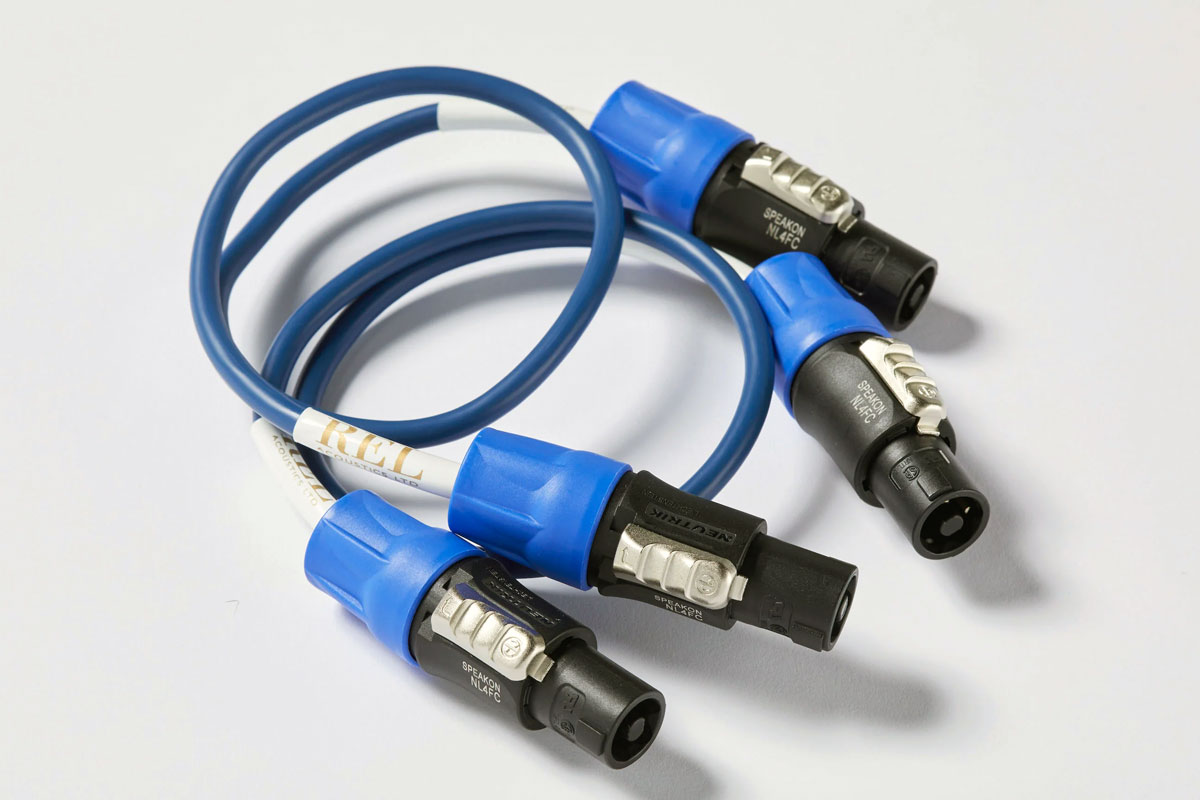
REL Bassline Blue Line-Array Connectors
With six subwoofers, cabling could quickly become cumbersome. REL Acoustics Ltd. therefore offers the Bassline Blue Line-Array Connectors, developed specifically for vertical arrays. For each channel, one high-level cable runs from the amplifier to the lowest subwoofer. Short connecting leads then pass the signal from the lower unit to the middle subwoofer and subsequently to the upper subwoofer. This daisy-chain arrangement reduces the number of long cable runs and allows the installation to remain orderly.
REL Acoustics Ltd. manufactures the Line-Array Connectors using high-quality conductor materials and pure silver solder. A complete stereo array requires one connector pair for each vertical level. The daisy-chain connection distributes only the high-impedance input signal. Every subwoofer continues to draw its operating power from its own mains supply and internal amplifier.
Prepared for REL Airship Direct
For completeness, the REL Carbon Special Black Label is prepared for REL Airship Direct, allowing the audio signal to be transmitted wirelessly where required. This can make domestic integration considerably easier when using a single subwoofer or a stereo pair.
With a carefully assembled Six-Pack, however, a fully wired high-level connection remains the more obvious solution when maximum control, orderly installation and repeatable operating conditions take priority.
The Review Location – Audio Tuning Townhouse
The review was conducted at the Audio Tuning Townhouse in a studio deliberately designed to resemble an elegant residential interior. This was highly relevant when assessing a system of such exclusivity and scale. Although technically sophisticated, a REL Six-Pack is not ultimately intended to succeed only under laboratory conditions. It must work in a credible living environment where architecture, furniture, surface materials and normal domestic use matter alongside acoustic performance.
The room provided sufficient space to position the two vertical arrays beside and slightly behind the main loudspeakers. At the same time, the system remained visually coherent as a whole. The six REL Carbon Special Black Label subwoofers did not appear to be additional effects devices attached to the installation after the event. They looked like a deliberate extension of the two Sonus faber Amati Supreme loudspeakers.
The Review System
The main loudspeakers were Sonus faber Amati Supreme finished in Sabbia Oro. Visually, they formed a suitably exclusive and imposing ensemble with the six Piano Black REL Carbon Special Black Label subwoofers and their distinctive wooden grilles. Amplification was provided by an Audio Research S 200 power amplifier. An Audio Research LS3 DAC & Phono Preamplifier served as preamplifier and handled digital conversion and phono duties.
For analogue playback, the system used an EAT Fortissimo S fitted with a Graham Elite 12-inch tonearm and an SME cartridge. Phono amplification could alternatively be provided by a Musical Fidelity M6X Vinyl. Digital sources comprised a HiFi Rose RS150B Streamer, a Musical Fidelity M6S CD Player and a Musical Fidelity M6x DAC.
Power conditioning for the central electronics was handled by an AudioQuest Niagara 5000 Power Conditioner. Two AudioQuest PowerQuest 3 units supplied the six active subwoofers, allowing each group of three to receive power through its own high-quality distribution system.
Positioning – Treating the Six-Pack as Part of the Loudspeaker System
Each vertical stack was clearly assigned to its corresponding main loudspeaker. This distinguishes the Six-Pack from conventional subwoofer installations in which one bass source is positioned wherever the most even room response can be achieved. A REL Six-Pack is conceived as an extension of the left and right loudspeakers. The arrays are therefore placed behind or close beside them and follow their basic geometry.
Exact positioning depends on the room, the loudspeakers and their distance from surrounding walls. Prescriptive universal measurements would be of little value. What matters is that the loudspeaker and array behave as one acoustic entity, with neither stack becoming perceptible as an independent sound source.
Mechanical safety also requires serious attention in a structure of this size. Not every subwoofer is suitable for stacking three units vertically. REL Acoustics Ltd. explicitly states that only models engineered for line-array use should be installed in this manner. Alongside the REL Carbon Special Black Label, the current REL Serie S models approved for this purpose include the REL S/850 and REL S/550.
Setup – Patience Is Part of the Concept
A Six-Pack is not a plug-and-play solution. Six active subwoofers can be connected quickly enough, but integrating them fully requires time, experience and careful listening. The most sensible approach is to work upwards through the array. Initially, only the two lowest subwoofers are activated. These establish the fundamental low-frequency foundation. Phase, crossover frequency and level must be adjusted until their output joins the main loudspeakers without an audible seam.
The middle pair is then introduced. Its contribution is balanced to increase tonal body, lower-midrange continuity and spatial stability without making voices or instruments sound heavier or inflated. Finally, the upper pair is activated. Its operating level will generally be especially low. Rather than being perceived as additional bass, its influence appears as greater soundstage height and a more effortless spatial presentation. At no point should setup be guided by the desire to create the most impressive immediate effect.
A REL subwoofer is correctly integrated when it cannot be identified as a separate device. The system should not sound as though subwoofers are playing. The main loudspeakers should simply appear more complete, more liberated and more authoritative.
Phase, Crossover Frequency and Level
Phase is selected first, using the setting that produces the strongest yet most precise summation between the main loudspeaker and subwoofer at the listening position. The crossover frequency is then raised cautiously from a low initial setting. The aim is not to replace the operating range of the main loudspeaker. During the review, the Sonus faber Amati Supreme continued to run unrestricted across their full frequency range. The REL line array was introduced as a complementary system.
Level is increased until the presentation gains substance and spatial stability. It is then normally reduced slightly. This reflects a familiar principle in setting up REL subwoofers: the optimum point is frequently just below the level at which the subwoofer becomes perceptible as an independent contribution.
With six units, the temptation to set the system for a demonstrative effect is considerable. That would be counterproductive. The available cone area and amplifier reserve are so extensive that very modest control settings are sufficient to produce a significant result.
The First Listening Impression – A Few Seconds Are Enough
The system at the Audio Tuning Townhouse already played at an exceptional level before the REL Six-Pack was activated. The Sonus faber Amati Supreme created a large, richly coloured and finely layered soundstage. The Audio Research electronics combined power and control with natural fluidity. There was no obvious absence to address. Yet within seconds of activating the REL Carbon Special Black Label Six-Pack, it became clear that considerably more was possible.
The improvement was not subtle. It required no prolonged familiarisation, no search for marginal frequency-response changes and no effort to interpret differences at the edge of perception. The effect was immediate and unequivocal. The soundstage opened. The extent varied from recording to recording, but the underlying change was consistently recognisable.
Some productions gained a modest increase in width and depth. Others seemed to detach almost completely from the loudspeakers, illuminating the entire area behind them in a new and more convincing manner. This was not an artificial magnification. Musicians did not become oversized, voices were not inflated and the room was not filled with indiscriminate reverberation. Instead, individual events were given more space and more air in which to exist.
Sting – “Fields of Gold”
“Fields of Gold”, in the version featured here from the album The Night Watch, proved an excellent example of the Six-Pack’s ability to reconstruct space and atmosphere. With the line array activated, Sting’s voice did not simply appear larger, but more corporeal and at the same time more liberated. The chest resonance gained natural substance without sounding heavy or dark. Breathing, articulation and subtle dynamic gradations remained fully intact.
The space surrounding the voice was particularly striking. It did not stand as an isolated event between the loudspeakers, but was convincingly embedded within the acoustic environment. The instruments occupied clearly defined positions, and the entire performance sounded more open and unrestrained.
Pink Floyd – “One of These Days”
“One of These Days” from the album 8-Tracks presented a different set of demands. Its distinctive bass structure and the recording’s progressively increasing density could easily tempt a system to exaggerate the effect through additional output. The REL Six-Pack responded differently. The bass line gained depth, definition and physical presence, yet remained exceptionally precise. Each impulse was clearly outlined, and the energy built in a controlled manner throughout the room. Nothing sounded soft, slow or prone to overhang.
More important, however, was the scale of the entire acoustic space. The recording developed tremendous breadth and atmospheric density. Effects appeared to extend far beyond the positions of the loudspeakers. The performance acquired an almost physically tangible dimension without the bass masking the remaining frequency ranges. This track demonstrated particularly impressively that headroom should not be confused with loudness. The Six-Pack reproduced considerable low-frequency energy with a composure that revealed no audible sense of effort.
Paul Simon – “Diamonds on the Soles of Her Shoes”
Paul Simon’s “Diamonds on the Soles of Her Shoes” from the album Graceland thrives on rhythmic precision, intricately layered voices and a multitude of finely interlocking instruments. The REL line array gave the rhythmic foundation greater elasticity and body. Bass and percussion did not merely sound more powerful, but better defined. The rhythmic structures became easier to follow because each impulse had a clear beginning, a natural development and a precise conclusion.
The voices benefited particularly from the broader spatial separation. The individual vocal lines could be distinguished more clearly without the musical coherence breaking apart. The arrangement sounded complex, but never congested. This track made especially clear how strongly additional low-frequency information influences the perception of the midrange. Voices appeared more colourful, more three-dimensional and more natural, even though the line array was ostensibly operating well below their primary frequency range.
Toto – “Africa”
Toto’s “Africa” is a densely produced recording whose many layers and effects place considerable demands on structure and transparency. With the Six-Pack, the production gained substantially in scale. The iconic percussion patterns appeared more precisely layered, the bass acquired greater weight, and the synthesiser textures were able to extend further into the room.
The voice remained clearly positioned at the centre without being crowded by the rich instrumentation. Individual layers within the arrangement were easier to follow, while the recording retained its cohesion and musical flow. The bass was deep and powerful, but never obtrusive. A production such as “Africa” could easily sound overloaded with six subwoofers. The opposite was true. The REL system created order rather than simply adding mass.
Meena Cryle & Chris Fillmore – “This Is My Will”
With “This Is My Will” from the album In Concert, the focus was on naturalness, live atmosphere and the emotional immediacy of the voice. Meena Cryle’s singing gained body and expressive power with the line array. Her voice appeared larger, but not artificially scaled. Subtle roughness, dynamic crescendos and the characteristic energy of the performance were conveyed with impressive directness.
The concert venue opened up significantly. There was a stronger sense of the dimensions of the location and of the distance between stage and audience. Low-frequency spatial information, which many systems merely suggest, contributed substantially to the credibility of the live recording. Even Chris Fillmore’s guitar gained greater foundation, allowing riffs and solos to rise more distinctly from the body of the band, while attacks and decays remained clearly traceable. The additional substance never came at the expense of speed.
Falco – “Vienna Calling”
“Vienna Calling” from the album Falco 3 combines a distinctive electronic rhythm with a densely layered production and a voice that must remain precisely anchored at the centre. The Six-Pack gave the track remarkable authority. The electronic bass impulses gained pressure and depth without shifting the recording towards an overtly club-like presentation.
Falco’s voice stood with three-dimensional solidity and assurance in the room. His rhythmic delivery, articulation and characteristic combination of detachment and presence were reproduced exceptionally well. The production benefited above all from improved spatial organisation. Electronic effects and rhythmic elements occupied more clearly defined positions. The track sounded larger, more structured and more controlled – and was all the more compelling for it.
a-ha – “Take On Me” from MTV Unplugged
The unplugged version of “Take On Me” demonstrates how profoundly a seemingly familiar pop song can be transformed through acoustic instrumentation and an intimate live atmosphere. With the REL Six-Pack, the venue opened into a wide and credibly proportioned acoustic space. Morten Harket’s voice was reproduced with impressive body and emotional presence. Its lower registers gained substance without compromising its lightness or characteristic upper range.
Acoustic instruments acquired greater volume and more natural resonant bodies. The lower registers of the strings and guitars in particular sounded more complete. At the same time, every detail remained clear and effortlessly audible. The audience and the room’s acoustic responses were not presented as separate effects, but as an organic part of the recording. This natural connection between direct sound and spatial information is one of the system’s greatest strengths.
Luciano Pavarotti – “Che gelida manina”
Finally, “Che gelida manina” from the first act of La Bohème presented a recording that must unite voice, orchestra and the dimensions of a large performance space.
With the line array, Pavarotti’s voice acquired an almost overwhelming presence. Yet this was not merely a matter of scale. What mattered was its stability, physical body and the system’s ability to reproduce even the most powerful dynamic crescendos without hardening or constriction.
The orchestra extended deeply and broadly behind the voice. Instrumental groups were clearly structured, yet remained part of a coherent whole. The low-frequency section gave the orchestra natural mass and authority without unduly emphasising individual sections. The vertical dimension was particularly impressive. The voice seemed to rise freely into the space, while the orchestra beneath and behind it formed a stable acoustic foundation. The listening room receded, and the scale of the recording became tangible in an exceptionally convincing manner.
More Space Creates Greater Clarity
The expanded spatial presentation immediately improved structural clarity. When voices and instruments are not crowded together, their contours are easier to follow. Low-level detail becomes more apparent without the system sounding brighter or more analytical. The line array did not introduce artificial presence. It reduced the impression of acoustic congestion.
Complex arrangements benefited in particular. Instruments that had already been clearly separated acquired more precisely defined locations. The stage was more convincingly unfolded, depth relationships were easier to understand and the space between performers felt more credible. This helps explain why a correctly integrated subwoofer can be perceived far beyond the conventional bass region.
Additional low-frequency information changes relationships throughout the presentation. Ambience, fundamentals and low-frequency decays are reproduced more fully. As a consequence, information in the midrange and treble also appears more clearly organised.
The Subwoofers Seem Not to Be Playing at All
The most remarkable quality of the complete installation was the acoustic invisibility of all six subwoofers. Standing in front of the arrays and watching the active drivers closely revealed hardly any visible excursion. At times, it was genuinely tempting to assume that nothing was happening. The opposite was true.
Every REL Carbon Special Black Label contributed only a small portion of the total output. No driver had to undertake significant movement. No amplifier was being meaningfully challenged. The combined radiating area and power of six active systems allowed the necessary low-frequency energy to be generated with minimal mechanical movement.
The result was not a display of force, but a study in restraint. That restraint represented the system’s real achievement. The Six-Pack never appeared to do too much. It supplied precisely the additional foundation, space and authority required to separate outstanding reproduction from something genuinely exceptional.
Dynamics Without Effort
A line array comprising six active subwoofers inevitably possesses immense dynamic reserves. During the review, however, this capability did not manifest itself as spectacular loudness. It appeared as complete ease. Quiet passages retained their fine gradations. Small rhythmic accents were reproduced with precision. When the music suddenly increased in energy, the system followed immediately, without perceptible compression.
With large orchestral or electronic transients, there was no impression that the installation had to gather momentum before delivering the event. The energy was simply present: fast, controlled and complete.
This quality also improved listening at moderate levels. Because the Six-Pack reproduced the low-frequency foundation and ambient information fully even at lower volumes, music retained physical body and spatial conviction without requiring elevated playback levels.
Tonal Authority Rather Than Bass Emphasis
A poorly integrated subwoofer alters the tonal balance. Bass instruments become oversized, voices acquire unwanted weight and the whole presentation takes on a darker character. None of this occurred with the REL Six-Pack. The bass did not sound elevated. It sounded complete.
Deep notes possessed greater substance and extended further downwards without thickening the upper bass. The tonal balance of the Sonus faber Amati Supreme remained intact. This is crucial. The REL Carbon Special Black Label subwoofers were not intended to overwrite the character of the main loudspeakers. The Sonus faber Amati Supreme retained their tonal colours, delicate textures and elegant coherence. The Six-Pack supplemented them precisely where additional energy, room coupling and reserve were beneficial.
More Detail Without Analytical Sharpness
The greater intelligibility of fine detail was initially one of the more surprising effects. The system did not sound brighter, sharper or more forward with the Six-Pack operating. Nevertheless, small pieces of information became easier to perceive. Room reflections, decays, quiet accompanying instruments and nuances within dense arrangements emerged more clearly.
The principal reason was improved spatial organisation. When individual events occupy more distinct positions and are not compressed into the same acoustic space, the ear has less work to do in separating them. Detail here was not produced by emphasising high frequencies. It arose from a fuller and more orderly presentation of the entire spectrum.
The Decisive Moment – Switching It Off
The contribution of the line array became clearest when all six subwoofers were switched off. The soundstage appeared to collapse inwards. That description may seem dramatic, but it reflects the listening impression accurately. The stage lost width and, more noticeably, depth and height. The presentation moved back towards the plane between the loudspeakers. Voices and instruments appeared more closely packed, the air between individual events diminished and the effortless nature of the presentation was substantially reduced.
The Sonus faber Amati Supreme continued to sound excellent without the REL Six-Pack. Bass remained deep, controlled and powerful. Tonal balance was convincing, dynamics were impressive and imaging remained at an extremely high level. Yet after hearing the complete system, what had disappeared could no longer be ignored. The line array had not replaced the abilities of the loudspeakers. It had extended their potential. It allowed the Sonus faber Amati Supreme to appear larger, freer and more assured without altering their inherent character.
A Monument Suitable for the Living Room?
A Six-Pack comprising six REL Carbon Special Black Label subwoofers is unquestionably monumental. Two vertical stacks of three full-sized subwoofers cannot be concealed. The Audio Tuning Townhouse nevertheless demonstrated that such an arrangement need not look misplaced in a generously proportioned and carefully designed residential interior. Its clear geometry, Piano Black surfaces and Premium Wood Grilles give the arrays an intentionally architectural identity. They become part of the visual composition of the room rather than pretending not to exist.
Naturally, sufficient space is essential. A Six-Pack is not intended for a small room, an inconspicuous installation or an owner determined to remove all visible technology from the interior. For the listener who has consciously chosen an uncompromising High-end system, however, the result is not six unrelated bass cabinets scattered around the room. It is a pair of clearly defined vertical elements visually and acoustically aligned with the main loudspeakers.
Effort, Cost and Commitment
The exceptional performance comes at a price that cannot be measured only in money. Six subwoofers must be delivered, unpacked, positioned and stacked securely. Six mains connections are required, together with suitable power distribution and carefully arranged high-level cabling. Setup takes time, experience and a willingness to judge very small changes by ear. The physical space required is also considerable.
These points must be stated plainly. The REL Six-Pack is not a pragmatic standard solution. It is intended for music enthusiasts who already own an exceptional High-end HiFi system and are prepared to invest the effort required to pursue the final, decisive stages of performance. That commitment is also part of the concept’s integrity.
REL Acoustics Ltd. has not attempted to compress reference performance into an arbitrarily small, invisible or universally applicable package. It has defined an uncompromising solution and accepted that the necessary conditions are equally uncompromising.
All Benefits at a Glance
- A Soundstage of Dramatically Greater Scale: Depending on the recording, the Six-Pack can expand the perceived width, depth and height of the presentation by a substantial margin.
- Clearer Spatial Organisation: Voices and instruments occupy more precisely defined positions and gain the space required to develop naturally.
- Exceptional Dynamic Composure: By sharing the workload across six active systems, the Six-Pack reproduces even demanding transients without audible stress or compression.
- Minimal Driver Excursion: Each active driver contributes only a small part of the total output, allowing it to remain within a highly linear operating range.
- No Artificial Bass Emphasis: Rather than producing an exaggerated low-frequency spectacle, the system adds extension, foundation and authority in a controlled and musically coherent manner.
- Greater Clarity Across the Spectrum: More complete reproduction of low-frequency and ambient information makes voices, instruments and subtle details easier to follow.
- Seamless Acoustic Integration: Once correctly adjusted, none of the six subwoofers can be identified as a separate sound source.
- The Main Loudspeaker Retains Its Identity: The Sonus faber Amati Supreme preserve their tonal character while gaining scale, freedom and spatial authority.
- Immense Dynamic Headroom: A combined 5,400 watts RMS and twelve 12-inch diaphragms provide exceptional reserves without requiring the system to display them ostentatiously.
- True Stereo Assignment: A dedicated vertical array supports each main loudspeaker, preserving left- and right-channel relationships.
- Residentially Considered Design: Piano Black surfaces and Premium Wood Grilles allow the two imposing arrays to integrate convincingly into a suitably sophisticated interior.
- A Genuinely Distinctive Concept: Few manufacturers pursue vertical subwoofer line arrays for High-end stereo systems with the same degree of consistency as REL Acoustics Ltd.
FAQ – REL Carbon Special Black Label Line-Array
What Does REL Mean by a Six-Pack?
A REL Six-Pack consists of six identical subwoofers. Three units are stacked vertically on each side and assigned to the left and right main loudspeakers respectively.
Is a Six-Subwoofer System Primarily About Producing More Bass?
No. A correctly adjusted Six-Pack should not sound obviously louder or more bass-heavy. Its primary objective is to create a larger, deeper and more stable soundstage, together with greater dynamics, transparency and composure.
Can the Six Subwoofers Be Heard Individually?
Not when they are positioned and adjusted correctly. During the review, the subwoofers could not be localised as individual sound sources.
Do the Main Loudspeakers Need to Be Relieved of Deep-Bass Duties?
No. With the REL concept, the main loudspeakers continue to operate across their full frequency range. The subwoofers are added through the high-level input.
Why Does REL Use a High-level Connection?
The signal is taken directly from the loudspeaker outputs of the power amplifier. This means that the subwoofers receive the same power-amplifier signal as the main loudspeakers, allowing particularly homogeneous integration.
Does the High-level Input Place a Load on the Power Amplifier?
Virtually none. The input has a very high impedance and reads only the voltage signal without drawing any meaningful current or power from the amplifier.
Why Are the Subwoofers Stacked Vertically?
The vertical arrangement extends the sound source across a greater proportion of the room’s height. It is intended to improve room coupling, the vertical dimension of the soundstage and dynamic scaling.
Can Any REL Subwoofer Be Stacked?
No. Only models specifically designed and approved by REL for use in a line array may be stacked in this way.
Why Is There Barely Any Visible Cone Movement?
The required low-frequency energy is distributed across six active drivers and six passive radiators. Each individual subwoofer therefore needs to produce only a comparatively small amount of excursion.
Does a Six-Pack Require a Very Large Room?
A suitably generous room is advisable. In addition to the acoustic potential of the system, the considerable space required by the two vertical arrays must also be taken into account.
How Long Does Setup Take?
That depends on the room, the main loudspeakers and the experience of the installer. A genuinely precise setup should not be rushed and may require several listening sessions. In most cases, a specialist retailer can also provide valuable assistance with installation and adjustment.
Can the System Be Operated Wirelessly?
The REL Carbon Special Black Label is prepared for REL Airship Direct. For a complete Six-Pack, however, a wired high-level connection remains the preferable solution when maximum control is required.
Price and Availability
The REL Carbon Special Black Label is currently offered through specialist retailers in Austria at a price of approximately € 5.699,- per unit. Six subwoofers for a complete Six-Pack therefore represent a combined price of approximately € 34.194,- for the bass systems alone.
The necessary high-level cables, REL Bassline Blue Line-Array Connectors, suitable high-quality power distribution and any additional installation costs must be added. The REL Carbon Special Black Label is available from authorised REL specialist retailers and is supplied as standard in Piano Black with the Premium Wood Grille included.
Conclusion
Some products improve a system. Others alter one’s understanding of what an already outstanding High-end HiFi installation might still achieve. The REL Carbon Special Black Label Six-Pack belongs unequivocally to the latter category. A vertical line array comprising six subwoofers is an undertaking of considerable scale. It requires space, an appropriately accomplished system, painstaking installation and a substantial budget.
Yet anyone concentrating solely on the number of cabinets, the combined 5,400 watts RMS or the twelve 12-inch diaphragms has missed the purpose of the arrangement. The Six-Pack is not a demonstration of brutal low-frequency power. Its greatest achievement is that all six subwoofers disappear as individual components. They do not force themselves into the foreground, continually shake the room or turn an audiophile stereo system into an oversized effects installation.
Instead, they operate with almost conspicuous restraint. The diaphragms barely appear to move, each subwoofer supplies only a modest share of the total energy, yet the complete system changes the presentation at a fundamental level. The stage opens. Voices gain space. Instruments are layered with greater precision. The performance acquires additional depth, height, structure and authority. The music does not simply contain more bass. It sounds more complete. Nor is the result spectacular merely in the superficial sense. It is more credible, more liberated and more natural.
The true extent of the contribution becomes apparent when all six REL Carbon Special Black Label subwoofers are deactivated. The previously expansive image then seems to contract, leaving an excellent system that suddenly sounds smaller, more compact and more firmly tied to the loudspeaker plane.
It is worth emphasising again that the Sonus faber Amati Supreme, Audio Research electronics and carefully selected source components formed a system in which nothing objectively essential was missing without subwoofers. That is precisely what makes the result so compelling. The REL Six-Pack does not repair a weakness. It releases additional potential at a level where improvements would normally become smaller, subtler and increasingly difficult to identify. Here, they are neither small nor subtle.
Everything promised by REL Acoustics Ltd. for a properly configured Six-Pack was realised during the review without qualification. Greater spatial scale, improved transparency, superior dynamic composure, deeper and more stable imaging and the near-total acoustic invisibility of the subwoofers were immediately apparent. The REL Carbon Special Black Label line array is therefore not merely an accessory added to a High-end HiFi system. It becomes an integral part of the reproduction chain and raises an already exceptional installation to a distinctly higher level. This is absolute reference performance. Nothing less.
| Product | REL Carbon Special Black Label Line-Array |
|---|---|
| Price | per piece € 5.690,- |
Technical Specifications
| Product | REL Carbon Special Black Label |
|---|---|
| Characterisation | Active High-end subwoofer for single-unit operation, stereo pairs and line arrays |
| Product Line | REL Serie S Line Subwoofer |
| Enclosure Principle | Active driver with passive radiator |
| Active Driver | 12-inch carbon-fibre flat diaphragm |
| Active Driver Orientation | Front-firing |
| Passive Radiator | 12-inch, carbon fibre |
| Passive Radiator Orientation | Down-firing |
| Amplifier | Linear Class D or hybrid amplifier |
| Amplifier Power | 900 watts RMS |
| Peak Power | Up to 1,250 watts |
| Lower Frequency Limit | 19 Hz at –6 dB |
| Inputs | High-level Neutrik Speakon, low-level RCA, LFE RCA |
| Level Control | Separate controls for high-level/low-level and LFE |
| Crossover Frequency | Variable |
| Phase Selection | 0 or 180 degrees |
| Suitable for Line Arrays | Yes |
| Wireless Preparation | REL Airship Direct |
| Grille | Premium Wood Grille supplied as standard, fabric grille optional |
| Finish | Piano Black |
| Dimensions W × H × D | 488 × 410 × 565 mm |
| Intended Use | High-quality stereo and home cinema systems in medium-sized to large rooms |

The REL Carbon Special Black Label Six-Pack isn’t a system for more bass, but for more music. It expands the soundstage, depth, clarity, and authority so fundamentally that even an already outstanding high-end system suddenly sounds bigger, freer, and more natural. An uncompromising concept with extraordinary results – and therefore an absolute reference.
Positive
- Exceptionally large and deep soundstage
- Significantly improved spatial structure
- Enormous dynamic control
- Near-perfect integration
- No overemphasis on bass
- Minimal mechanical stress on each individual driver
- Outstanding build quality
- Exclusive, living room-oriented design
- Consistent and unique line array concept
- Absolute reference performance
Negative
- Significant space requirement
- Comparatively high installation and coordination effort
- Appropriate power supply required
- Quite a significant investment required
Test Environment
- Audio Research LS3 DAC & Phono Preamplifier
- Audio Research S 200 power amplifier
- Sonus faber Amati Supreme Sabbia Oro speakers
- Six REL Carbon Special Black Label subwoofers
- EAT Fortissimo S turntable
- Graham Elite 12″ tonearm
- SME pickup
- Musical Fidelity M6X vinyl phono preamplifier
- HiFi Rose RS150B network streamer
- Musical Fidelity M6S CD player
- Musical Fidelity M6x DAC
- AudioQuest Niagara 5000 Power Conditioner
- Two AudioQuest PowerQuest 3 power conditioners for the subwoofers
- AudioQuest NRG-Z3 power cable
- AudioQuest Mackenzie as an XLR signal cable
- AudioQuest Vodka Toslink
- AudioQuest Rocket 44 as a speaker cable
- REL Bassline Blue and REL Bassline Blue Line-Array Connectors as high-level and array cabling
- Roon as a data provider for Hi-res audio streaming including Apple iPad as remote control
| Brand | REL Acoustics Ltd. |
|---|---|
| Manufacturer | REL Acoustics Ltd. |
| Distribution | Audio Tuning Vertriebs GmbH |
| More about this manufacturer at HiFi BLOG |
Conclusion
Sound
Design
Handling
Price/Performance
Reference
The REL Carbon Special Black Label Six-Pack impressively demonstrates that six subwoofers don't necessarily mean six times the bass. When properly configured, the line array expands the overall soundstage with spaciousness, depth, clarity, and effortless authority – all while remaining virtually imperceptible as a low-frequency source.